
Whale Recovery Meets Expanding Krill Fleet in Southern Ocean
This digest was compiled by AI from multiple sources — links to the originals are below.
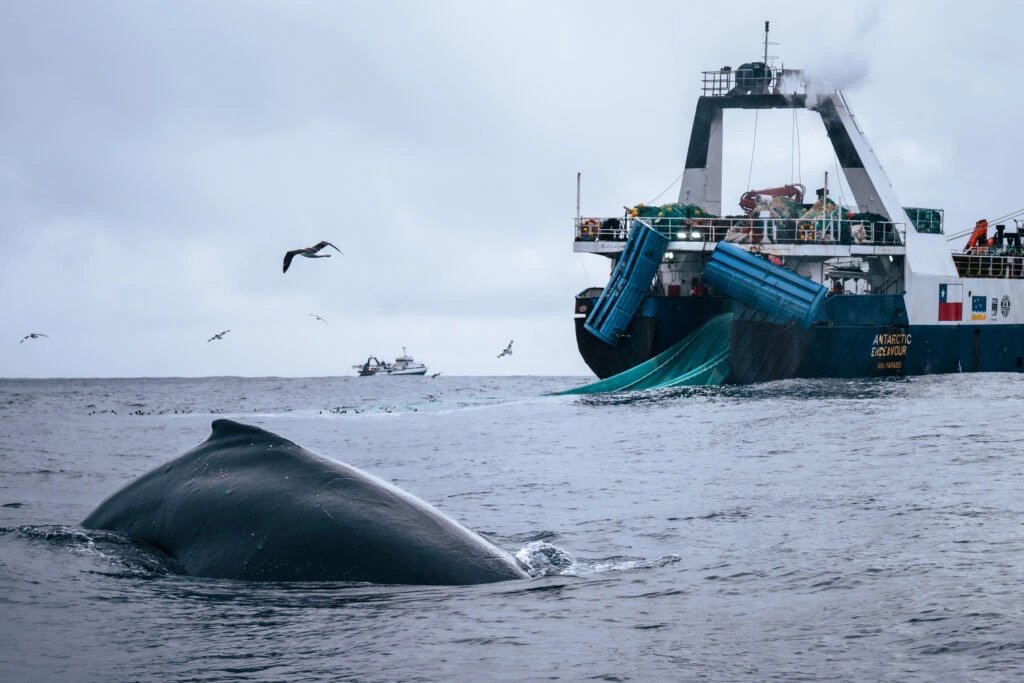
Antarctica's industrial krill fleet halted operations early for the second consecutive year after reaching its 620,000-ton seasonal limit. Scientists warn that growing whale populations now compete with the expanding fishery for krill near the Antarctic Peninsula and South Orkney Islands.
Key Facts
- The krill fleet stopped fishing after harvesting 620,000 tons, the precautionary limit set in the 1990s by the Commission for the Conservation of Antarctic Marine Living Resources.
- The fleet halted early for the second year in a row, after a conservation measure requiring catch distribution across vast areas expired in 2024.
- Humpback whales have largely recovered since the International Whaling Commission banned commercial whaling in the early 1980s, according to Peter Hammarstedt of Sea Shepherd Global.
- Sea Shepherd partnered with Stanford University's Hopkins Marine Lab and the University of California, Santa Cruz, to gather whale data near the South Orkney Islands.
Krill Catch Limits
The fleet must stop fishing once it collectively harvests 620,000 tons of krill under current rules. The precautionary threshold was established in the 1990s by the Commission for the Conservation of Antarctic Marine Living Resources. Until last year, the fleet never reached the limit, primarily due to a former conservation measure that required the catch to be distributed across vast ocean areas. Since that measure expired in 2024, the fishing industry has been able to make its catch easier.
Whale Recovery
Decades of commercial whaling had left few, if any, whales alive in Antarctica, with most species driven to the brink of extinction. Over the last few decades, some whale populations have made a remarkable comeback after the International Whaling Commission adopted a global ban on commercial whaling in the early 1980s. Humpback whales have largely recovered, while fin whales and blue whales are experiencing a much slower recovery but are still regularly documented in the region, said Peter Hammarstedt, chief campaigns officer for Sea Shepherd Global. Whales are the largest consumers of krill in the Southern Ocean, yet the conservation commission has not taken them into account in its fisheries management plan.
Competition for Krill
The krill fleet is able to take an increasingly large number of the catch in an increasingly smaller area, and the area they focus on is where krill is most highly concentrated, which is also where the highest concentrations of whales, penguins and seals are found, Hammarstedt said. Sea Shepherd recently partnered with independent scientists from the Hopkins Marine Lab at Stanford University and the University of California, Santa Cruz, to gather data about whale populations feeding near the South Orkney Islands. Many scientists and marine advocates say more data is needed on whale populations to ensure that fishing in Antarctic waters does not deprive the marine mammals of their primary prey.
1 source
Time · lag behind first