
Scientists first observe plasma vortices on Sun's surface via Hawaii telescope
This digest was compiled by AI from multiple sources — links to the originals are below.
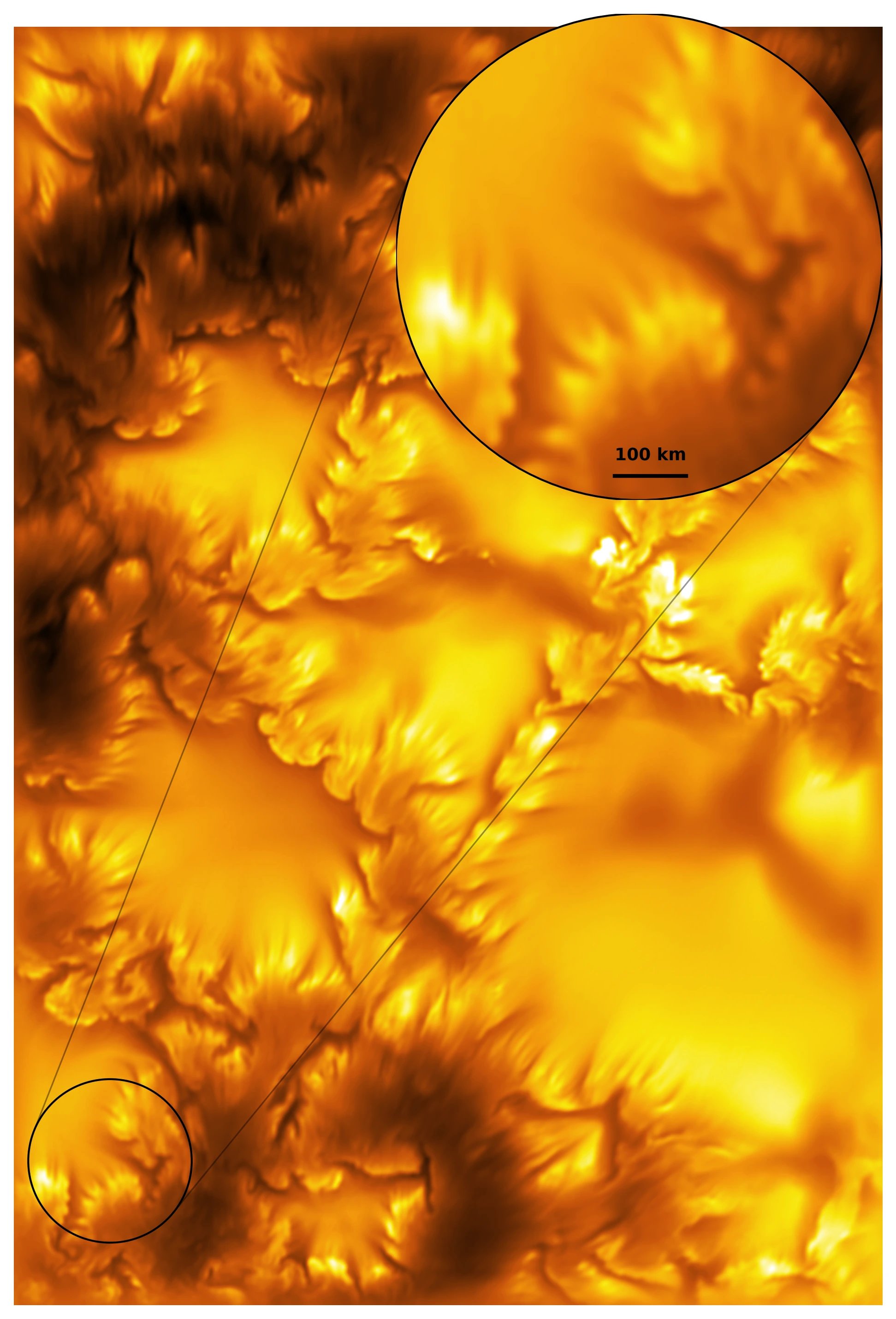
Researchers have directly observed plasma vortices on the Sun's visible surface for the first time using the Daniel K. Inouye Solar Telescope in Hawaii. The vortices arise from Kelvin-Helmholtz instability, a phenomenon seen in clouds, oceans, and planetary atmospheres but never before confirmed on the Sun. The discovery may help explain how energy builds up and triggers solar flares and coronal mass ejections.
Key Facts
- The Daniel K. Inouye Solar Telescope in Hawaii captured the high-resolution images that revealed the vortices.
- The vortices are caused by Kelvin-Helmholtz instability, which occurs when two fluid or plasma layers move past each other at different speeds.
- Similar structures have been seen in Earth's clouds, oceans, and the atmospheres of Jupiter and Saturn, but this is the first direct detection on the Sun's surface.
- Scientists believe the vortices may twist the Sun's magnetic field lines, leading to energy buildup that can trigger solar flares and coronal mass ejections.
The Discovery
The discovery was made using high-resolution images from the Daniel K. Inouye Solar Telescope in Hawaii, the world's most powerful solar telescope. The telescope captured extremely fine details in the photosphere, the Sun's visible surface. Researchers identified the vortices as arising from Kelvin-Helmholtz instability, a physical phenomenon that occurs when two fluid or plasma layers moving at different speeds pass by each other. Small ripples at the boundary grow over time into spiral structures resembling breaking ocean waves.
Scientific Implications
Similar Kelvin-Helmholtz effects have been observed in Earth's clouds, oceans, and the atmospheres of Jupiter and Saturn, but this is the first direct detection on the Sun's surface. Scientists think the vortices may bend the Sun's magnetic field lines, causing energy to accumulate. The sudden release of this stored energy could trigger solar flares and coronal mass ejections. The findings may also help explain why the Sun's outer atmosphere is millions of degrees hotter than its surface.
1 source
Time · lag behind first