
Scientists capture two DNA strands zipping together for the first time
This digest was compiled by AI from multiple sources — links to the originals are below.
Researchers using atomic force microscopy have directly observed two DNA strands aligning groove-for-groove, overcoming their natural electrostatic repulsion. Computer simulations revealed that positively charged metal ions act as molecular bridges between the strands. The findings provide experimental support for the two-decade-old 'DNA zipper' model.
Key Facts
- Atomic force microscopy captured two DNA strands aligning with groove-for-groove precision.
- Computer simulations showed double-charged metal ions bridge the two DNA molecules, holding them in alignment.
- The results support the 'DNA zipper' model proposed about twenty years ago by Professor Alexey Kornyshev of Imperial College London.
- Professor Agnes Noy of the University of York co-led the research and said the discovery could help identify genome regions involved in DNA pairing and cancer.
Direct Observation
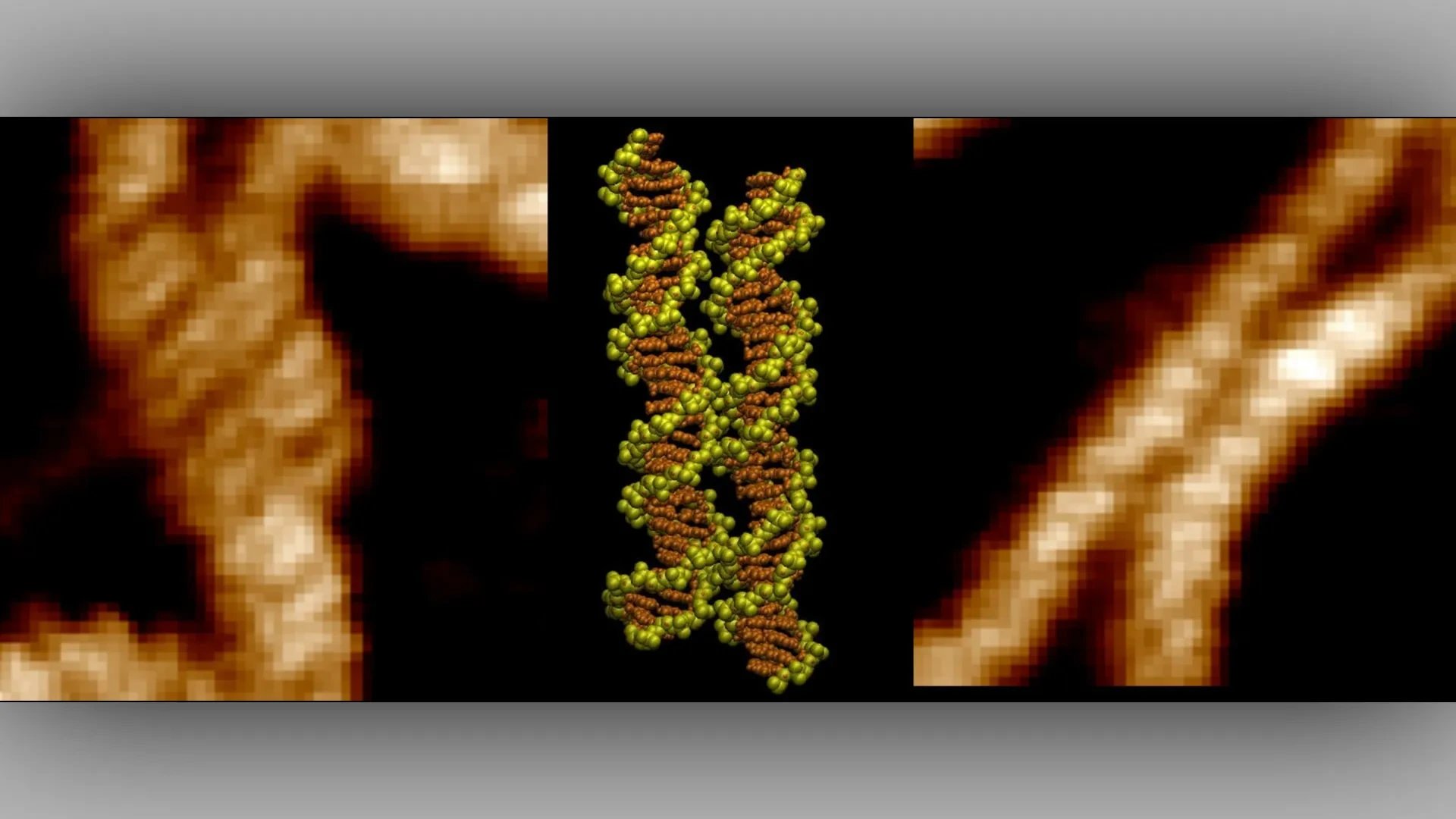
Researchers scanned DNA samples with atomic force microscopy, a technique that maps surfaces at extremely small scales. The scans produced detailed topographical maps showing how the DNA molecules were positioned. Dr. Thomas Catley of the University of Sheffield, co-lead author, said it was incredible to directly visualize the long-hypothesized mechanism for the first time.
Molecular Bridging
Computer simulations followed individual atoms and ions as they moved around the DNA. The simulations showed that double-charged metal ions can behave like two charged arms, each interacting with both DNA molecules at once. These ions form a bridge across the space separating the strands and help hold them in alignment.
DNA Zipper Model
The results provide experimental support for the 'DNA zipper' model proposed about twenty years ago. Professor Alexey Kornyshev from Imperial College London and collaborators originally suggested that salt ions surrounding DNA could produce alternating patterns of electrical charge. Those patterns would help neighboring DNA molecules align like two interlocking spiral staircases.
1 source
Time · lag behind first