
CHIME telescope logs 4,539 fast radio bursts from 3,641 sources over five years
This digest was compiled by AI from multiple sources — links to the originals are below.
The Canadian Hydrogen Intensity Mapping Experiment (CHIME) has released its second catalog of fast radio bursts, logging 4,539 events from 3,641 distinct sources. The catalog covers more than five years of continuous observations from July 25, 2018, to September 15, 2023, and supersedes the first catalog of 536 bursts. The fixed telescope in British Columbia uses 1,024 antennas to monitor the sky without moving parts.
Key Facts
- The CHIME/FRB collaboration released a second catalog of 4,539 fast radio bursts from 3,641 distinct sources.
- The catalog spans observations from July 25, 2018, to September 15, 2023, more than five years of continuous sky-watching.
- The first catalog, released in 2021, covered one year of observations ending in mid-2019 and recorded 536 bursts.
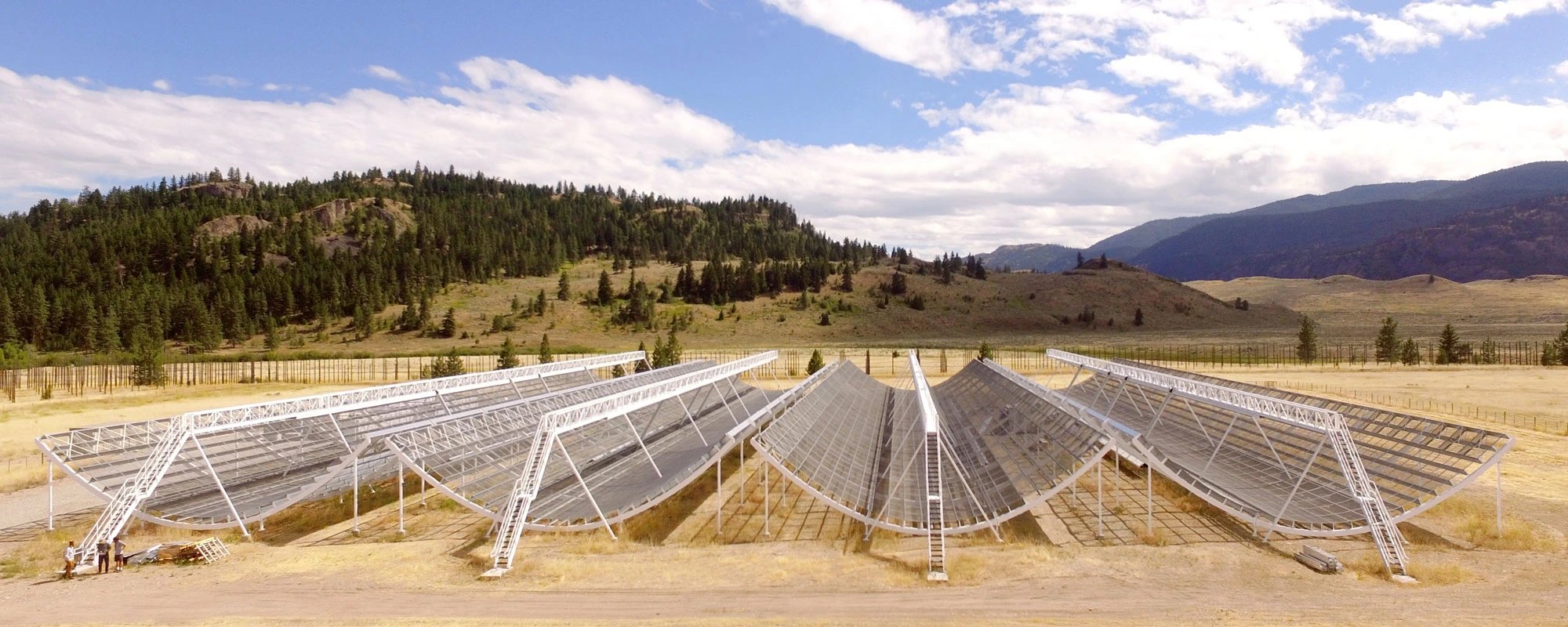
- CHIME consists of four stationary half-pipe reflectors, each 100 meters long and 20 meters wide, with 1,024 dual-polarization antennas total.
- The telescope is located at the Dominion Radio Astrophysical Observatory near Penticton, British Columbia, and has no moving parts.
The CHIME Instrument
CHIME is located at the Dominion Radio Astrophysical Observatory near Penticton, British Columbia. It consists of four stationary half-pipe reflectors, each 100 meters long and 20 meters wide, laid side by side and oriented north-south. Each cylinder's focal line is strung with 256 dual-polarization antennas, for 1,024 across the array. The telescope has no moving parts and forms 1,024 beams electronically through a digital signal-processing system. CHIME watches a roughly 200-square-degree strip of sky directly overhead and uses Earth's rotation to survey the northern sky.
Catalog Growth
The first catalog, released in 2021, logged just over 500 bursts from a single year of data. The new catalog folds in more than four additional years of observing time, pushing the source count past 3,600. The new release spans roughly five times the observing period and delivers more than eight times as many detected events. Fast radio bursts are intense pulses of radio waves lasting typically a few milliseconds, first identified in archival data in 2007.
1 source
Time · lag behind first