
Bristol team detects first candidate dark matter signal in xenon detector
This digest was compiled by AI from multiple sources — links to the originals are below.
A team led by Sam Eriksen of the University of Bristol recorded a candidate dark matter signal in a 10-tonne liquid xenon detector. The result was presented at a high-energy astrophysics conference in Japan. The event has a statistical significance of 2.6 sigma, below the 5-sigma threshold for a discovery claim.
Key Facts
- The candidate signal was detected in a 10-tonne ultra-pure liquid xenon detector located deep underground.
- The event was recorded during 220 days of observations from March 2023 to April 2024.
- The statistical significance of the event is 2.6 sigma, corresponding to a 0.5% probability of being a random fluctuation.
- The event could correspond to a WIMP particle with a mass of at least 200 GeV, more than 200 times heavier than a proton.
- The results were presented at a high-energy astrophysics conference in Japan.
The Detection
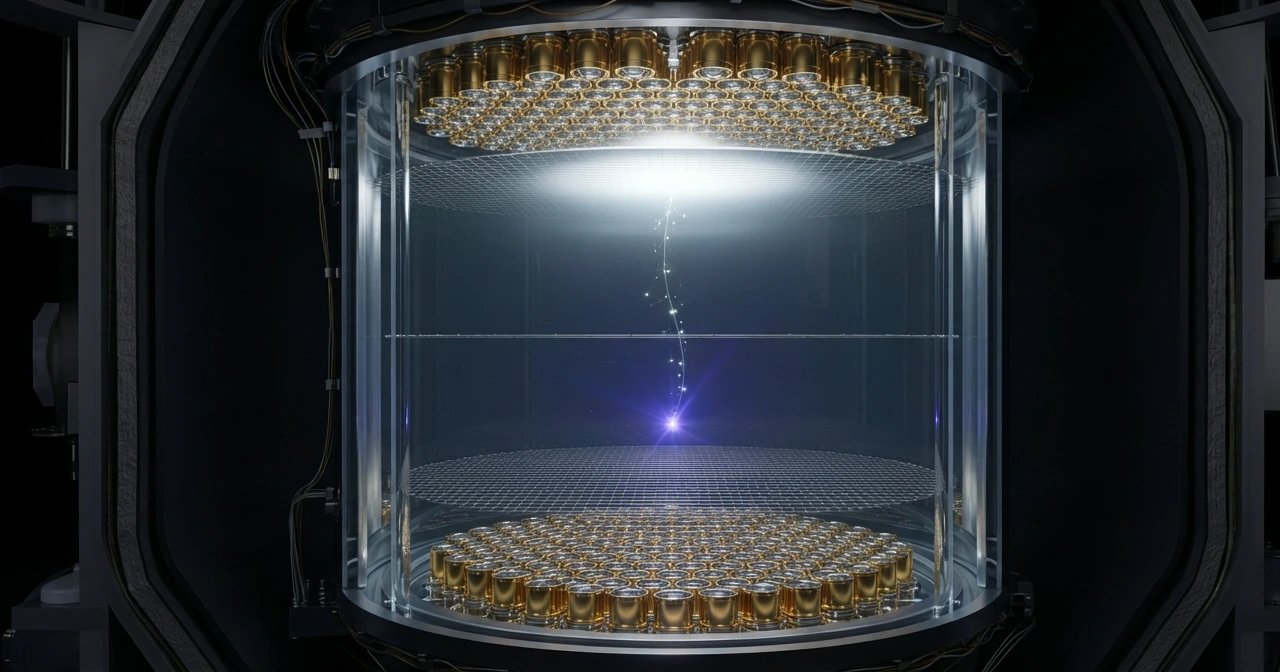
A team led by Sam Eriksen of the University of Bristol recorded a single unusual event in the world's largest dark matter detector. The detector uses 10 tonnes of ultra-pure liquid xenon and is buried deep underground to shield it from background noise. The event appeared in the region where a dark matter particle signal is expected and could not be explained by known background sources.
Statistical Significance
The team analysed 220 days of data collected between March 2023 and April 2024. The event has a statistical significance of 2.6 sigma, meaning the probability of a random coincidence is about 0.5%. Particle physics requires a 5-sigma significance for an official discovery claim. The event could correspond to a WIMP with a mass of at least 200 GeV, more than 200 times heavier than a proton.
Next Steps
The scientists emphasise that the result is an intriguing hint, not proof. Further observations will test the signal: if real, it will strengthen with more data; if a fluctuation, it will disappear. Dark matter makes up about 85% of all matter in the universe but has never been directly detected.
2 sources
Time · lag behind first