
Europa water plume claim falls below 90% confidence in 2026 Hubble reanalysis
This digest was compiled by AI from multiple sources — links to the originals are below.
Researchers who reported water plumes erupting from Europa in 2014 have reanalysed 14 years of Hubble data and found no localized water-vapour emission. The confidence in the original December 2012 feature has fallen below 90 percent, according to a 2026 paper. The finding narrows the evidence for geysers on Jupiter's moon without ruling out smaller or intermittent eruptions.
Key Facts
- The 2026 reanalysis found no localized water-vapour emission in any suitable Hubble image, including the December 2012 observation behind the original claim.
- Lorenz Roth said the confidence in the original feature has fallen below 90 percent, down from the 99.9 percent reported in 2014.
- The original 2014 Science paper analysed Hubble observations from 1999 and 2012 and inferred two possible plumes extending to about 200 kilometres altitude.
- The December 2012 feature appeared while Europa was near the farthest point of its orbit around Jupiter, where tidal stresses could open fractures differently.
The Reanalysis
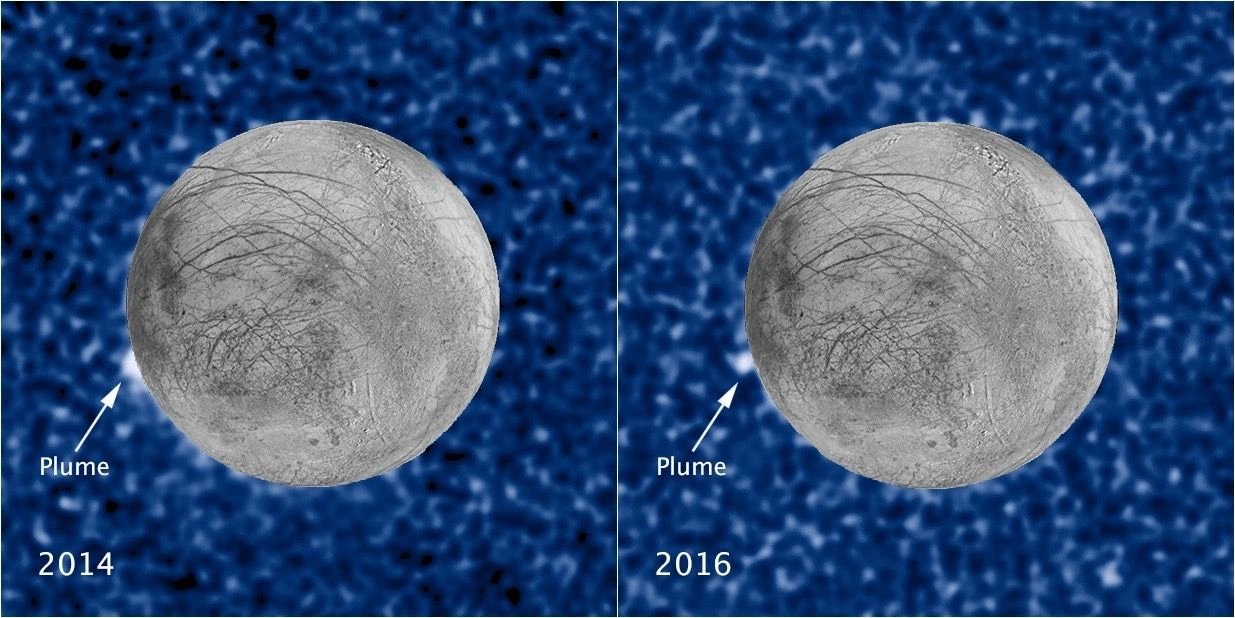
Many of the same researchers who reported the 2014 plume have now reanalysed that observation within a larger archive of 14 years of Hubble data. Their 2026 paper finds no localized water-vapour emission in any of the suitable Hubble images, including the one behind the original claim. In a Southwest Research Institute account of the work, Roth said the confidence had fallen below 90 percent. The original 2014 Science paper by Roth, Joachim Saur, Kurt Retherford and co-authors reported 99.9 percent confidence in the localized feature.
The Original Evidence
Hubble's Space Telescope Imaging Spectrograph recorded a faint patch of ultraviolet emission associated with hydrogen and oxygen above Europa's southern limb in December 2012. The team inferred two possible plumes with water vapour extending to an altitude near 200 kilometres. The feature appeared while Europa was close to the farthest point of its slightly eccentric orbit around Jupiter. That timing seemed physically meaningful because tidal stresses could open fractures differently as the moon's distance from Jupiter changes.
What Hubble Saw
Europa has an exceedingly thin atmosphere produced as sunlight and Jupiter's radiation interact with its icy surface. Hubble can separate some of the ultraviolet wavelengths emitted by atoms in that environment, but it cannot resolve Europa as a landscape in which a geyser appears like Old Faithful against the horizon. One December 2012 image contained excess hydrogen Lyman-alpha and oxygen emission near the south pole. Energetic electrons striking water vapour can split and excite the molecules, creating just such an ultraviolet aurora.
1 source
Time · lag behind first