
Archaeologists find 6,500-year-old circular structure in Czech Republic
This digest was compiled by AI from multiple sources — links to the originals are below.
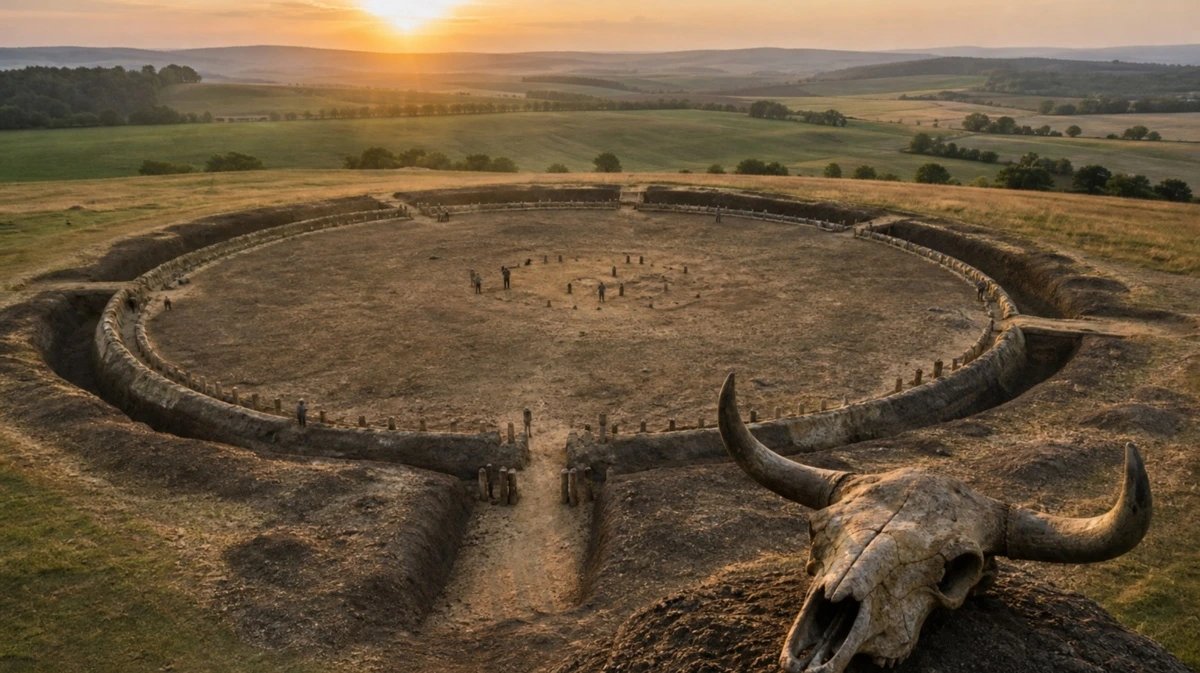
Archaeologists have discovered a monumental circular structure near the Czech village of Hleby, dating back more than 6,500 years and predating Stonehenge by about a millennium. The complex, roughly 230 meters in diameter, is among the oldest such structures in Central Europe. Excavations revealed a ditch over 2.5 meters deep and twelve entrances aligned with solar and lunar movements.
Key Facts
- The circular structure near Hleby, Czech Republic, is over 6,500 years old, about 1,000 years older than Stonehenge.
- The complex has a diameter of approximately 230 meters and is located in the Central Bohemian Region.
- Excavations uncovered a ditch more than 2.5 meters deep and twelve entrances leading to the center.
- Some entrances align with sunrise and sunset at the summer and winter solstices, while others align with extreme lunar positions recurring roughly every 18 years.
- Animal bones, including cattle skulls and horns, were found inside the ditch, especially near the entrances.
Discovery and Age
Archaeologists found the monumental circular structure near the Czech village of Hleby. The structure is more than 6,500 years old, roughly a millennium older than Stonehenge. With a diameter of about 230 meters, it is among the oldest such structures in Central Europe. Nothing of the structure remains above ground, but researchers identified traces of a ditch over 2.5 meters deep.
Astronomical Alignment
Excavation leader Petr Krištuf said the arrangement of the twelve entrances was not random and was linked to observations of the Sun and Moon. Some entrances are oriented toward sunrise and sunset at the summer and winter solstices. Other entrances align with extreme lunar positions that recur approximately every 18 years. Krištuf noted that the same principle is seen along the main axis of Stonehenge, indicating the Czech structure was designed in a similar way.
Ritual Significance
The complex likely held religious significance for early farming communities. Inside the ditch, archaeologists found animal bones, including cattle skulls and horns, especially near the entrances. Researchers suggest these remains may have decorated the gates, with the bull serving as a symbol of strength and fertility.
1 source
Time · lag behind first