
Perseverance finds organic carbon in Jezero Crater mudstones over 3,500 km from Curiosity site
This digest was compiled by AI from multiple sources — links to the originals are below.
NASA's Perseverance rover found organic carbon in ancient river mudstones at Jezero Crater, more than 3,500 km from where Curiosity made similar discoveries in Gale Crater. The findings, published in a 2025 Nature paper, show organic material in two distant water-shaped environments. The discovery suggests carbon chemistry associated with habitability was not confined to one isolated basin.
Key Facts
- Perseverance found organic carbon in mudstones at Bright Angel, a light-toned sedimentary formation in Neretva Vallis, Jezero Crater.
- The two rover sites, Jezero Crater and Gale Crater, are separated by roughly 3,750 kilometres along the Martian surface.
- A 2025 paper in Nature reported organic carbon in the Bright Angel mudstones together with iron phosphate and iron sulfide minerals, probably vivianite and greigite.
- Perseverance drilled a core from the rock Cheyava Falls and sealed it in a sample tube named Sapphire Canyon.
- The SHERLOC instrument supplied the organic signal using ultraviolet laser fluorescence and Raman spectroscopy.
The Discovery
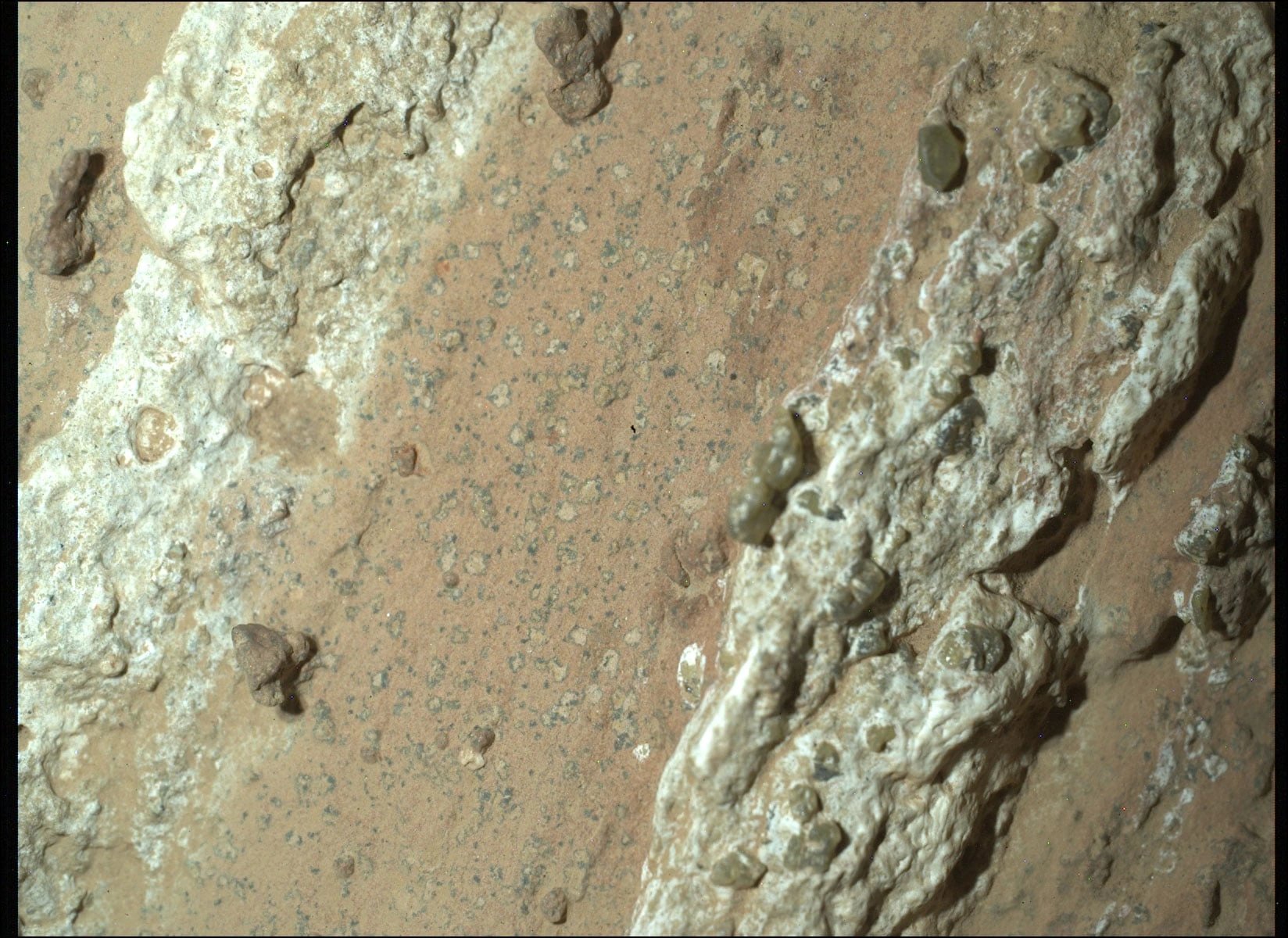
Perseverance encountered the most striking Jezero material in 2024 while driving through Neretva Vallis, a dry river valley that once carried water toward the crater lake. In a light-toned sedimentary formation called Bright Angel, the rover examined fine-grained mudstones containing clay, silt and evidence of chemical alteration. One rock, nicknamed Cheyava Falls, contained pale spots with dark rims that the mission team informally called leopard spots. Perseverance drilled a core from the rock and sealed it in a sample tube under the name Sapphire Canyon.
Scientific Analysis
A 2025 paper in Nature reported organic carbon in the Bright Angel mudstones together with small nodules and reaction fronts enriched in iron phosphate and iron sulfide minerals, probably vivianite and greigite. The spatial relationships suggest that the organic matter participated in low-temperature chemical reactions after the mud was deposited. That combination is scientifically interesting because similar reactions on Earth can occur in the presence of microbes and can provide energy for microbial metabolism. The authors considered non-biological routes, including reactions involving organic matter made on Mars or delivered from space.
Instrumentation and Context
Perseverance's SHERLOC instrument supplied the organic signal by shining an ultraviolet laser onto a rock and reading the fluorescence and Raman-scattering response. NASA's published spectra from Bright Angel contain Raman G-bands associated with carbonaceous material. PIXL, an X-ray instrument on the same robotic arm, mapped the elements and minerals within the spots. These techniques preserve location, showing where carbon-rich material sits in relation to iron, sulfur, phosphorus and the visible textures of the rock.
1 source
Time · lag behind first