
China's Zhurong rover finds buried beach deposits on Mars, supporting ancient northern ocean
This digest was compiled by AI from multiple sources — links to the originals are below.
China's Zhurong rover detected subsurface structures consistent with buried beach deposits in Mars's Utopia Planitia, according to a 2025 study. The findings provide independent evidence for an ancient northern ocean, alongside separate research on river systems at Aeolis Dorsa. The two studies strengthen the case for a vanished ocean despite longstanding uncertainties about proposed shorelines.
Key Facts
- Zhurong landed in southern Utopia Planitia on 15 May 2021 and travelled 1,921 metres before hibernation in May 2022.
- The rover's low-frequency radar channel operates at 15–95 megahertz and can probe deep beneath the Martian surface.
- A separate 2025 study examined ancient rivers at Aeolis Dorsa and found upstream responses consistent with a large standing body of water.
- Proposed Martian shorelines vary significantly in elevation, which has kept the northern ocean hypothesis controversial.
Radar Evidence Beneath Utopia Planitia
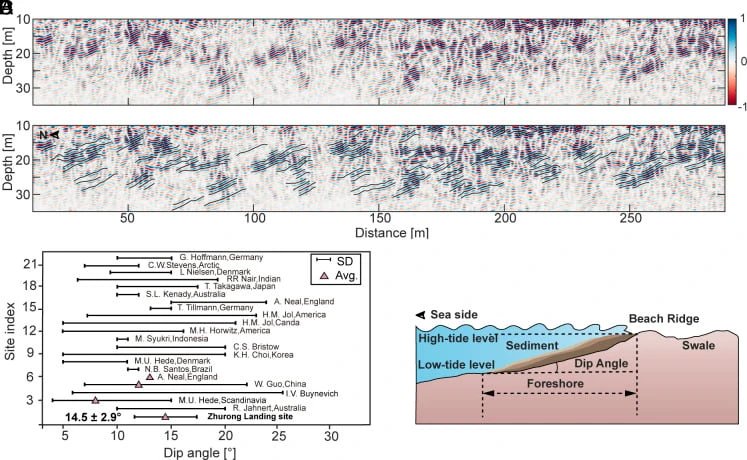
Zhurong's Rover Penetrating Radar (RoPeR) used a high-frequency channel for shallow detail and a low-frequency channel to probe deeper layers. The low-frequency channel revealed internal structures beneath the rover's path that match the architecture expected under a beach. These subsurface features were detected in southern Utopia Planitia, a region within Mars's vast northern lowlands. The study did not directly observe water or prove that the deposits formed at the same time as other coastal features.
Independent River System Analysis
A second 2025 study focused on ancient river systems at Aeolis Dorsa, a region with well-preserved fluvial features. Researchers found that the rivers' upstream characteristics are consistent with flowing into a large standing body of water. The two studies used different instruments at widely separated sites to identify different parts of a coastal system. Neither study proves the ocean was global, but together they make the vanished-ocean hypothesis harder to dismiss.
Shoreline Controversy
Mars's northern lowlands sit several kilometres below the heavily cratered southern highlands and cover an immense fraction of the globe. Orbital images have revealed candidate shorelines, sedimentary fans, and the widespread Vastitas Borealis Formation. Proposed shoreline segments show large unexplained elevation differences, which have kept the ocean hypothesis controversial. Wind, impacts, and later erosion can erase the low-relief forms that distinguish a beach from an ordinary slope.
1 source
Time · lag behind first