NASA-led study finds no statistical evidence for polar cap saturation
This digest was compiled by AI from multiple sources — links to the originals are below.
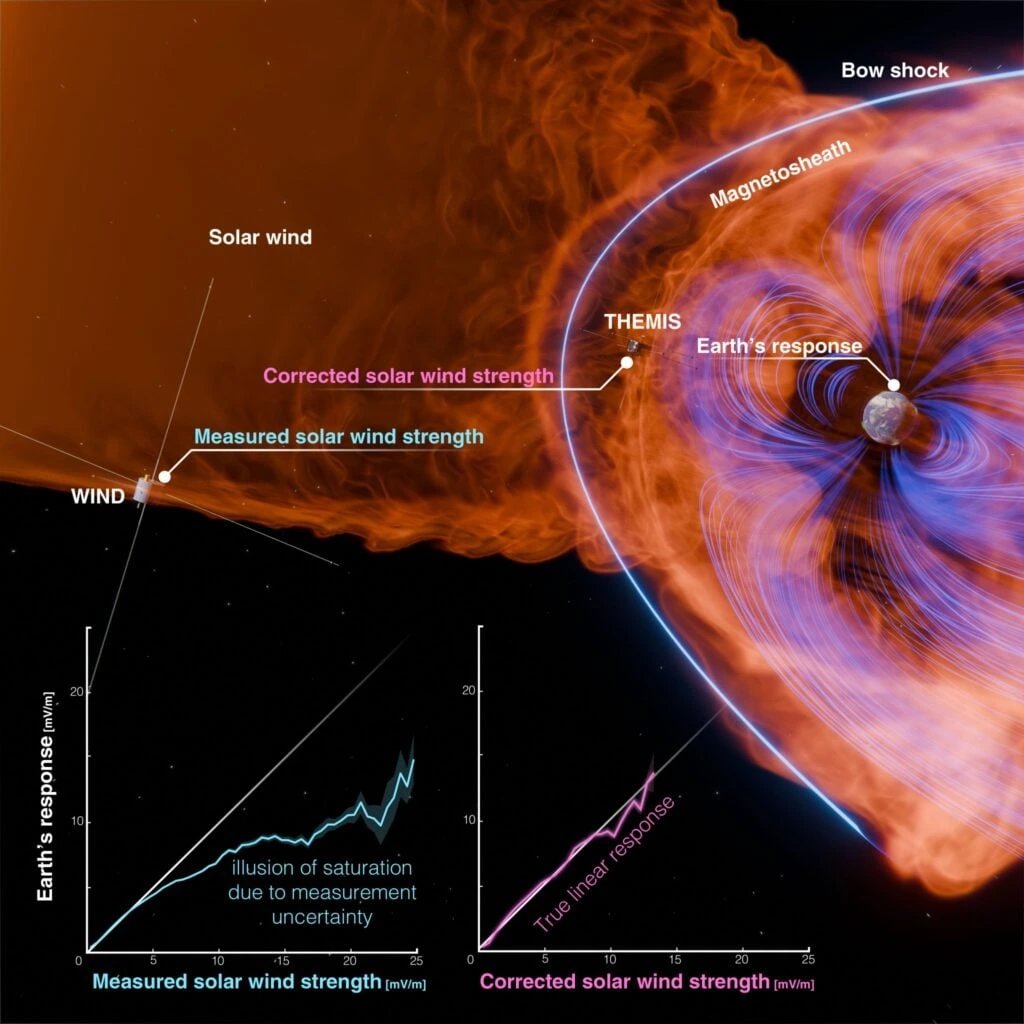
A NASA-led study published in Nature on 15 July 2026 found no statistical evidence for saturation in the polar cap index response to solar wind driving. The apparent ceiling was largely an artifact of measurement uncertainty in solar-wind data. The corrected response continues upward approximately linearly, reaching roughly twice the old saturated level at extreme driving.
Key Facts
- The study was published in Nature on 15 July 2026 by a seven-author team led by Nithin Sivadas of NASA Goddard and the Catholic University of America.
- After correcting a statistical bias in solar-wind measurements, the polar cap index response continued upward in an approximately straight line, reaching roughly twice the old saturated level at extreme driving.
- The study examined the relationship between the solar-wind merging electric field and the polar cap index, a proxy for the dawn-to-dusk electric field over the polar cap.
- At least ten theories had been developed to explain the apparent saturation of the cross-polar cap potential.
- Space-weather monitors commonly sample the solar wind near the Sun-Earth L1 region, about 1.5 million kilometres sunward of Earth.
The Apparent Ceiling
Early studies found that the polar cap index rose linearly as solar-wind driving strengthened. As more rare and powerful intervals accumulated, the average curve began to flatten at its high end. The apparent saturation of the cross-polar cap potential became a physical puzzle, and researchers developed at least ten theories to explain why the magnetosphere might throttle further energy transfer. The new work does not begin with an eleventh throttling mechanism; it asks whether the curve needing an explanation was biased before the physics was interpreted.
Measurement Bias Correction
The solar wind is measured a million miles too early: space-weather monitors commonly sample the solar wind near the Sun-Earth L1 region, about 1.5 million kilometres sunward of Earth. That position is invaluable because it gives forecasters advance warning. Once the researchers corrected a statistical bias in the solar-wind measurements, the response continued upward in an approximately straight line. At an extreme extrapolated driving strength, it could reach roughly twice the level inferred from the old saturated curve.
Scope of the Finding
The paper did not double the predicted value of every solar-storm effect, and it did not prove that Earth’s response can never saturate. It found no statistical evidence for saturation in the relationship it tested, through the range the observations can presently support. The central comparison concerned the way energy from the solar wind couples into the polar ionosphere, not a combined score of power-grid failures, satellite anomalies and auroral brightness.
1 source
NASA-led study finds no statistical evidence for polar cap saturation