
Rocket Lab and MIT to launch private Venus probe with single cloud instrument
This digest was compiled by AI from multiple sources — links to the originals are below.
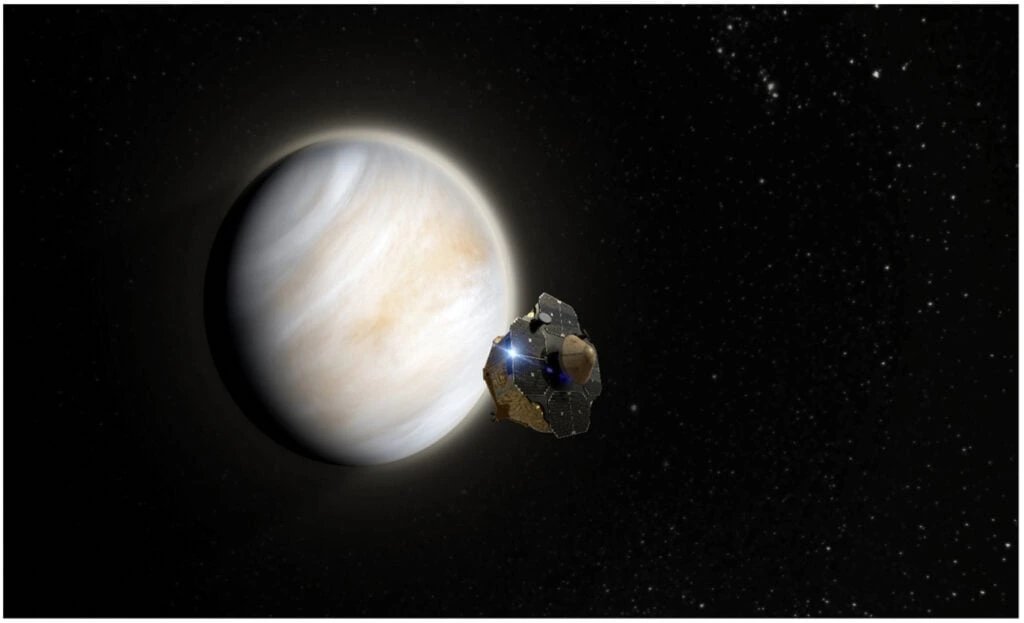
Rocket Lab and MIT are preparing a privately funded probe to plunge through Venus's clouds with a single laser instrument. The mission has no confirmed launch date, rocket, or site as of August 21, 2026. The probe would spend about five minutes collecting data in the planet's middle cloud deck.
Key Facts
- Rocket Lab's launch manifest lists Venus Life Finder as TBC with no rocket or launch site confirmed as of August 21, 2026.
- The probe is a direct-entry capsule roughly 40 centimetres across with a mass of about 17 kilograms and a single instrument weighing approximately one kilogram.
- The published science profile gives the probe about 330 seconds, or five and a half minutes, between roughly 60 and 48 kilometres altitude.
- The only instrument, an autofluorescence nephelometer, projects a 440-nanometre polarized laser through a fused-silica window.
Mission Status
Rocket Lab and MIT are preparing a privately funded probe to plunge through Venus's clouds looking for signs of life. The project has an instrument, a fitted heat shield, and active data-analysis work, but it is not yet a dated mission. As of August 21, 2026, Rocket Lab's launch manifest lists Venus Life Finder as TBC, with no rocket or launch site confirmed. Earlier targets of May 2023, January 2025, and summer 2026 have passed or slipped.
Probe Design
The peer-reviewed mission design describes a direct-entry capsule roughly 40 centimetres across, with a mass of about 17 kilograms and space for a single instrument weighing approximately one kilogram. Earlier versions paired an Electron rocket with Rocket Lab's high-energy Photon spacecraft, which would carry the probe across interplanetary space and release it about 30 minutes before atmospheric entry. The entry probe is ballistic, with no balloon to keep it in the clouds and no ambition to operate on the ground. Georgia Tech's mission team says the instrument will have about five minutes to collect its primary cloud data and the probe may have another 15 minutes to transmit before conditions become too severe.
Instrument and Science
The payload is an autofluorescence nephelometer, or AFN, which projects a focused, polarized laser with a wavelength of 440 nanometres through a fused-silica window. As individual droplets and other aerosol particles pass through the beam, the instrument records light scattered back toward the capsule. That pattern can constrain the concentration, size, and shape of the particles, while polarization and refractive index provide indirect information about composition. The AFN also watches at wavelengths from about 470 to 520 nanometres for particles that absorb the blue laser light and re-emit some of the energy as fluorescence.
1 source
Time · lag behind first