
James Webb Space Telescope finds water-altered clay minerals on two Neptune moons and rings
This digest was compiled by AI from multiple sources — links to the originals are below.
The James Webb Space Telescope has detected magnesium-rich phyllosilicates on Neptune's inner moons Larissa and Galatea and in the planet's rings, researchers report in Science Advances. Faint spectra from 1.7 to 4.5 micrometres show a 2.72-micrometre absorption matching water-altered clay minerals.
Key Facts
- Webb's Near-Infrared Spectrograph observed Proteus, Larissa and Galatea and combined light from the Adams, Arago and Le Verrier rings, producing spectra from 1.7 to 4.5 micrometres.
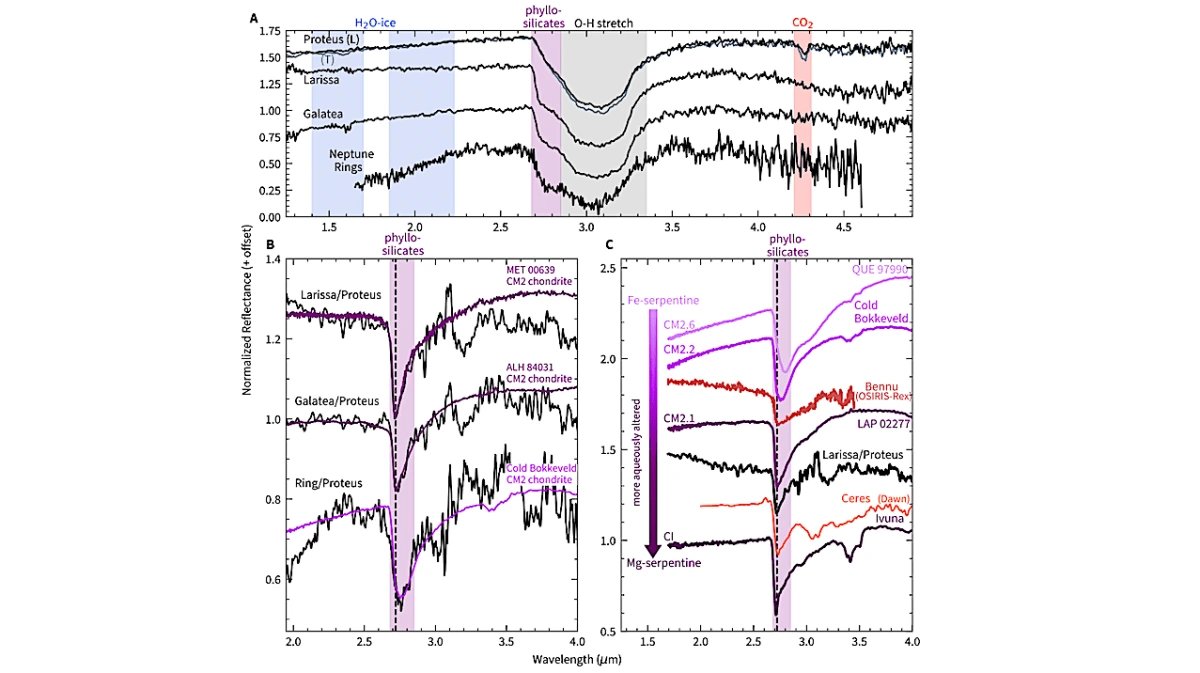
- All three moons and the rings displayed a deep, broad absorption near three micrometres associated with hydroxyl bonds, with no clear water-ice bands at 1.5, 1.65, 2.0 or 4.5 micrometres.
- Larissa, Galatea and the ring spectrum contain a sharp absorption centred at 2.72 micrometres whose checkmark shape matches magnesium-rich phyllosilicates in CM carbonaceous chondrite meteorites and Ceres.
- The study reports that phyllosilicates form when silicate rock reacts with liquid water, and the band shape indicates extensive alteration lasting at least one to ten million years below 300 to 400 kelvin.
Webb's Spectra
Researchers used the integral-field unit on Webb's Near-Infrared Spectrograph to observe Proteus, Larissa and Galatea and combined light from the Adams, Arago and Le Verrier rings. The targets are faint and sit beside a bright planet, so a custom reduction separated them from scattered background light. The resulting spectra, described in the peer-reviewed Science Advances paper, cover roughly 1.7 to 4.5 micrometres. All three moons and the rings displayed an unusually deep, broad absorption around three micrometres associated with hydroxyl bonds. The spectra show no clear water-ice bands at 1.5, 1.65, 2.0 or 4.5 micrometres and no obvious 3.1-micrometre Fresnel peak.
The Clay Signature
Larissa, Galatea and the ring spectrum contain an additional sharp absorption centred at 2.72 micrometres. Its checkmark-like shape closely matches magnesium-rich, serpentine-like phyllosilicates measured in heavily altered CM carbonaceous chondrite meteorites. The resemblance is also strong to the clay-rich spectrum of the dwarf planet Ceres. Phyllosilicates form through aqueous alteration, when primary silicate rock reacts with liquid water and is converted into hydrated minerals. The band shape points toward extensive alteration lasting at least roughly one to ten million years at moderate temperatures below about 300 to 400 kelvin.
Primordial Parent Bodies
The present moons are far too small to have supplied the heat required for aqueous alteration. The leading explanation is that the minerals formed inside much larger primordial satellites before Neptune captured Triton. Triton's arrival destabilised the original moon system, and collisions broke those worlds apart, exposed material once buried in their interiors and left rubble to gather into the inner moons and rings seen today. The team also leaves room for another large icy body to have wandered too close to Neptune and been torn apart. What Webb has measured securely is the mineral fingerprint, while the parent bodies and the precise sequence of destruction are inferred from chemistry and orbital dynamics.
1 source
Time · lag behind first