
Webb finds MoM-BH*-1 660 million years after Big Bang with luminosity of 100 billion Suns
This digest was compiled by AI from multiple sources — links to the originals are below.
The James Webb Space Telescope identifies a point-like red object, MoM-BH*-1, about 660 million years after the Big Bang that radiates at roughly 100 billion Suns. Its spectrum shows a Balmer break strength of 7.7 and broad hydrogen-beta emission around 3,036 kilometres per second, leading scientists to model it as an accreting black hole inside a dense gas cocoon rather than a fusion-powered star.
Key Facts
- MoM-BH*-1 was identified in the PRIMER extragalactic field as the reddest source in roughly 250 square arcminutes and selected for Webb’s Mirage or Miracle program.
- Webb’s NIRSpec spectrograph fixed the object’s redshift at 7.7569, corresponding to a universe about 660 million years old.
- The object’s Balmer break strength was measured at 7.7 (plus 2.3, minus 1.4), far above the ≈3 expected for standard dust-free stellar populations and below the contrived pure A-type limit of 5.
- The source showed broad, multi-peaked hydrogen-beta emission around 3,036 kilometres per second and absorption in hydrogen-beta and hydrogen-gamma.
- The object radiates on the order of 100 billion Suns, but Webb recorded it as unresolved, point-like light rather than a measured stellar surface.
Detection and Redshift
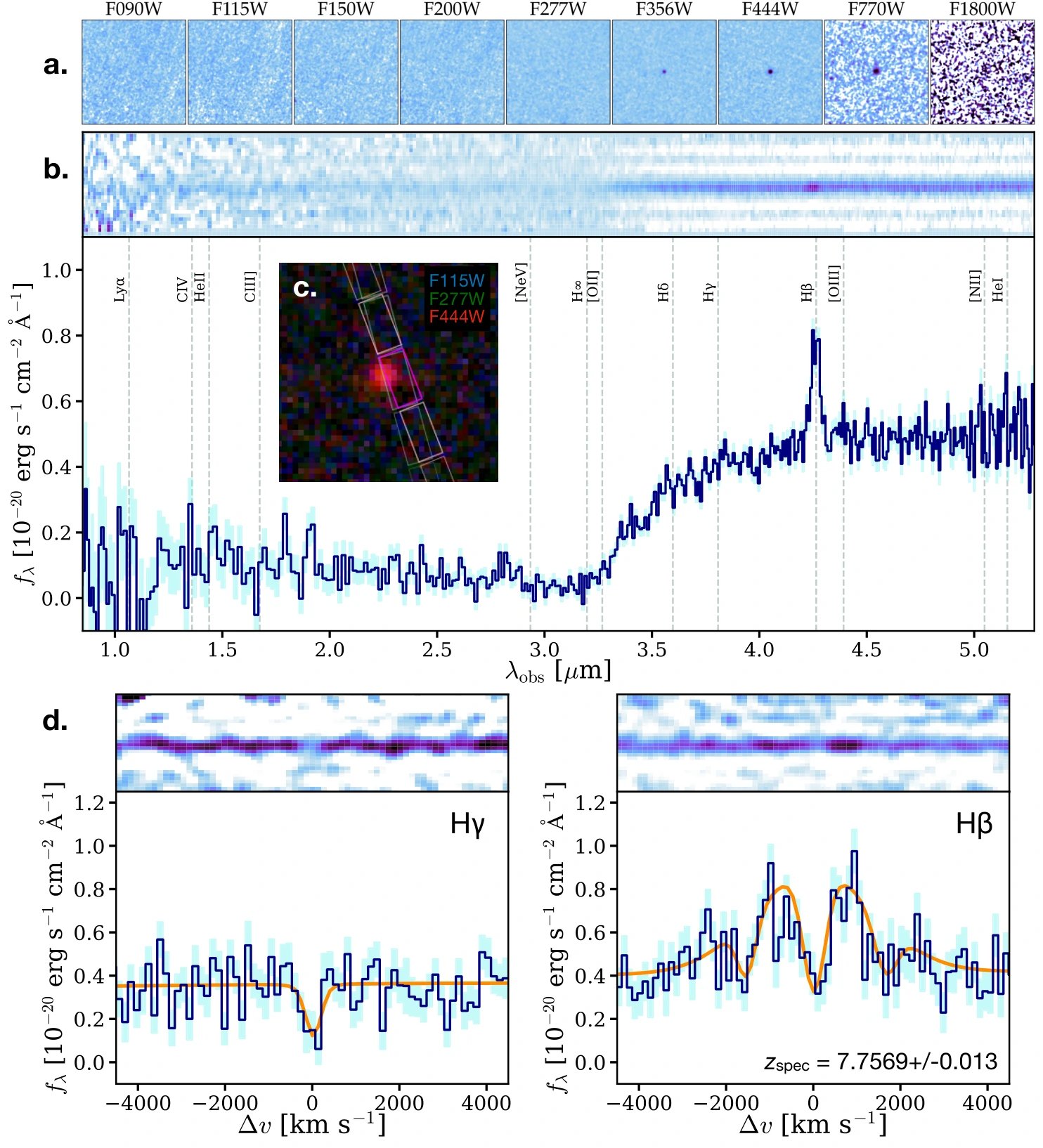
MoM-BH*-1 was identified in the PRIMER extragalactic field and selected for spectroscopic follow-up by Webb’s Mirage or Miracle program, which deliberately pursued risky targets. The object was the reddest source in an area covering roughly 250 square arcminutes. Webb’s NIRCam detected it in the F356W and F444W filters, while it appeared to vanish at wavelengths shorter than about two micrometres. NIRSpec fixed its redshift at 7.7569, corresponding to a universe about 660 million years old under the standard cosmological model. A 4.5-hour prism spectrum and an independent higher-resolution spectrum showed that the red colour came from a huge change in brightness across the Balmer limit.
Balmer Break Anomaly
MoM-BH*-1’s Balmer break strength was measured at 7.7, with uncertainty of plus 2.3 and minus 1.4. Standard dust-free stellar populations were expected to reach only about 3, and even a population composed entirely of A-type stars remained below 5. Across the observed spectrum, the flux increased by more than a factor of 20 from Webb’s F277W band to F444W. The object also showed broad, multi-peaked hydrogen-beta emission with a width around 3,036 kilometres per second, plus absorption in hydrogen-beta and hydrogen-gamma. A narrow oxygen doublet anchored the redshift.
Black Hole Star Model
The team studying MoM-BH*-1 proposes an accreting black hole buried inside an extraordinarily dense cocoon of gas as the power source. Radiation released as matter spirals toward the black hole heats and filters through that envelope, giving the object a star-like atmosphere. Astronomers call the configuration a “black hole star,” a name describing appearance and radiative physics rather than a star with a conventional fusion-burning core.
2 sources
Time · lag behind first