Scientists in Japan create female clones from male mice using CRISPR
This digest was compiled by AI from multiple sources — links to the originals are below.
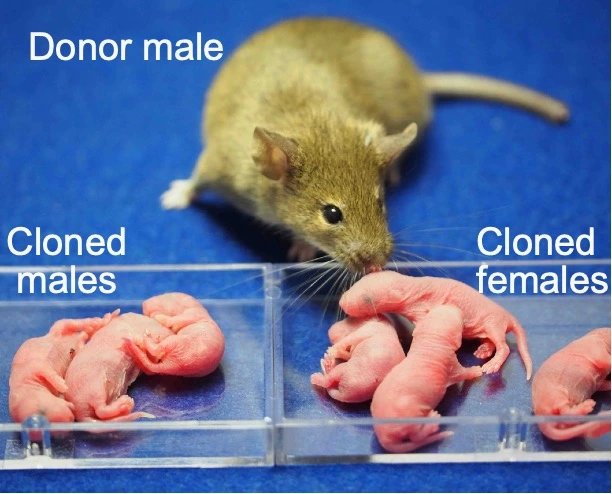
Scientists in Japan create female clones of male mice by using CRISPR to remove the Y chromosome from male cells. The findings, shared as a bioRxiv preprint this month, have not been peer-reviewed; researchers say the technique could change assumptions about reproduction and help conserve endangered species.
The Technique
Takashi Ishiuchi of the University of Yamanashi and Shogo Matoba of the Riken BioResource Research Center led the team that used a CRISPR-based method to remove the Y chromosome from male mouse cells and produce female clones. The work was inspired by the Okinawa rubble goby, a fish that can change sex when males are absent. A 2009 experiment accidentally produced one female pup among 27 clones made from male mouse cells, but the new result is the first deliberate sex conversion in mammals. The findings were posted as a preprint on bioRxiv earlier this month and have not been peer-reviewed.
Conservation Potential
Cloning cannot rebuild a population if only males survive because it copies only the donor’s genes and creates all-male offspring. Ishiuchi and Matoba say the technique could rescue endangered species in cases where few individuals remain; Ben Novak of Revive & Restore said he was confident there would be plenty of applications, particularly for conservation purposes. Cloning has already aided two species—black-footed ferrets and Przewalski’s horse—but cloned individuals are genetically identical and their offspring may be more vulnerable to disease. Monika Ward of the University of Hawaii, who was not involved in the research, said no one has done this before.
What's Next
Peer review of the bioRxiv preprint is the next formal step, but no journal submission date has been announced. It remains unclear whether the technique will work in other mammals or at a scale needed for endangered species rescue.
1 source
Scientists in Japan create female clones from male mice using CRISPR