
Rockefeller Scientists Uncover Hidden Mechanism That Drives RNA Synthesis
This digest was compiled by AI from multiple sources — links to the originals are below.
Scientists at Rockefeller University have uncovered a hidden mechanism that drives RNA synthesis, solving a decades-old mystery about how experimental antibiotics disable RNA polymerase. The findings, published in the Proceedings of the National Academy of Sciences, reveal that a crucial moving part of the enzyme must briefly swing into place to stabilize transcription, and the antibiotics block that motion. The dual discovery lays the groundwork for next-generation antibiotics.
The Hidden Movement
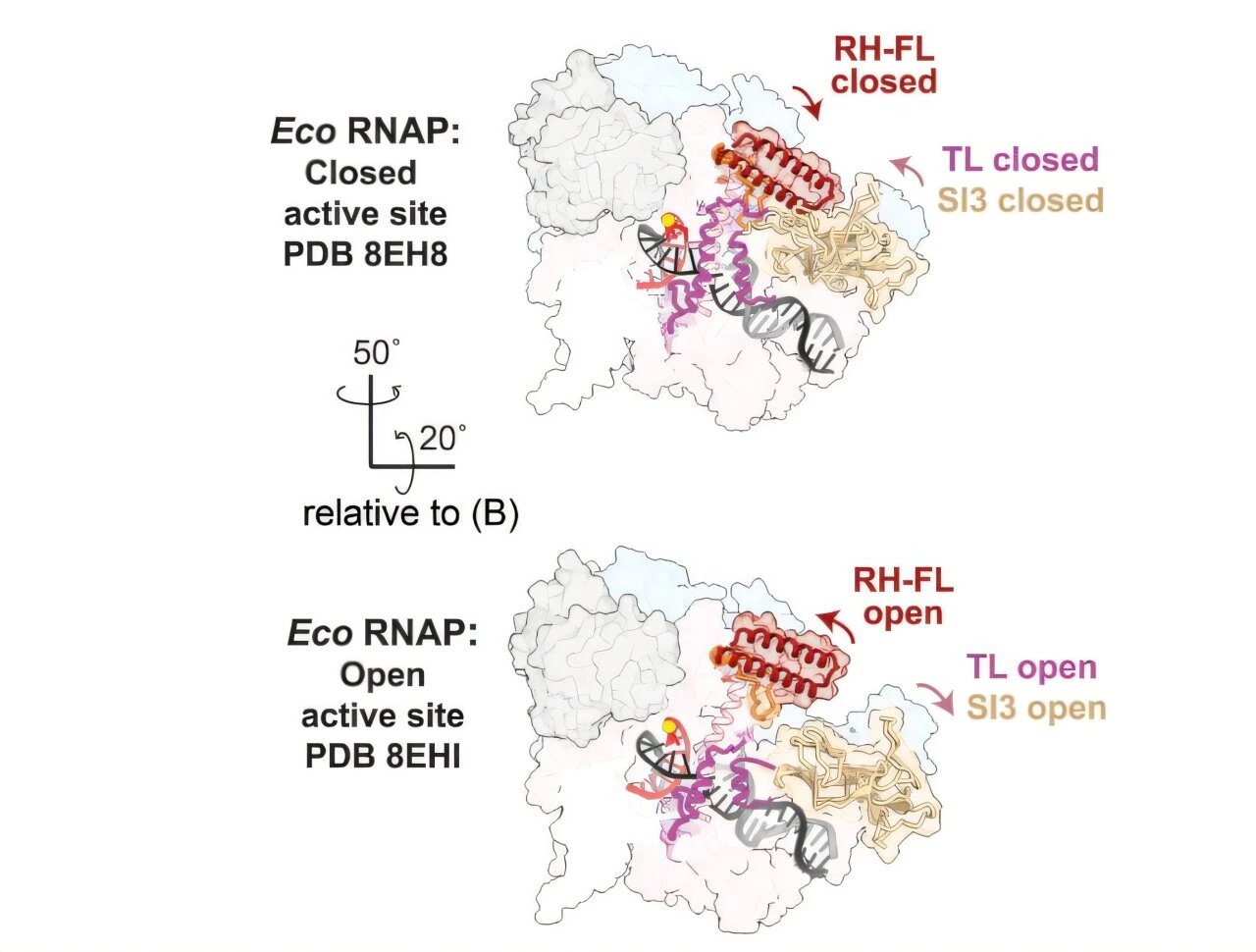
RNA polymerase transcribes DNA into RNA by cycling through shape changes. One essential moving part, the trigger loop, opens and closes to add each nucleotide, while the function of a neighboring structure, the rim helices/F-loop, had remained unknown. Researchers at Rockefeller's Laboratory of Molecular Biophysics, led by Seth A. Darst, used cryo-electron microscopy to observe RNAP in action. They found that the rim helices/F-loop briefly swings into place to stabilize the active site during RNA synthesis.
Antibiotic Inhibition
Two antibiotic classes—CBR9379 targeting E. coli RNAP and AAP-SO2 targeting M. tuberculosis RNAP—have long been known as inhibitors, but their mechanism was unclear. Cryo-EM images showed that these drugs bind precisely where the rim helices/F-loop needs to move. By locking that part in an open conformation, the antibiotics prevent the stabilizing motion, halting transcription. This explains how the drugs silence gene expression in pathogens, including the tuberculosis bacterium.
Drug Design Potential
The discovery provides a new structural target for antibiotic development. Since the movement is conserved across diverse life forms, inhibitors designed to exploit this mechanism could be broad-spectrum. Darst notes, "We now know how these inhibitors work, and the inhibitors also revealed a conformational change we didn't know was important." The findings, published in PNAS, open avenues for rational design of next-generation RNAP inhibitors.
1 source
Time · lag behind first