
TU Dortmund physicists synchronize time crystals across 40 micrometers
This digest was compiled by AI from multiple sources — links to the originals are below.
Physicists at TU Dortmund University have synchronized multiple continuous time crystals in a gallium arsenide semiconductor, locking their oscillations over distances up to 40 micrometers, according to a study published in Nature Communications. The nonlocal coupling, mediated by diffusing spin-polarized electrons, may provide a basis for future spin-based technology networks.
Time Crystal Oscillations
The time crystals are created in a semiconductor made of gallium arsenide with small additions of indium and silicon, which provides localized electrons. At temperatures near –270°C, each electron interacts with approximately one million surrounding nuclear spins. A pump laser aligns the electron spins, and the polarization is transferred to the nuclear spins. In a weak magnetic field, the nuclear-spin polarization begins to rotate, and feedback between electron and nuclear spins sustains the oscillations, which are monitored by a second laser.
Synchronization Across Distance
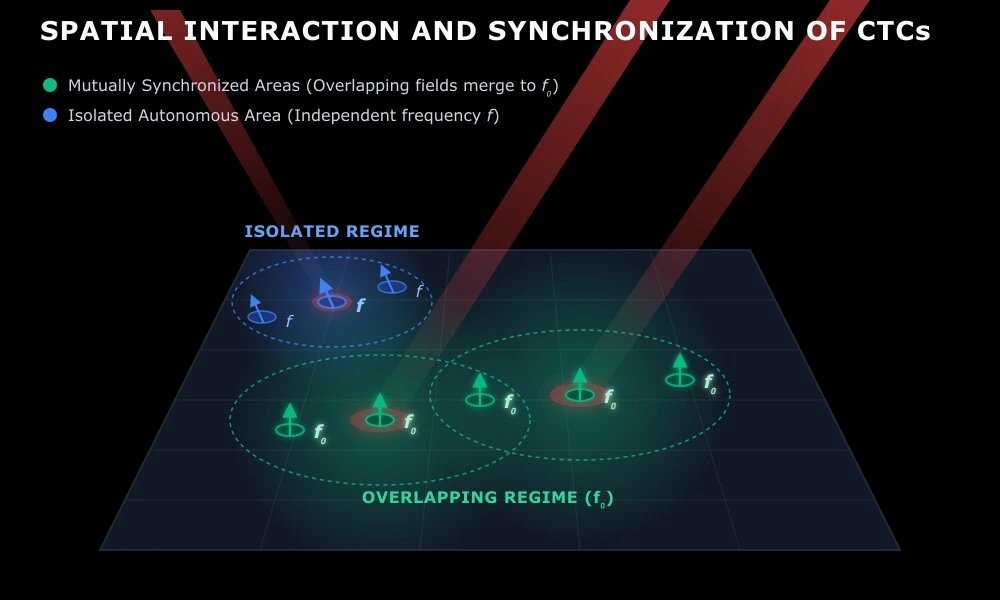
Because the microscopic environment varies across the semiconductor, individual regions normally oscillate at slightly different frequencies. When a broad laser beam excites many regions simultaneously, however, their oscillations lock to a common frequency. The synchronization resembles Christiaan Huygens’ 1665 pendulum clocks, but the coupling in the semiconductor arises from the diffusion of spin-polarized electrons. The researchers found that time crystals separated by up to 40 micrometers—over 1,000 times the characteristic size of an individual oscillator—can synchronize.
Implications for Spin Networks
The results, led by Professor Alex Greilich, demonstrate nonlocal coupling between spatially separated spin systems. This achievement, published in Nature Communications, may provide a foundation for controllable networks of spin oscillators in future spin-based technologies. Such networks could enable advances in quantum information processing and precision measurement.
1 source
Time · lag behind first