
Nuclear clocks tick for first time, may surpass atomic precision
This digest was compiled by AI from multiple sources — links to the originals are below.
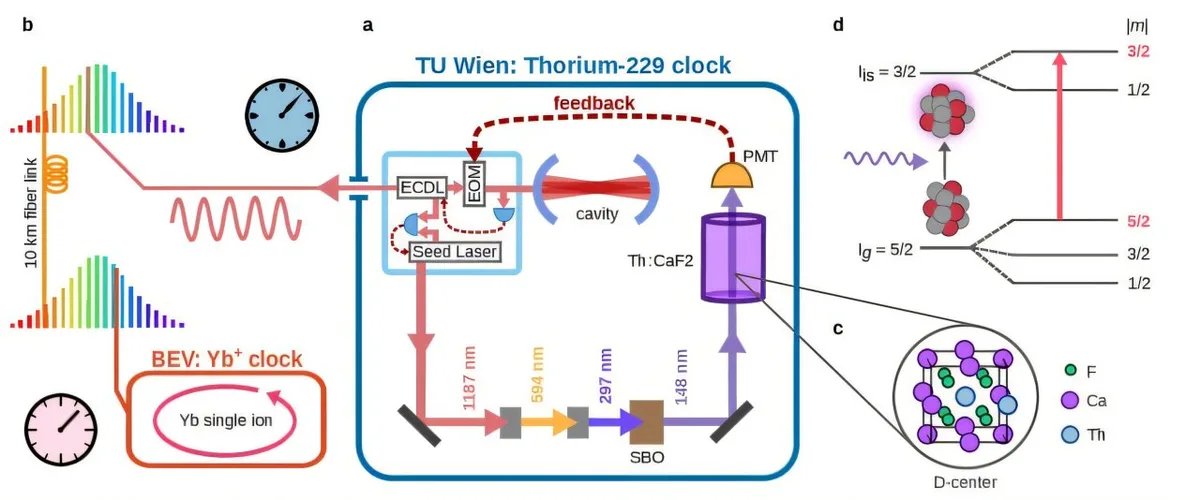
Two independent teams built the first working nuclear clocks, exploiting thorium-229 nuclei. The devices, developed at Tsinghua University and the Vienna Center for Quantum Science and Technology, may achieve precision beyond current atomic clocks.
The Breakthrough
Beichen Huang at Tsinghua University and Luca Toscani De Col at the Vienna Center for Quantum Science and Technology led teams that independently built nuclear clocks. The clocks use a thorium-229 nucleus, whose low-energy transition is excited by a laser. This marks the first time such devices have operated, a goal pursued for decades.
Precision Potential
Nuclear clocks could outperform atomic clocks, which currently define the second. The thorium-229 transition is less sensitive to external perturbations than atomic transitions. Early measurements suggest the nuclear clock's stability may exceed that of the best atomic clocks by an order of magnitude.
1 source
Time · lag behind first