
NASA New Horizons flies past Arrokoth, most distant object ever visited
This digest was compiled by AI from multiple sources — links to the originals are below.
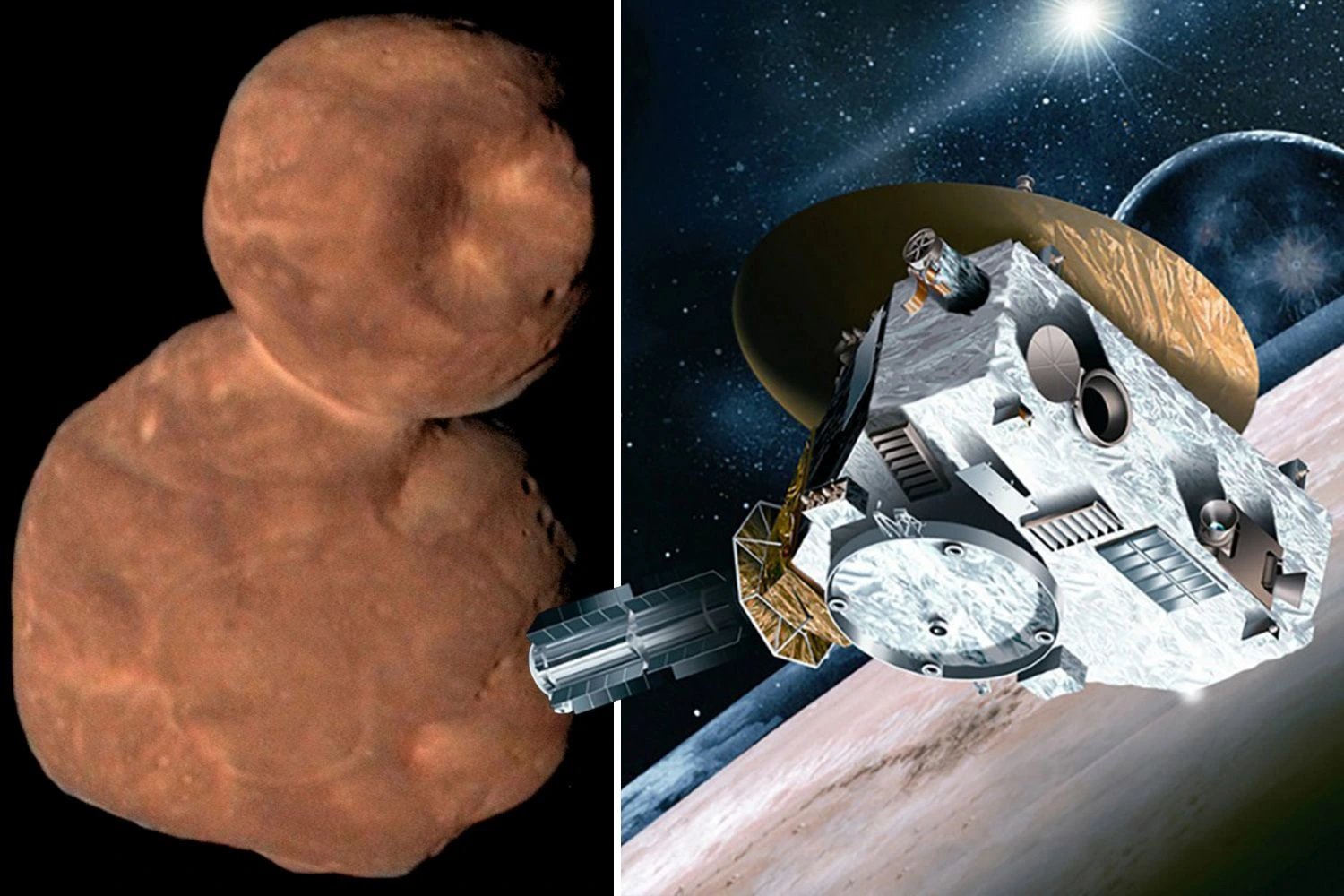
On January 1, 2019, NASA’s New Horizons spacecraft flew within 3,500 kilometers of Arrokoth, a Kuiper Belt object 4 billion miles from Earth, making it the most distant world ever explored up close. The flyby revealed a flattened, two-lobed body measuring 35 kilometers long, challenging initial snowman-shaped impressions. The encounter occurred three and a half years after New Horizons’ historic Pluto flyby, extending its mission into the outer solar system’s primordial past.
The Flyby
New Horizons passed Arrokoth at 5:33 UTC on New Year’s Day 2019, at a distance of about 3,500 kilometres. Radio signals from the encounter took roughly six hours to traverse the 4 billion miles back to Earth. The target was so faint that it had been unknown when New Horizons launched in 2006; the team discovered it only in 2014 using the Hubble Space Telescope after a dedicated search for Kuiper Belt objects along the spacecraft’s path. Course corrections after the Pluto flyby steered the probe toward the encounter point.
Arrokoth's Shape
Early approach images suggested two nearly spherical lobes touching at a narrow neck, reminiscent of a snowman. Departure photographs, including stellar occultation frames, later revealed a flatter profile: the larger lobe is broad and lentil-shaped, while the smaller lobe is more rounded but still flattened. NASA’s refined measurements give the object a length of 35 kilometres, a width of 20 kilometres, and a thickness of only 10 kilometres. The two lobes likely gently merged at low speed soon after the solar system formed, preserving a pristine record of planetesimal accretion.
Record-Setting Distance
At the time of encounter, Arrokoth was 4.01 billion miles (6.47 billion kilometres) from the Sun, making it the most distant object ever explored by a passing spacecraft. This distinction separates a targeted flyby from the trajectories of Voyager 1 and 2, which are farther from Earth but never made a close pass of another body, and from telescopic imaging of distant galaxies. New Horizons’ approach was close enough to map a 35-kilometre object that subtended less than a pixel in Hubble observations.
1 source
Time · lag behind first