
Inouye telescope reveals tiny magnetized swirls on sun that may trigger solar flares
This digest was compiled by AI from multiple sources — links to the originals are below.
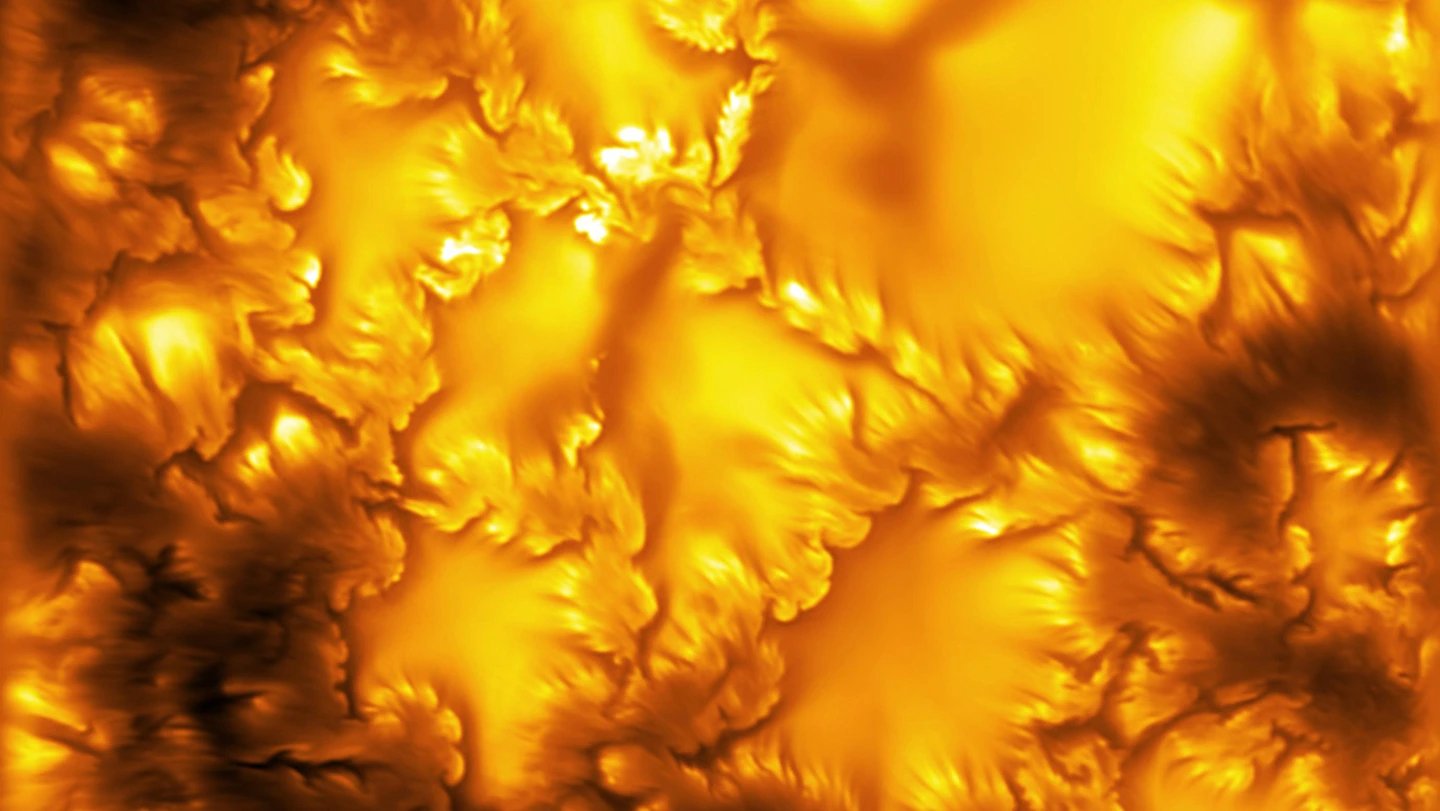
The Daniel K. Inouye Solar Telescope has captured the highest-resolution images of the sun's surface, revealing tiny whirlpools of magnetized plasma that provide the first direct evidence of a fluid instability thought to trigger solar flares. The findings, published in Nature on August 5, could help scientists understand how energy from magnetic elements transfers and leads to solar eruptions.
Unprecedented Resolution
The Daniel K. Inouye Solar Telescope, located near the summit of Haleakalā volcano in Hawaii, captured images of a 19-kilometer-wide patch of the sun's surface, resolving structures down to 20 kilometers. This level of detail—never achieved before—was made possible by its 4-meter mirror and an adaptive optics system that corrects blurring caused by Earth's atmosphere. The telescope observed millions of magnetic elements exhibiting swirling motions.
Liquid Instability on the Sun
The images provide the first direct observation of Kelvin-Helmholtz instability (KHI) on the sun's surface. KHI occurs when adjacent fluid layers move at different speeds, creating curling waves that roll up. On the sun, magnetized plasma acts as a fluid, and the instability converts swirling motions into tension that twists magnetic fields, storing energy that can be released explosively. 'This instability occurs everywhere at the boundaries of solar magnetic elements,' said astrophysicist David Kuridze of the National Solar Observatory.
From Swirls to Solar Storms
This energy transfer mechanism may explain how energy from the sun's interior reaches its surface and triggers solar flares and coronal mass ejections. Understanding this process could improve space weather forecasting. 'We are now beginning to understand that we need to study this process,' said Leon Ofman, an astrophysicist at the Catholic University of America, who was not involved in the study.
1 source
Time · lag behind first