
Duke study: Vision, not frontal lobe, drove primate brain expansion
This digest was compiled by AI from multiple sources — links to the originals are below.
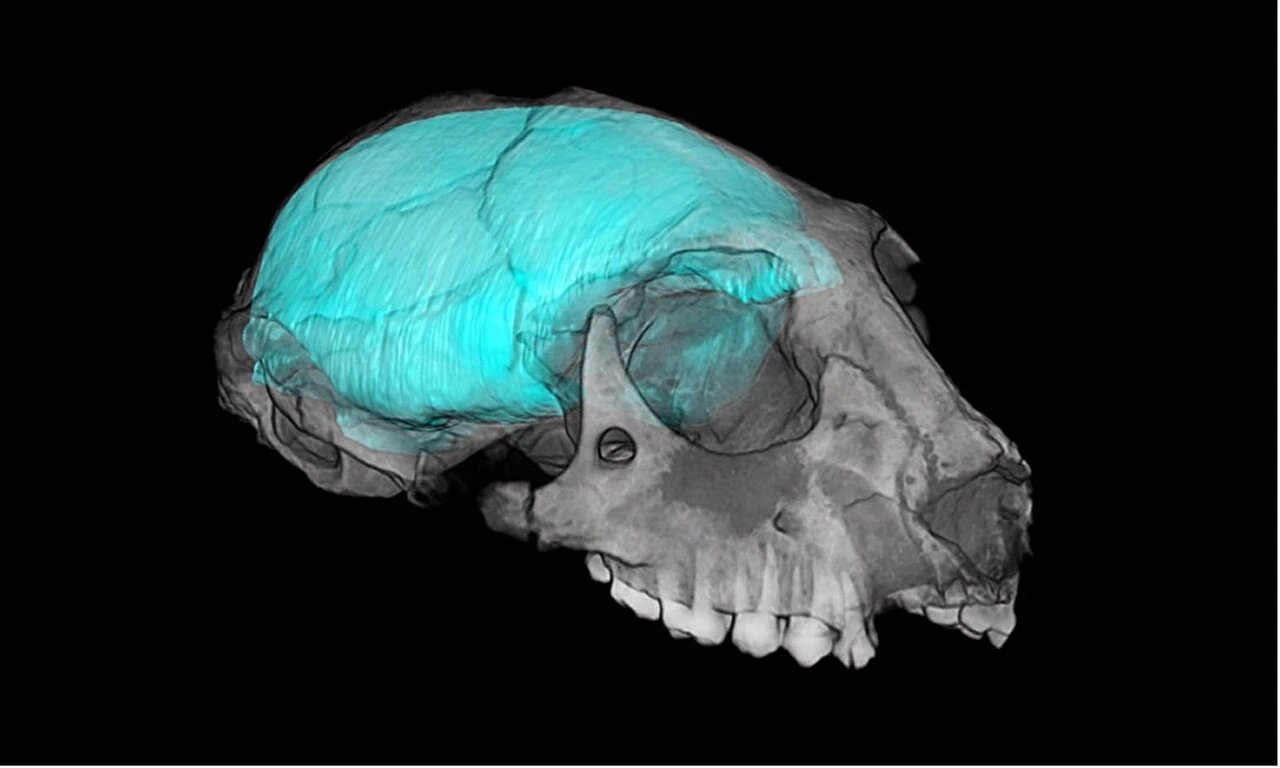
A study led by Duke University and published in Science finds that the expansion of the primate neocortex was driven primarily by vision, not by disproportionate growth of the frontal lobe. The research overturns a long-held assumption that the frontal lobe, associated with higher reasoning, ballooned independently in many primate lineages. The findings are based on digital models of fossil skulls from the Duke Lemur Center Museum.
The Fossil Evidence
Researchers created virtual endocasts from high-resolution micro-CT scans of fossil skulls housed at the Duke Lemur Center Museum. These 3D models allowed comparison of brain component volumes across living and extinct primates over 56 million years. The team, led by Richard F. Kay of Duke’s Trinity College of Arts & Sciences and Nicholas School of the Environment, analyzed neocortical surface areas and optic nerve sizes. The study appears in the journal Science.
Frontal Lobe Scaling
The frontal lobe, often associated with advanced cognition, was thought to have expanded independently in different primate lineages. However, the study found that its size grew predictably with overall brain size across all major primate groups. Kay noted that humans down to tree shrews all fall on the same scaling line. The proportion of the frontal lobe relative to total brain size remained constant throughout primate evolution.
Vision's Driving Role
The occipital, parietal, and temporal lobes, which process visual information, expanded rapidly and disproportionately in tarsiers and anthropoids—the group containing monkeys, apes, and humans. These increases coincided with enlargement of the optic nerve, indicating greater visual input. The findings challenge earlier studies that relied on visual inspection of fossils rather than quantitative digital modeling.
1 source
Time · lag behind first