
Stuttgart and IIT team demonstrate light channeling in MoOCl₂ without nanofabricated waveguides
This digest was compiled by AI from multiple sources — links to the originals are below.
Researchers from the University of Stuttgart and Istituto Italiano di Tecnologia have demonstrated a mechanism for channeling light in a natural van der Waals material without conventional nanofabricated waveguides. The discovery, published in Nature Nanotechnology, could simplify photonic integrated circuits and on-chip optical communication.
The Waveguide Challenge
Conventional photonic devices rely on waveguides to confine and direct light, essential for optical fiber communications and integrated circuits. Fabricating these waveguides requires complex lithography involving resist coating, lithography, and etching. This process is costly and technically demanding, limiting scalability and integration. Researchers have long sought alternatives that eliminate the need for artificially fabricated waveguides. A team from the University of Stuttgart and Istituto Italiano di Tecnologia has now demonstrated a material-based solution.
MoOCl₂ and Biaxial Light Channeling
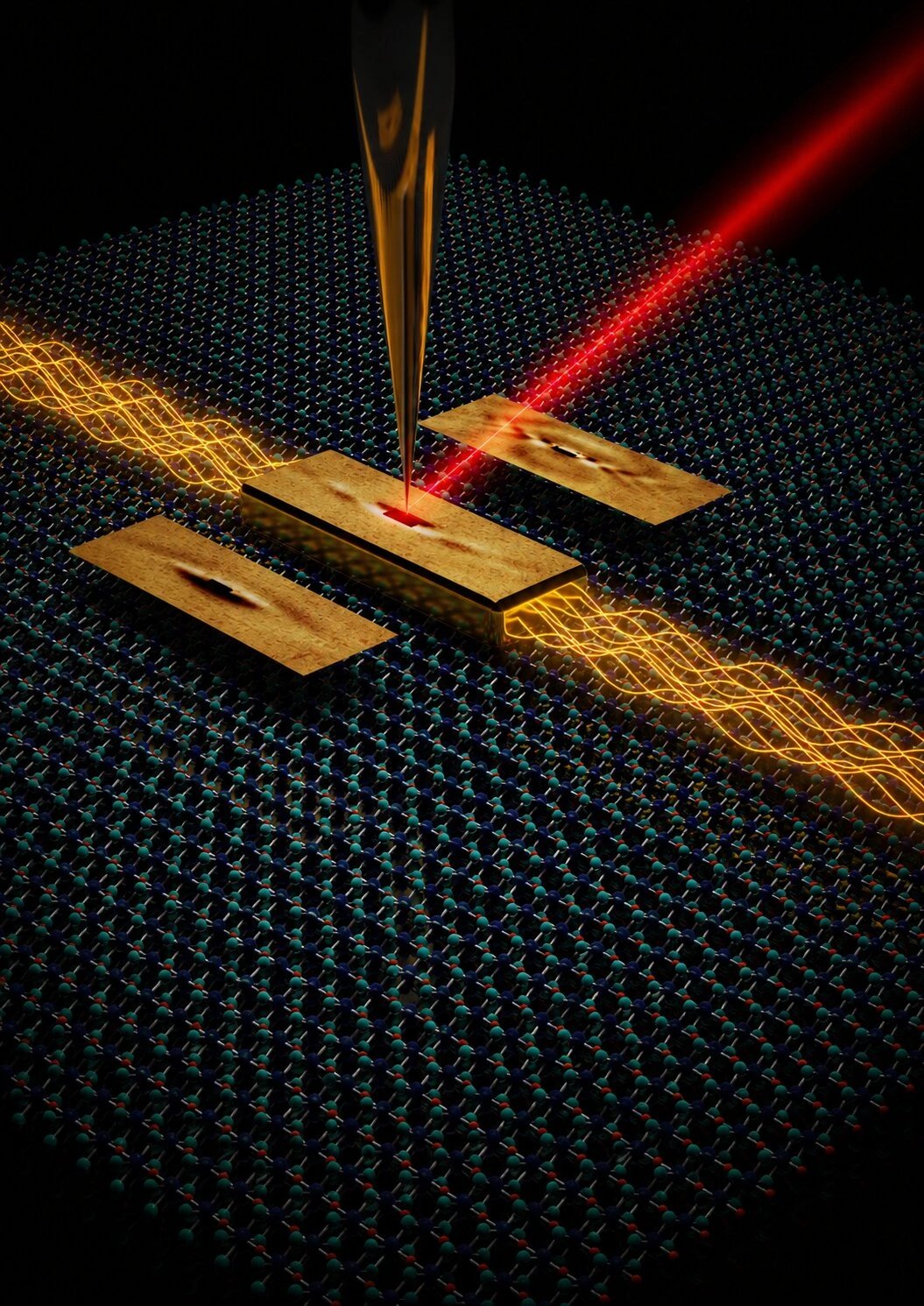
The team used the two-dimensional van der Waals material molybdenum oxy-dichloride (MoOCl₂), a biaxial crystal whose optical properties vary along three distinct axes. By placing a nanoscale gold antenna on the surface and illuminating it with infrared laser light, they generated highly confined optical waves that propagated exclusively along a single direction. The light remained naturally confined to a narrow channel, mimicking an invisible waveguide embedded in the material. The experiments, carried out by doctoral researcher Farid Aghashirinov and postdoctoral fellow Andrea Mancini using scattering-type scanning near-field optical microscopy, confirmed the directional propagation. The findings appear in Nature Nanotechnology.
Implications for Photonics
The discovery eliminates the need for nanofabricated waveguides in certain photonic applications, potentially reducing manufacturing costs and complexity. The natural light-channeling mechanism could simplify the design of on-chip optical communication systems and quantum technologies. Professor Harald Giessen from the 4th Physics Institute and Dr. Antonio Ambrosio from IIT led the research. The approach leverages intrinsic material properties, offering a scalable alternative for directing light in integrated photonics. Future work may explore other biaxial materials and practical device integration.
1 source
Time · lag behind first