
South Korean team transfers nanocircuits onto leaves via water
This digest was compiled by AI from multiple sources — links to the originals are below.
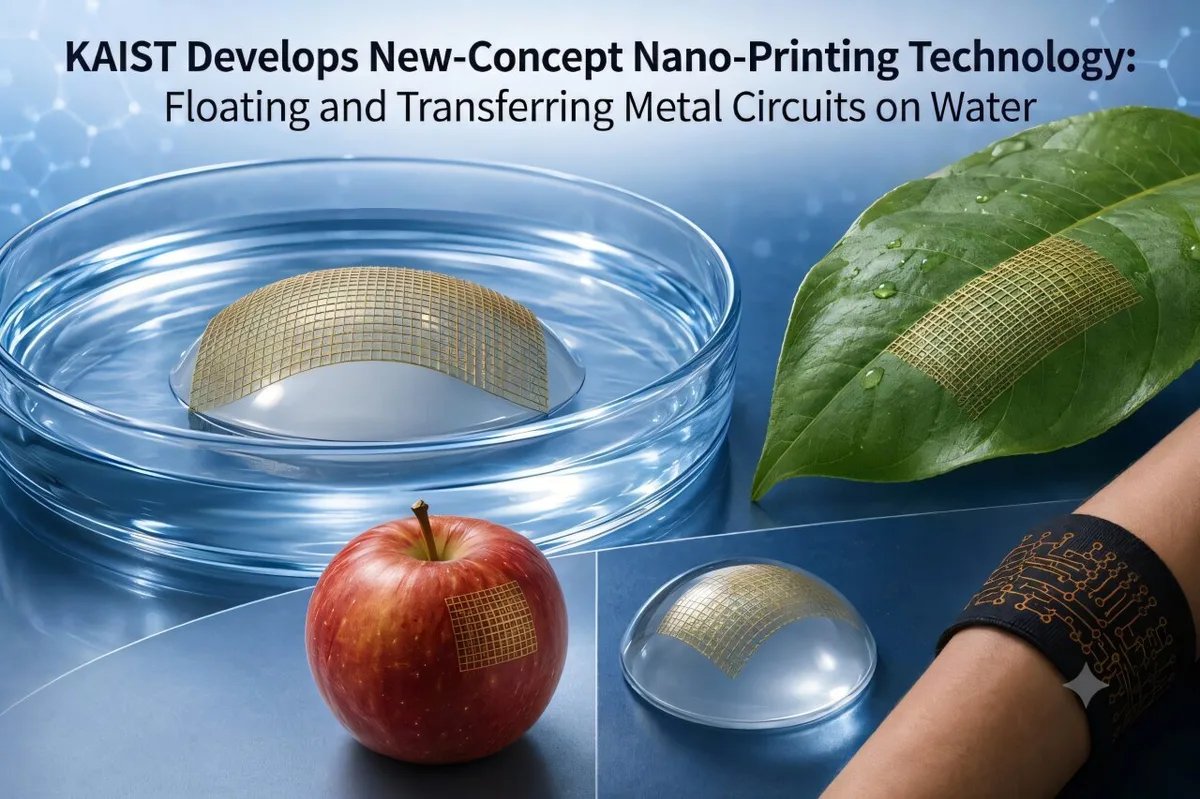
A South Korean research team has developed a water-based nanoprinting technique that transfers metal circuits onto delicate 3D surfaces like plant leaves without damage. The method floats ultra-fine nanocircuits on water and deposits them onto the target surface. This breakthrough could enable smart agriculture and wearable bioelectronics.
The Technique
The team, led by Professor Lee Seung-woo at the Korea Advanced Institute of Science and Technology (KAIST), developed a method to transfer metal nanocircuits onto delicate 3D surfaces. The circuits are first fabricated on a water surface, then lifted and placed onto targets such as plant leaves, curved automotive parts, or robot exteriors. The process avoids damage because no direct contact or high temperature is required.
Potential Applications
The technology could be used in smart agriculture to embed sensors on leaves for real-time monitoring of plant health. In healthcare, it may enable wearable devices that conform to skin or organs. The researchers also demonstrated transfer onto a rose petal and a curved car door, showing versatility across industries.
1 source
Time · lag behind first