
DGIST and Caltech researchers boost photocatalytic methane yield 65-fold using dual cocatalysts
This digest was compiled by AI from multiple sources — links to the originals are below.
A joint team from South Korea’s DGIST and the California Institute of Technology develops a photocatalyst that converts carbon dioxide into methane at a yield 65 times higher than conventional catalysts. Using dual cocatalysts of molybdenum diselenide and platinum nanoparticles on titanium dioxide, the catalyst produces 17.81 μmol/g under solar concentration. The approach stabilizes the usually unstable metallic 1T-MoSe₂ phase, overcoming a key barrier in photocatalysis.
Dual-Cocatalyst Architecture
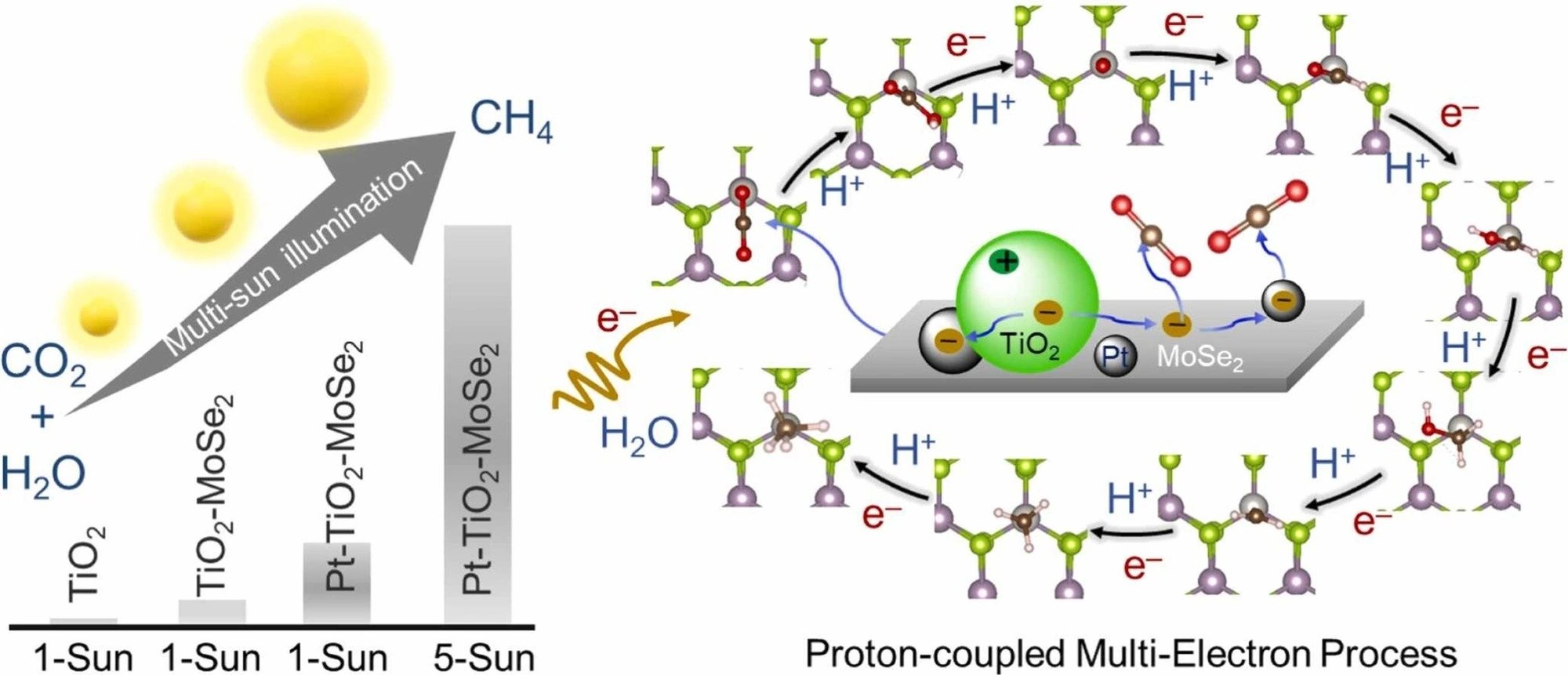
The team led by Su-Il In (DGIST) and William A. Goddard III (Caltech) anchored two-dimensional molybdenum diselenide (MoSe₂) and platinum (Pt) nanoparticles onto titanium dioxide (TiO₂). MoSe₂ creates a favorable microenvironment for CO₂ activation, while Pt rapidly captures photogenerated electrons. The layered structure of MoSe₂ typically suffers from aggregation, but the researchers engineered a precise heterojunction interface between TiO₂ and MoSe₂ to enable continuous electron transfer. This stabilizes the highly active yet unstable metallic 1T-MoSe₂ phase. The synergistic effect of the two cocatalysts enhances overall catalytic activity and durability.
Methane Production Record
Under solar-concentrating light, the Pt/TiO₂-MoSe₂ ternary photocatalyst produced 17.81 μmol/g of methane. This represents a threefold increase compared with performance under standard illumination. Relative to conventional TiO₂ photocatalysts, the methane yield was 65 times higher. Experimental validation and density functional theory calculations confirmed that the high photon flux from light concentration and efficient charge transfer across the catalyst interfaces drive the enhanced production. The results were published in Applied Catalysis B: Environment and Energy.
1 source
Time · lag behind first