
NTU scientists convert CO2 to methane at 40% efficiency with black silicon catalyst
This digest was compiled by AI from multiple sources — links to the originals are below.
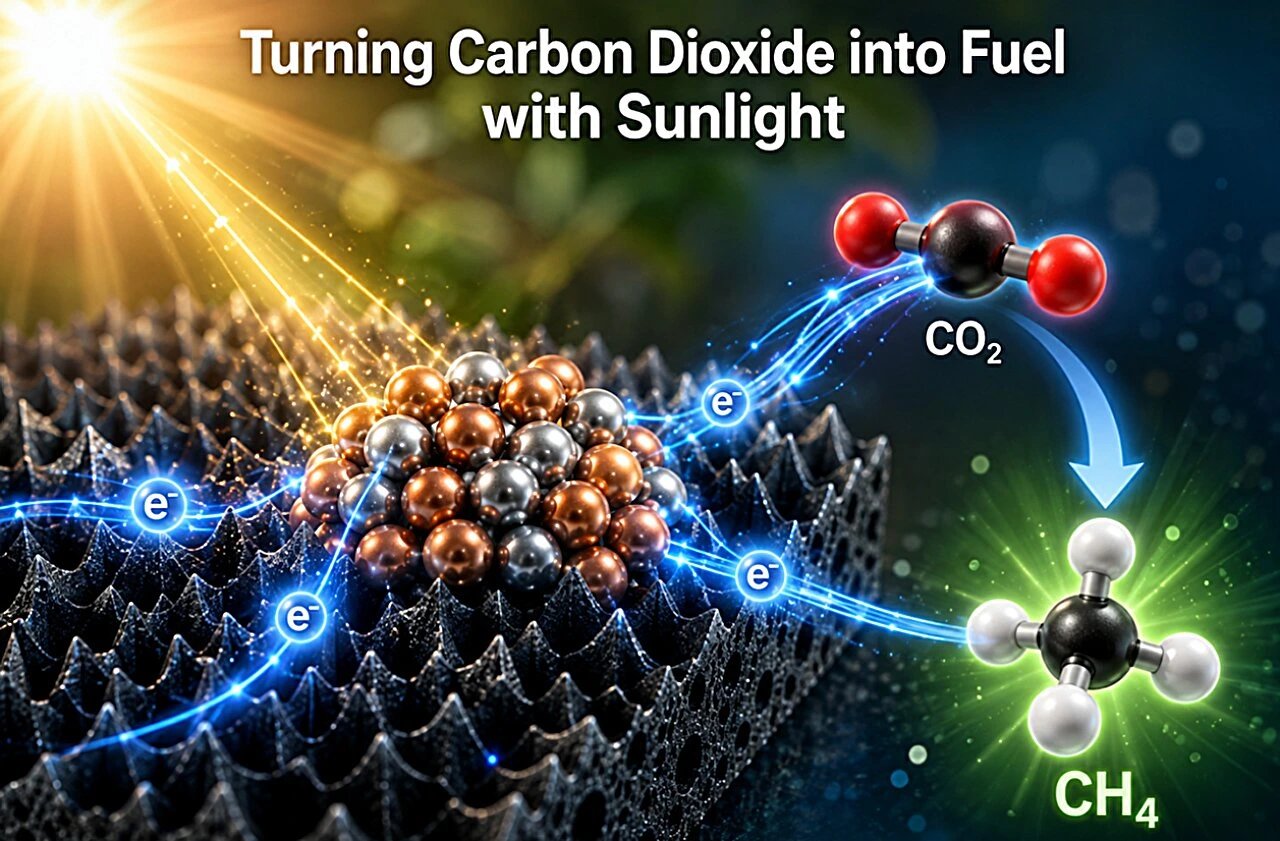
Researchers at National Taiwan University have developed a black silicon catalyst that converts carbon dioxide into methane with sunlight, reaching a Faradaic efficiency of 40%. The system uses copper-zinc nanoparticles that dynamically adjust their electronic structure, making the conversion more selective and energy-efficient than conventional methods. The findings were published in Applied Catalysis B: Environment and Energy.
The Black Silicon Catalyst
The photoelectrochemical device pairs a black silicon surface with copper-zinc alloy nanoparticles. When illuminated, it converts CO2 to methane, the main component of natural gas, at a Faradaic efficiency of approximately 40%. The catalyst requires less applied voltage than pure copper systems, reducing energy input. The research was led by Professor Hao Ming Chen at National Taiwan University and published in Applied Catalysis B: Environment and Energy.
Dynamic Electronic Structure
Using synchrotron X-ray spectroscopy and in situ Raman spectroscopy, the team tracked the catalyst during CO2 reduction. They found that the copper-zinc interface continuously adjusts its electronic state under light. Zinc stabilizes metallic copper, enabling stronger binding of reaction intermediates, while sunlight generates energetic electrons that accelerate methane formation. These cooperative effects explain the 40% efficiency and high selectivity, offering a new design principle for photocatalysts.
1 source
Time · lag behind first