
Sungkyunkwan team develops catalyst converting CO2 to ethanol at 69% efficiency
This digest was compiled by AI from multiple sources — links to the originals are below.
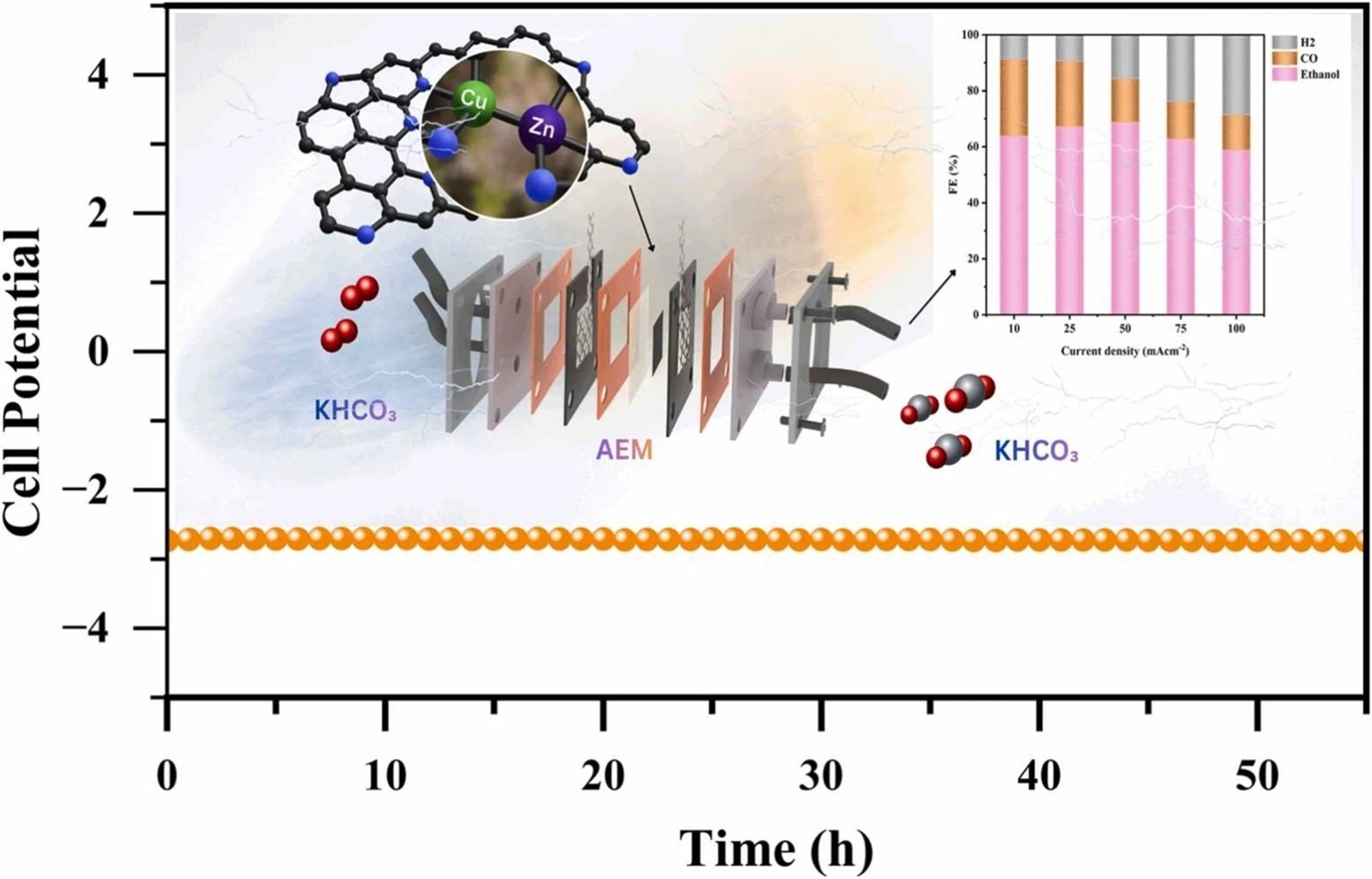
A research team led by Professor Hyoyoung Lee at Sungkyunkwan University in South Korea has developed a catalyst that converts carbon dioxide into ethanol using electricity, achieving a 69% Faradaic efficiency for the desired product. The copper-zinc catalyst operates in a membrane electrode assembly system and substantially reduces unwanted byproducts. The advance adds momentum to global efforts aimed at turning captured CO2 into valuable fuels.
Atomic-Scale Synergy
The catalyst, designed by Professor Hyoyoung Lee’s group at Sungkyunkwan University, positions copper and zinc atoms directly adjacent on a carbon support. At this scale, zinc facilitates the formation of key reaction intermediates, while copper drives the asymmetric coupling of carbon-carbon bonds required for ethanol production. This cooperative mechanism suppresses competing reaction pathways that typically yield ethylene or other hydrocarbons.
High Selectivity and Stability
In a membrane electrode assembly (MEA) system, the catalyst achieved a Faradaic efficiency of 69% for ethanol, a level of selectivity that reduces the need for downstream purification. The study, published in Applied Catalysis B: Environment and Energy, also reports operational stability under continuous testing. Traditional CO2 electroreduction often produces a mixture of alcohols and gases, but the Cu-Zn design directs the reaction toward a single liquid fuel.
Path to Scalability
Ethanol is widely used as a renewable fuel additive, industrial solvent, and disinfectant, making the conversion of CO2 into ethanol an attractive route for carbon utilization. The SKKU team notes that further progress in current density, energy efficiency, and product concentration is needed before the technology can be deployed at industrial scale. The research was supported by South Korea’s National Research Foundation and the Ministry of Science and ICT.
1 source
Time · lag behind first