
Los Alamos scientists demonstrate manganese-doped quantum dots drive chemical reduction
This digest was compiled by AI from multiple sources — links to the originals are below.
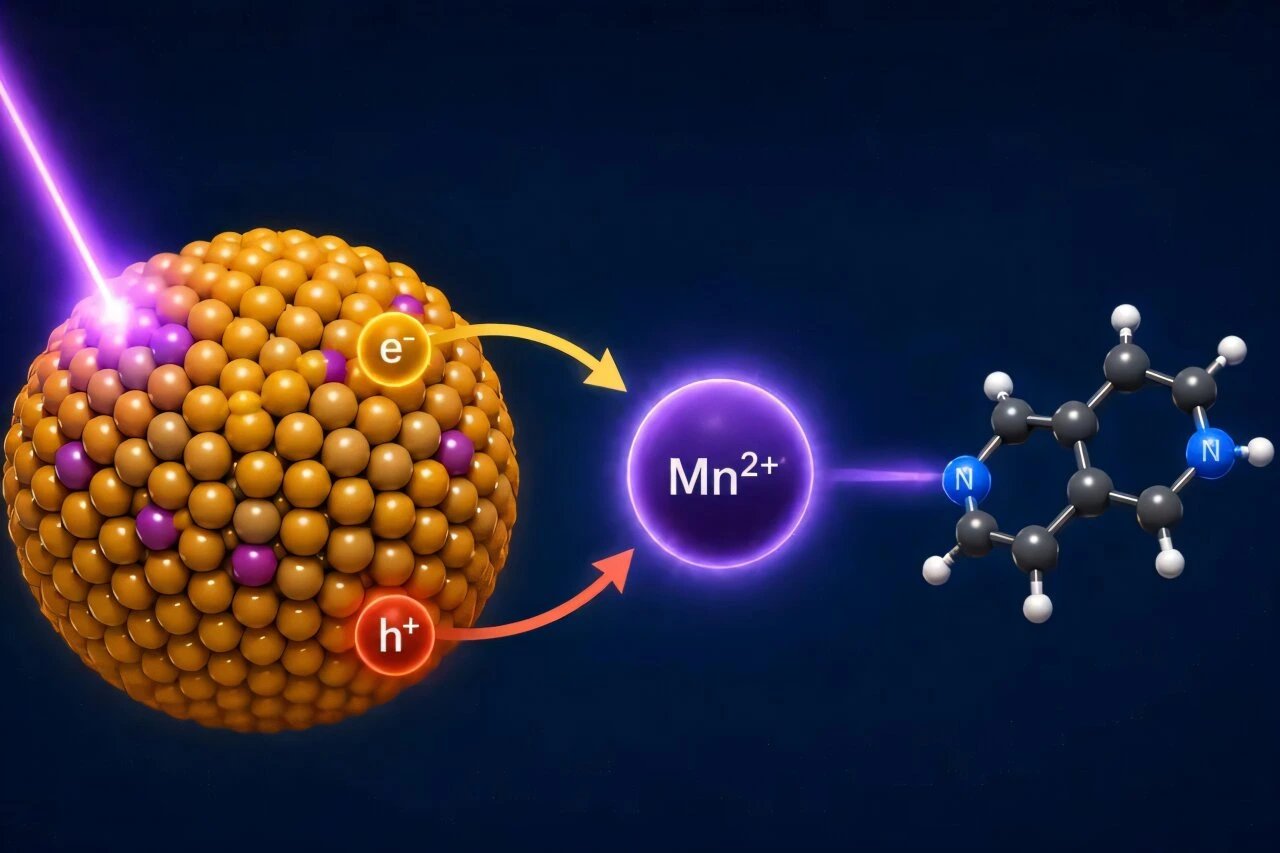
Los Alamos National Laboratory scientists demonstrate a manganese-doped quantum-dot mechanism that captures hot-electron energy for chemical reduction. The ultrafast spin-exchange pathway, reported in Nature Communications, overcomes rapid thermalization losses that normally limit light-driven chemistry, enabling reduction even when conventional energetics are unfavorable. The finding opens a new route to high-energy photoreduction, says principal investigator Victor Klimov.
Magnetic Dopant Spin Exchange
Los Alamos researchers introduced manganese dopants into semiconductor quantum dots to create an ultrafast spin-exchange pathway. The process captures hot-exciton energy within picoseconds before it is lost as heat. Spin exchange transfers energy from a hot exciton to a manganese ion, which then undergoes spin-flip relaxation to drive charge separation and reduction of an attached molecular acceptor. Methyl viologen served as the model acceptor in the experiments. The pathway enables reduction even when conventional band-edge energetics are unfavorable, a limitation that plagues undoped quantum dots.
Femtosecond Transient Absorption
Femtosecond transient absorption spectroscopy revealed the two-step process in unprecedented detail, said lead spectroscopist Valerio Pinchetti. Measurements show that manganese doping not only speeds up interfacial electron transfer but also activates a hot-exciton channel. The direct observation confirms that spin exchange operates on a quadrillionth-of-a-second timescale, outpacing thermalization losses. This direct evidence addresses a long-standing obstacle to practical hot-electron photochemistry.
Photocatalysis Without Band-Edge Limits
The Nature Communications study demonstrates that magnetic dopants can do more than modify optical properties—they can redirect energy into useful chemistry. Principal investigator Victor Klimov noted that the finding opens a fundamentally new route to high-energy photoreduction. The mechanism could expand the reach of light-driven chemistry by enabling reactions that require highly reducing electrons, which are typically unavailable due to rapid cooling. The concept is not limited to manganese and could be applied with other magnetic ions.
1 source
Time · lag behind first