
University of Warwick astronomers discover black holes expel nearly as much matter as they swallow
This digest was compiled by AI from multiple sources — links to the originals are below.
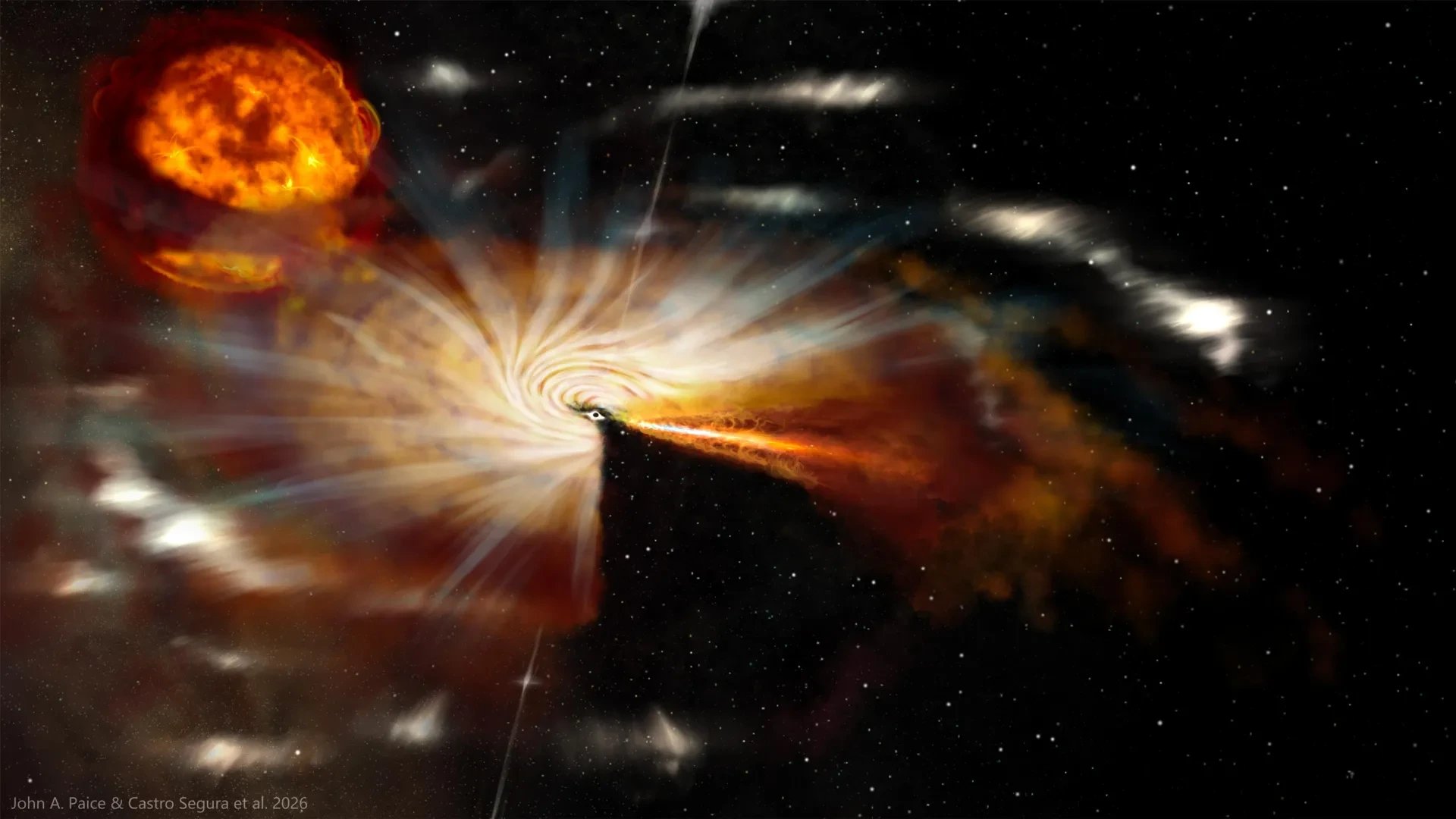
A black hole observed during a 2023 eruption ejected nearly as much matter through jets and winds as it swallowed, new optical data show. The outflows continued even after the system, Swift J1727.8-1613, became extremely faint, challenging previous assumptions about black hole feeding.
The 2023 Eruption
Swift J1727.8-1613 was detected as a bright X-ray source in 2023, marking the start of a months-long outburst. The system contains a black hole drawing gas from a nearby star, forming a superheated accretion disc. Astronomers from the University of Warwick used the European Southern Observatory's Very Large Telescope to capture the most detailed optical record ever assembled of such an event. The observations spanned multiple stages of activity, allowing real-time tracking of the feeding process.
Persistent Jets and Winds
Contrary to expectations, powerful jets and winds persisted long after the black hole's brightness faded. Lead author Dr. Noel Castro Segura said the team was surprised to see material being expelled at rates nearly equal to accretion. 'People often imagine black holes simply swallowing everything around them. What we're seeing is a much more complex process,' he said. The findings indicate that black holes may eject a significant fraction of infalling matter, reshaping their surroundings even during quiescent phases.
A Cosmic Digestive System
The results challenge the traditional picture of black holes as bottomless pits. Instead, they suggest a cosmic digestive system where matter is processed and expelled back into space. This feedback process could influence how galaxies evolve, as black-hole winds and jets inject energy into the interstellar medium. The study, released on July 31, provides new constraints for theoretical models of accretion.
1 source
Time · lag behind first