
Titan's seasons span 7.5 Earth years, powering methane rain and transient lakes
This digest was compiled by AI from multiple sources — links to the originals are below.
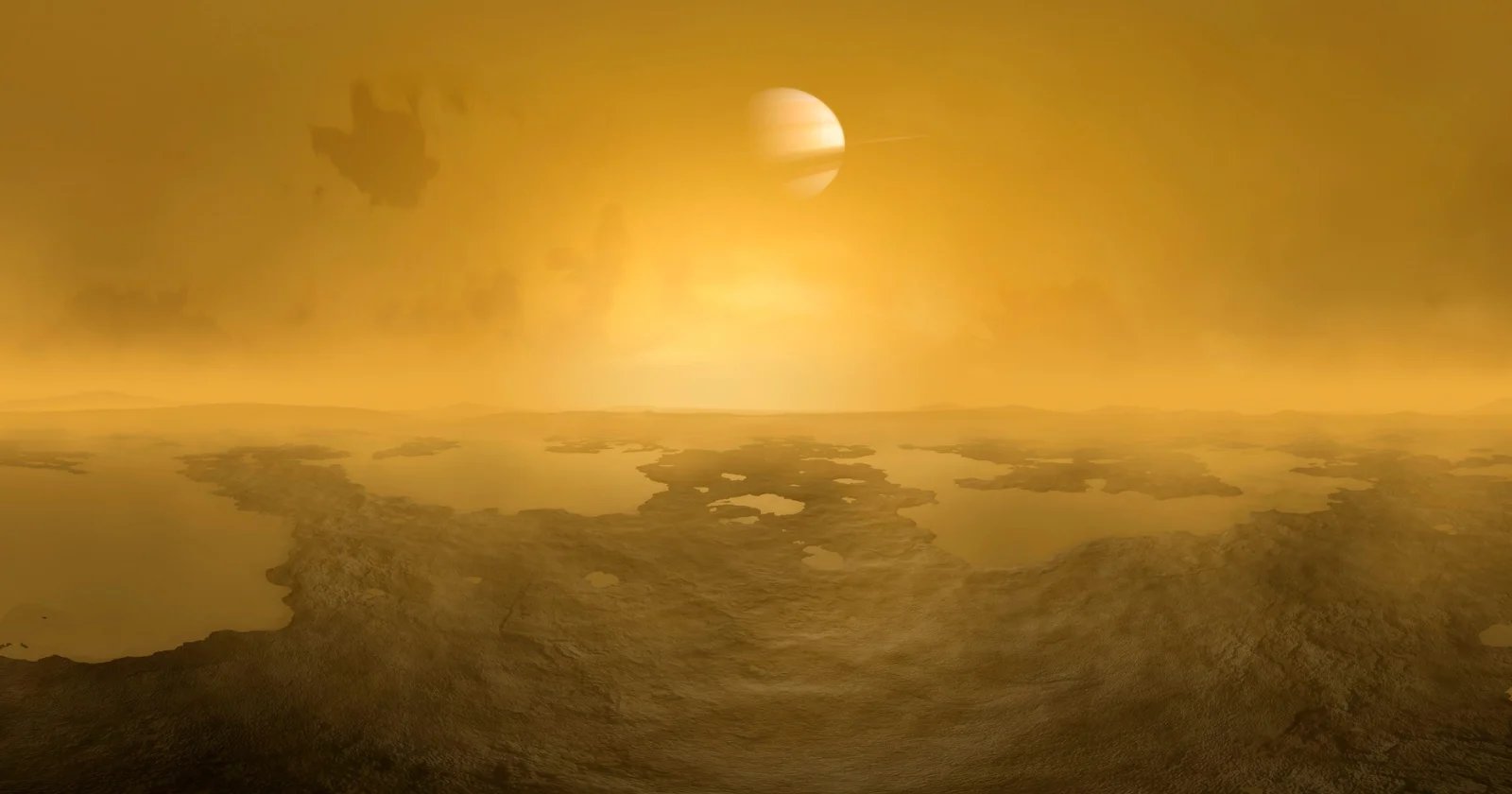
Titan, Saturn's largest moon, experiences a full seasonal cycle every 29 Earth years, with each season lasting about 7.5 years due to Saturn's slow orbit. Cassini spacecraft observations show an active methane-based weather system of rain, rivers, and lakes analogous to Earth's water cycle, as well as transient shallow lakes that appear and vanish with the seasons. However, the 13-year Cassini mission covered less than half a Titan year, leaving the full seasonal pattern only partially understood.
Orbital Tilt and Year Length
Saturn's axial tilt of 27 degrees, similar to Earth's 23 degrees, drives seasons on both Saturn and its moons. Titan orbits in Saturn's equatorial plane and thus shares its host planet's slow 29-year trip around the Sun, where each of the four seasons stretches to roughly 7.5 Earth years. NASA's Cassini spacecraft, which gathered data from 2004 to 2017, made more than 100 targeted flybys of Titan and delivered the Huygens lander to its surface in 2005, yet covered less than half a Titan year.
Methane Cycle and Lakes
On Titan, surface temperatures around -179°C freeze water ice into rock, so liquid hydrocarbons—methane and ethane—act as the working fluids of the climate system. Cassini radar observed methane rain, river channels, and large lakes in the northern hemisphere, some exceeding 100 meters in depth and dominated by liquid methane. Shannon MacKenzie and colleagues at Johns Hopkins Applied Physics Laboratory noted that smaller, shallow lakes appeared to come and go, possibly evaporating or seeping underground over the course of a season.
Equatorial Dunes and Wind Shifts
Titan's equator is lined with linear sand dunes up to 100 meters high and hundreds of kilometers long. Cassini radar identified a secondary population of reoriented dunes that diverge by about 23 degrees from the main orientation, signalling wind patterns that shifted over long climate cycles. These features suggest that Titan's atmosphere has undergone multi-seasonal, possibly multi-millennial climate variations that the 13-year mission could only glimpse.
1 source
Time · lag behind first