
Nature publishes silicon quantum processor study advancing qubit performance tenfold
This digest was compiled by AI from multiple sources — links to the originals are below.
A study published today in Nature details a fully integrated silicon quantum processing unit (QPU) that combines a custom cryo-CMOS controller, a superconducting ribbon cable, and a 54-dot chip configurable into 18 exchange-only qubits. The team reports a tenfold improvement in single- and two-qubit gate fidelities, an order-of-magnitude advance over prior exchange-only qubit systems. The breakthrough comes as industry pushes for scalable quantum computers, with silicon-based designs leveraging existing semiconductor manufacturing infrastructure.
Quantum Processing Unit
The QPU integrates three components: a custom low-power cryogenic CMOS controller operating at 4 kelvin, a high-density superconducting ribbon cable, and a quantum chip with 54 exchange-coupled quantum dots. The chip can be configured as up to 18 exchange-only qubits, which simplify control by using charge states to encode quantum information. The controller generates all time-varying signals and transmits them through the ribbon cable to the millikelvin qubits, resolving the wiring bottleneck common in room-temperature control schemes. The entire system uses semiconductor-compatible fabrication, promising easier scaling than competing technologies.
Performance Leap
The team demonstrated single-qubit and entangling gates with fidelities that improve on the state of the art for exchange-only qubits by roughly tenfold. This order-of-magnitude advance stems from the integrated design, which minimizes noise and signal degradation. Gate times and coherence metrics were not disclosed in the abstract, but the improvement marks a critical step toward fault-tolerant operation. The results were validated against detailed simulations, confirming the system's low-noise characteristics.
Error-Correction Codes
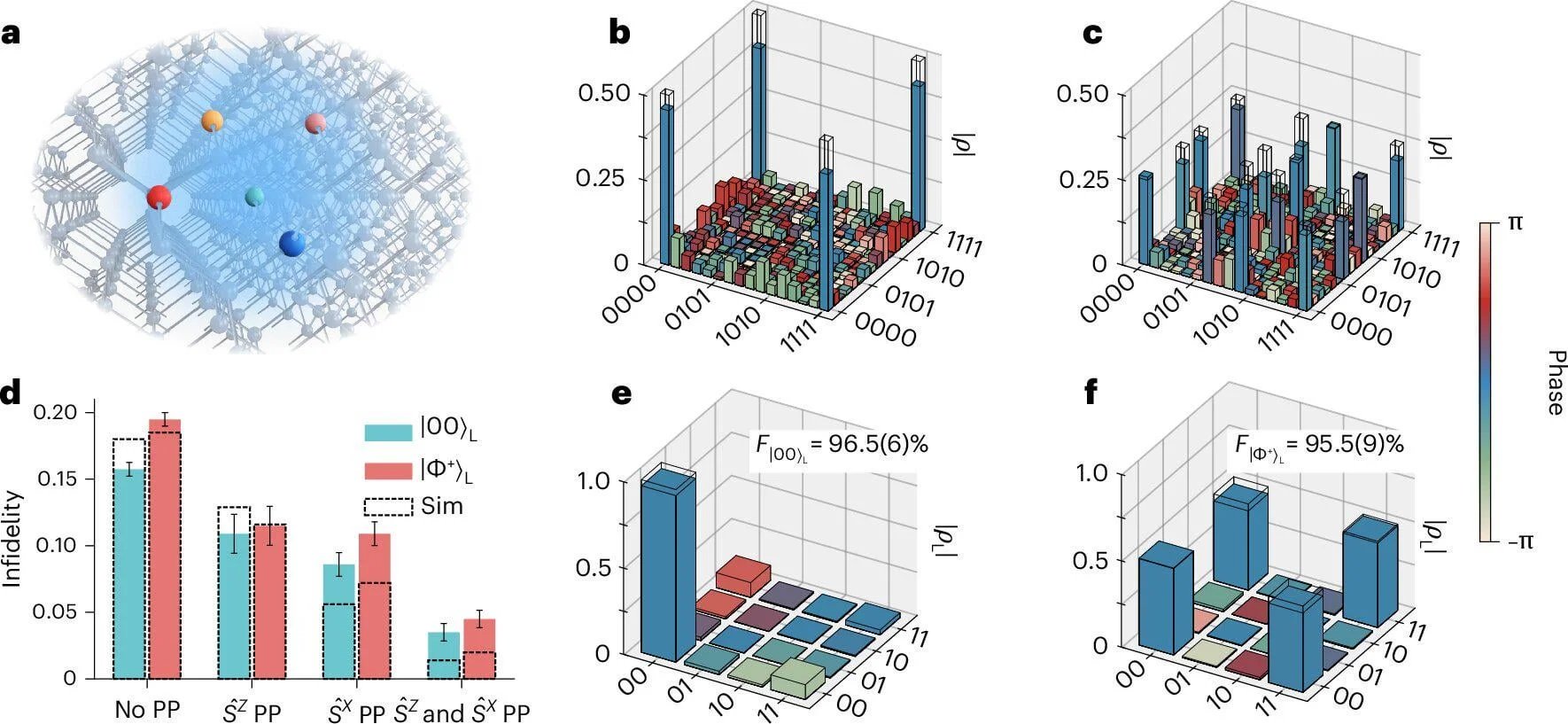
To validate fault tolerance, the researchers implemented a distance-5 repetition code and a distance-2 quantum error-detecting code on the processor. The distance-5 code is capable of correcting up to four errors, a notable demonstration of logical qubit stability. Comparison with simulations showed agreement, indicating that the physical error rates are low enough for error-corrected operation. This is among the first practical demonstrations of error detection on a fully integrated silicon QPU.
3 sources
Time · lag behind first