
RNA forms large structures, challenging origin-of-life assumptions
This digest was compiled by AI from multiple sources — links to the originals are below.
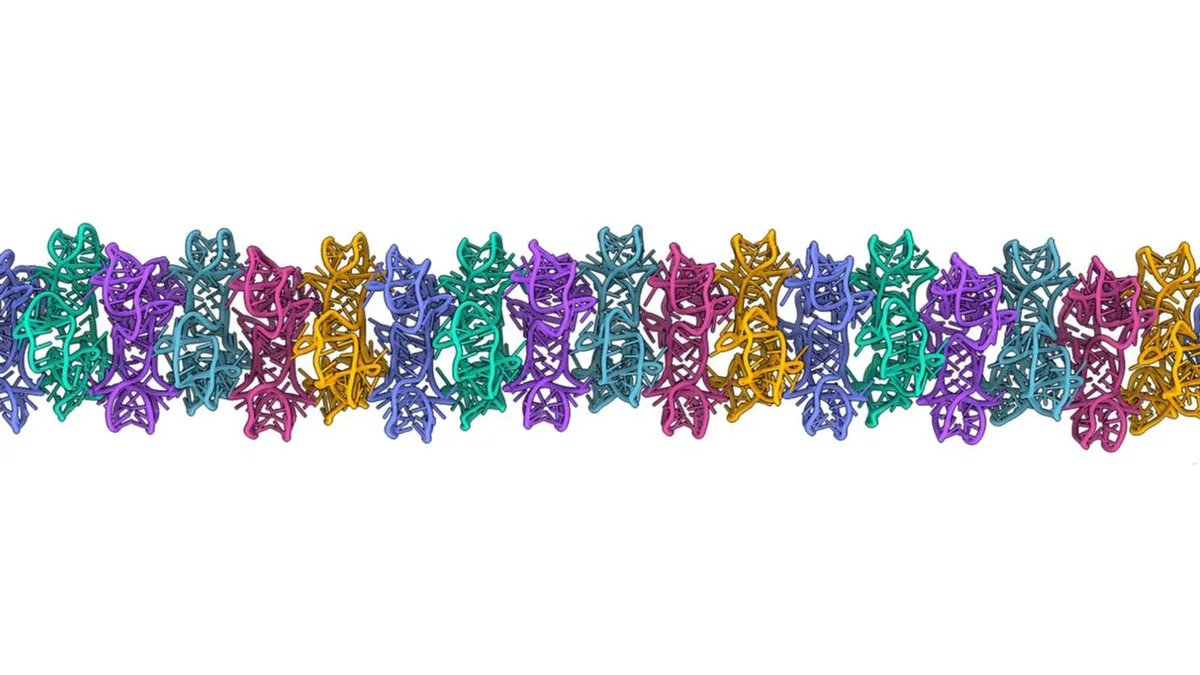
New research shows that naturally occurring RNA molecules can assemble into large, sophisticated geometries such as filaments and cages, challenging long-held assumptions that RNA could only form small, simple structures. The findings suggest that at the dawn of life, RNA may have had the capacity to form complex shapes previously thought exclusive to proteins.
The RNA World Hypothesis
The RNA world hypothesis posits that RNA-based life-forms preceded modern organisms that use DNA and proteins. RNA, a molecular cousin of DNA, still functions in modern cells but no longer serves as primary genetic material. Primordial species are thought to have used RNA to store genetic information and catalyze reactions as stand-in enzymes.
New Structural Discoveries
Researchers led by Lin Huang at Sun Yat-Sen University in China identified a family of RNA molecules from bacteriophages that form 'kissing stem loops' — structures where RNA strands fold over and bond with each other. Using cryo-electron microscopy, they observed that some RNA molecules assembled into long filaments resembling the cellular cytoskeleton, while others formed icosahedral cages similar to viral capsids. The study was posted to the preprint server bioRxiv on July 1 and has not yet been peer-reviewed.
Implications for Early Life
The discovery challenges the assumption that only proteins, with their 20 amino acid subunits, could form diverse large structures. RNA, composed of just four nucleotide types, now demonstrates comparable geometric versatility. Co-author Lin Huang stated, 'It suggests that at the origin of life RNA could assemble into all kinds of shapes.'
1 source
Time · lag behind first