
Quantum computer simulates holographic gravity in landmark experiment
This digest was compiled by AI from multiple sources — links to the originals are below.
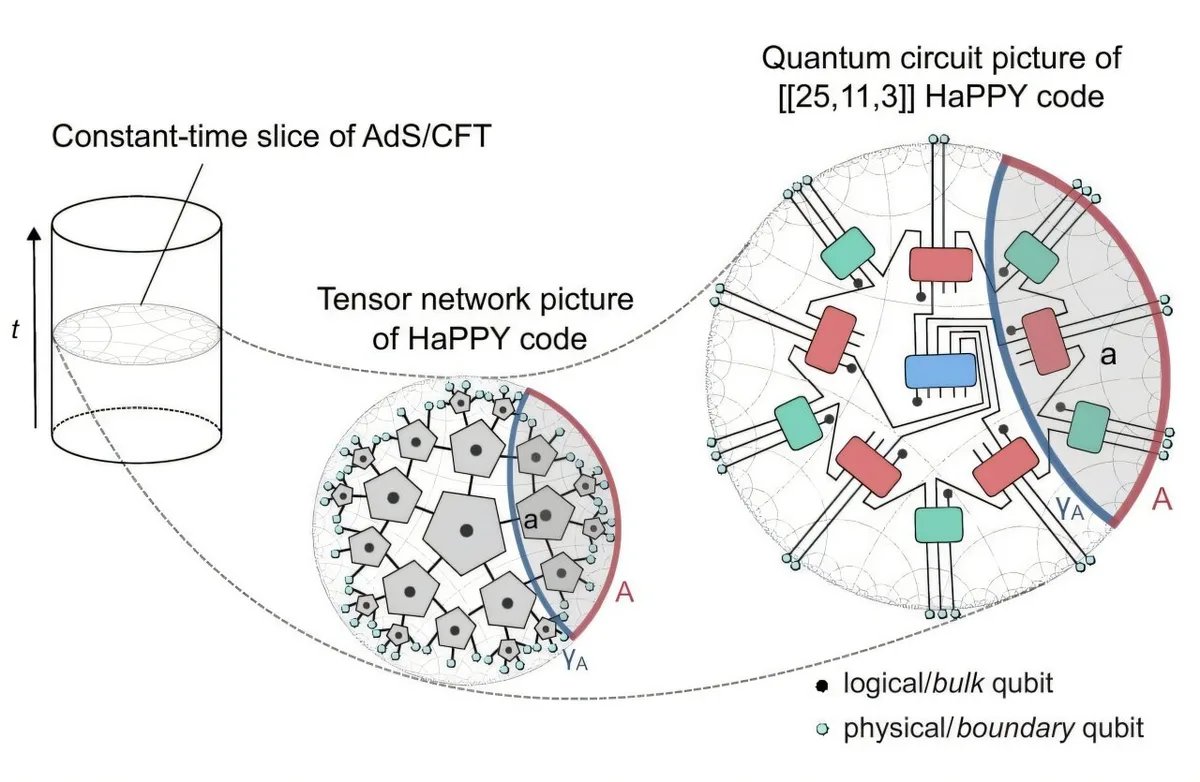
Researchers at the National Quantum Laboratory (QLab@UMD) and partners used the IonQ Forte quantum computer to simulate a holographic universe based on the AdS/CFT correspondence. The experiment, detailed in a paper posted to arXiv, demonstrated key entanglement properties predicted by the holographic principle, marking a step toward understanding how gravity emerges from quantum systems.
The Experiment
The team, led by Crystal Noel and Charles Cao and including pioneers John Preskill and Christopher Monroe, implemented the HaPPY quantum error-correction code on the IonQ Forte ion-trap quantum computer. This code simulates a toy model of a universe with a negative cosmological constant, where a higher-dimensional gravitational 'bulk' is fully encoded in a lower-dimensional boundary system without gravity. The researchers successfully observed entanglement properties that mirror those expected in real quantum gravity.
Theoretical Framework
The experiment is grounded in the AdS/CFT correspondence, the most successful realization of the holographic principle proposed by Gerard 't Hooft and Leonard Susskind. In this framework, a gravitational universe in anti-de Sitter space (AdS) is dual to a conformal field theory (CFT) on its boundary. The study used a simplified model where the bulk is a quantum error-correcting code, allowing the team to probe how information is encoded holographically.
Implications
The results provide a concrete demonstration of how quantum error correction can encode gravitational degrees of freedom, supporting the idea that spacetime emerges from quantum entanglement. While the model is highly simplified, it offers a testbed for exploring the connection between quantum computing and fundamental physics. The paper is posted to arXiv and has not yet been peer-reviewed.
Subsequent Wormhole Criticism
In February 2023, an independent team of physicists presented evidence that the original experiment did not create any wormholes, holographic or otherwise. The criticism was covered by Quanta Magazine.
2 sources
Time · lag behind first