
PLATON camera tracks invisible particles in 3D with AI
This digest was compiled by AI from multiple sources — links to the originals are below.
Scientists have developed a particle detector called PLATON that uses a light-field camera, photon sensors, and AI to reconstruct particle paths in 3D. Simulations indicate it could match or surpass current detectors while being easier to scale. The technology may also improve PET medical imaging.
The Detector Design
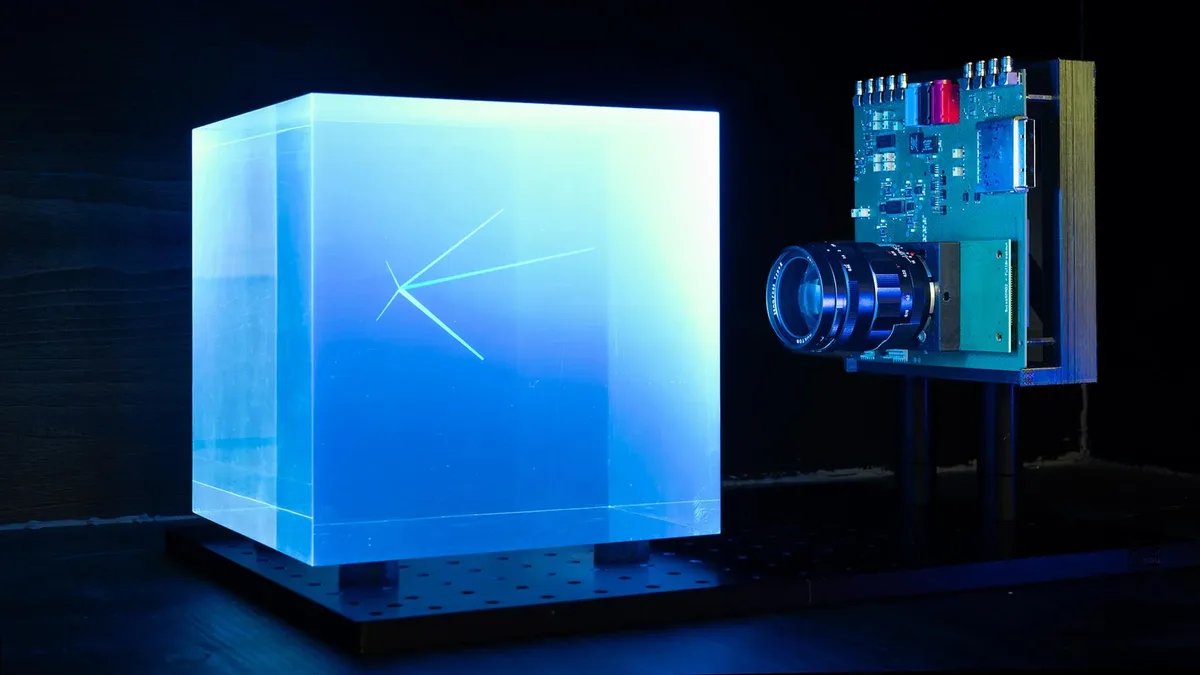
PLATON replaces millions of tiny detector components with a single block of light-producing material. A light-field camera captures particle interactions, while highly sensitive photon sensors and AI reconstruct paths in fast, detailed 3D. The design simplifies scaling compared to traditional detectors.
Simulation Results
Simulations suggest PLATON could match or surpass today's best detectors in performance. The system achieves high-resolution tracking without the complexity of multi-component arrays. Researchers emphasize the potential for cost-effective scaling.
Medical Applications
The technology may lead to sharper PET medical scans by improving particle detection. PLATON's 3D reconstruction could enhance imaging precision. Further development is needed before clinical use.
1 source
Time · lag behind first