
Kazakh universities adopt AI-first model, shift from fixed professions
This digest was compiled by AI from multiple sources — links to the originals are below.
Kazakhstan's universities are restructuring around artificial intelligence, moving from fixed four-year professions to project-based learning and the 'AI + X' model. The shift follows the Astana AI Declaration 2026 adopted at the Rectors' Club: Central Asia+ meeting during AI & Digital Bridge 2026. President Kassym-Jomart Tokayev has directed Qazaq AI Research University to focus on applied economic tasks and expand the AI-Sana program.
Key Facts
- The Astana AI Declaration 2026 was adopted at the eighth Rectors' Club: Central Asia+ meeting in Astana on October 1–3, 2026.
- Qazaq AI Research University (QAIRU) was officially opened in Astana during AI & Digital Bridge 2026 as the first AI-Enabled University in Central Asia.
- President Kassym-Jomart Tokayev proposed linking research and personnel training directly to enterprise needs and orienting QAIRU toward applied economic tasks.
- Minister of Science and Higher Education Sayasat Nurbek said students are now creating their own AI agents in agriculture, education, healthcare, and industrial applications.
- Kazakhstan is considering the U.S. superintelligence agreement as a possible model for a broader international AI safety treaty under UN auspices.
The Astana Declaration
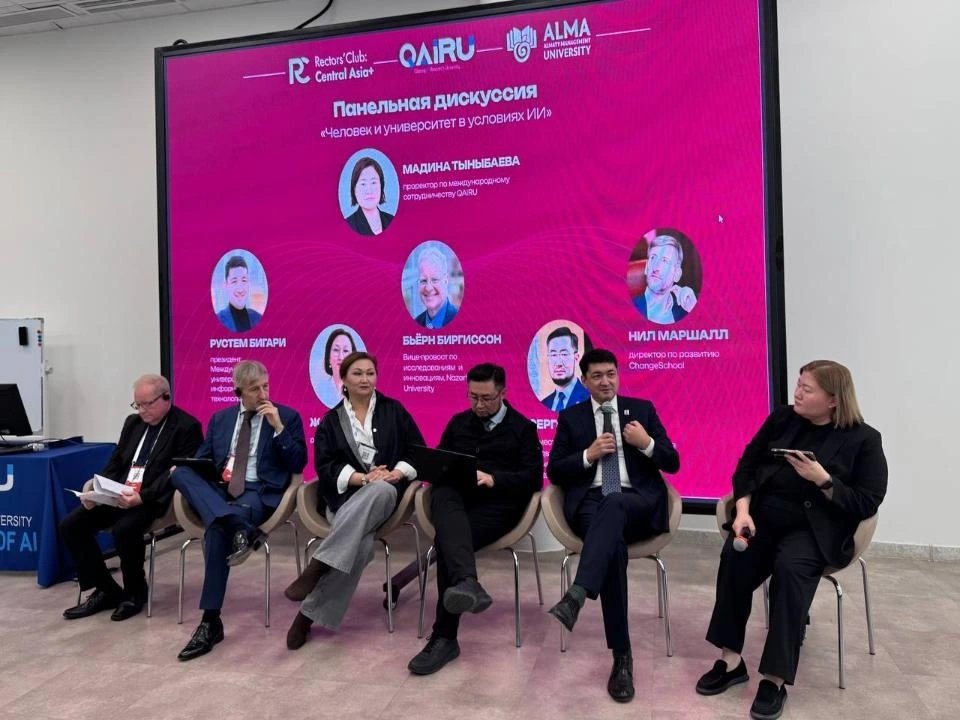
The eighth Rectors' Club: Central Asia+ meeting, organized by Almaty Management University (AlmaU) and Qazaq AI Research University (QAIRU), adopted the Astana AI Declaration 2026. The meeting was part of the AI & Digital Bridge 2026 agenda held in Astana from October 1 to 3, covering artificial intelligence, human capital, digital economy, and technological entrepreneurship. QAIRU Rector Sapar Toksanov said universities face serious challenges from AI development and that the 'AI + X' model, mandated by the head of state, integrates AI into various fields. AlmaU President Assylbek Kozhakhmetov stated that Central Asian universities must jointly shape the future of higher education rather than merely exchanging experience.
Shift to Project-Based Learning
President Kassym-Jomart Tokayev proposed at the third AI Development Council meeting to link research and training to enterprise demands and to orient QAIRU toward applied economic tasks. Coventry University Kazakhstan President Miras Daulenov said Kazakhstan must abandon the model of preparing a person for one predetermined profession over four years and move to project-based learning. Minister Sayasat Nurbek said the second stage of the AI-Sana program, launched this year, trains students to create AI agents for agriculture, education, healthcare, and industrial applications. Nurbek emphasized that the program's goal is not just to use ready-made AI services but to train students to build and train their own algorithms for specific tasks.
AI Safety and Global Regulation
Kazakhstan Institute for Strategic Studies (KISI) expert Aidar Kurmashev said Kazakhstan needs to develop national AI expertise while participating in international AI safety rule-making. Kurmashev noted that the U.S. superintelligence agreement model includes four levels of control: internal monitoring, separate internal verification, independent external audit, and board committee oversight. The agreement remains voluntary and does not provide for legal sanctions, according to Kurmashev. Kazakhstan proposes that the 'Washington model' could become the basis for an international treaty under UN auspices after expert study, and plans to present its vision at the upcoming G20 summit in Miami.
6 sources
Time · lag behind first