
Astronomers find unexpected shock wave around dead star RXJ0528+2838
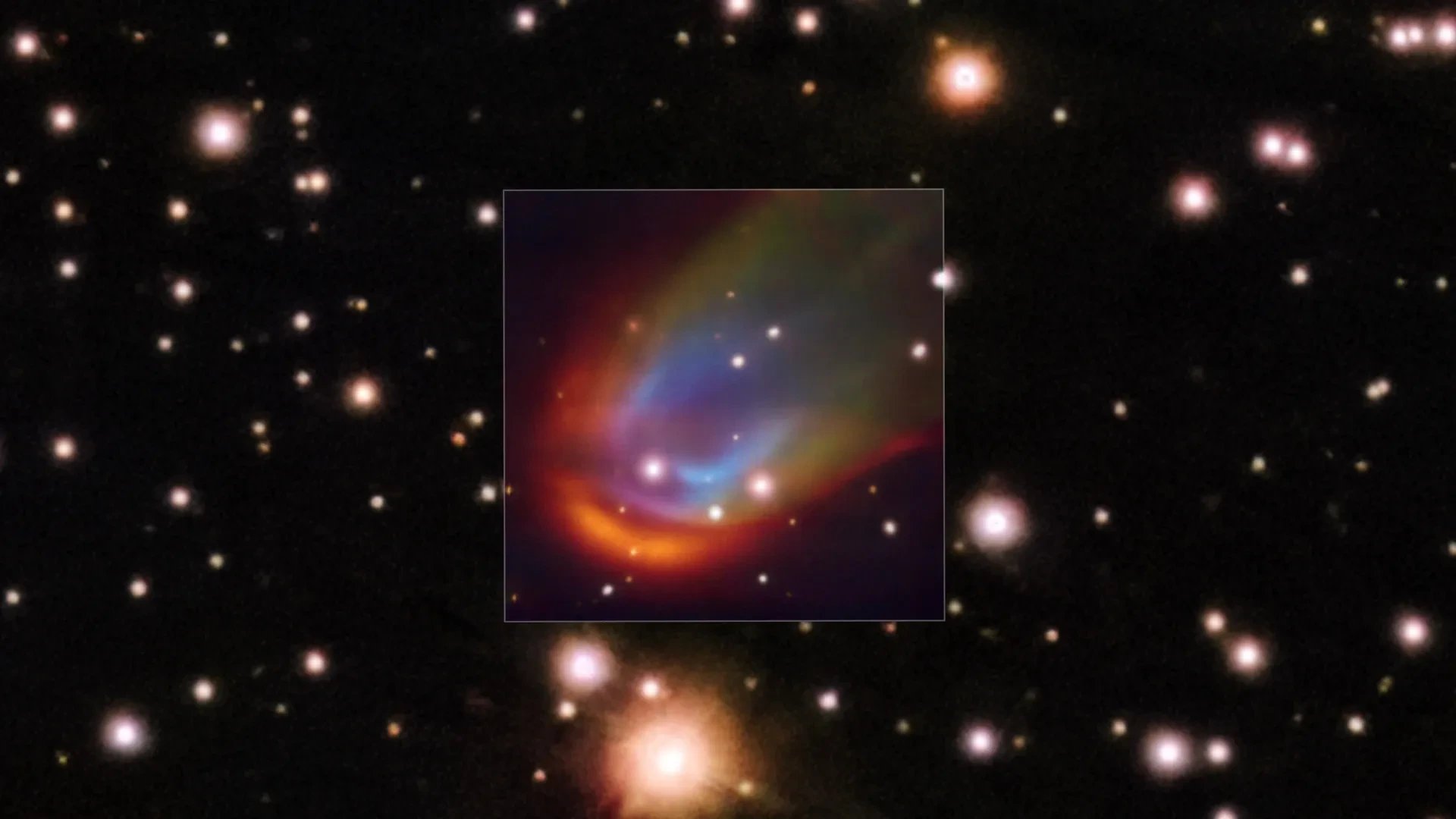
This digest was compiled by AI from multiple sources — links to the originals are below.
Astronomers using ESO's Very Large Telescope have captured a powerful outflow and bow shock around the white dwarf RXJ0528+2838, located about 730 light-years from Earth. The structure is unexpected because the system shows no evidence of the accretion disc normally required to produce such outflows. The findings, published in Nature Astronomy, challenge current models of how dead stars exchange matter and energy with their surroundings.
Key Facts
- RXJ0528+2838 lies about 730 light-years from Earth and is a white dwarf orbited by a Sun-like companion.
- The bow shock was first noticed in images from the Isaac Newton Telescope in Spain and later mapped in detail with the MUSE instrument on ESO's VLT.
- The study was co-led by Simone Scaringi of Durham University and Krystian Ilkiewicz of the Nicolaus Copernicus Astronomical Center, and published in Nature Astronomy.
- Noel Castro Segura of the University of Warwick describes the bow shock as "a curved arc of material, similar to the wave that builds up in front of a ship."
The Unexpected Outflow
Astronomers have captured a powerful outflow around the white dwarf RXJ0528+2838 using the European Southern Observatory's Very Large Telescope. Simone Scaringi, associate professor at Durham University and co-lead author, said, "We found something never seen before and, more importantly, entirely unexpected." Krystian Ilkiewicz, postdoctoral researcher at the Nicolaus Copernicus Astronomical Center and study co-lead, added, "Our observations reveal a powerful outflow that, according to our current understanding, shouldn't be there." The discovery challenges current ideas about how dead stars exchange matter and energy with their surroundings.
A Discless White Dwarf
RXJ0528+2838 is a white dwarf, the leftover core of a dying low-mass star, orbited by a Sun-like companion. In binary systems like this, material pulled from the companion often forms a disc around the white dwarf, feeding it and powering outflows. However, astronomers see no evidence of such a disc around RXJ0528+2838, leaving them without the usual explanation for the outflow and surrounding nebula. Scaringi described the finding as "one of those rare 'wow' moments" that a supposedly quiet, discless system could drive such a spectacular nebula.
VLT Observations
The unusual structure was first noticed in images taken with the Isaac Newton Telescope in Spain. Its strange appearance prompted researchers to investigate it more closely using the MUSE instrument on ESO's VLT. Noel Castro Segura, research fellow at the University of Warwick, described the bow shock as "a curved arc of material, similar to the wave that builds up in front of a ship." The MUSE observations allowed the team to map the bow shock in detail and analyse its composition.
1 source
Time · lag behind first