
BRICS Summit in New Delhi Issues 140-Point Declaration
This digest was compiled by AI from multiple sources — links to the originals are below.
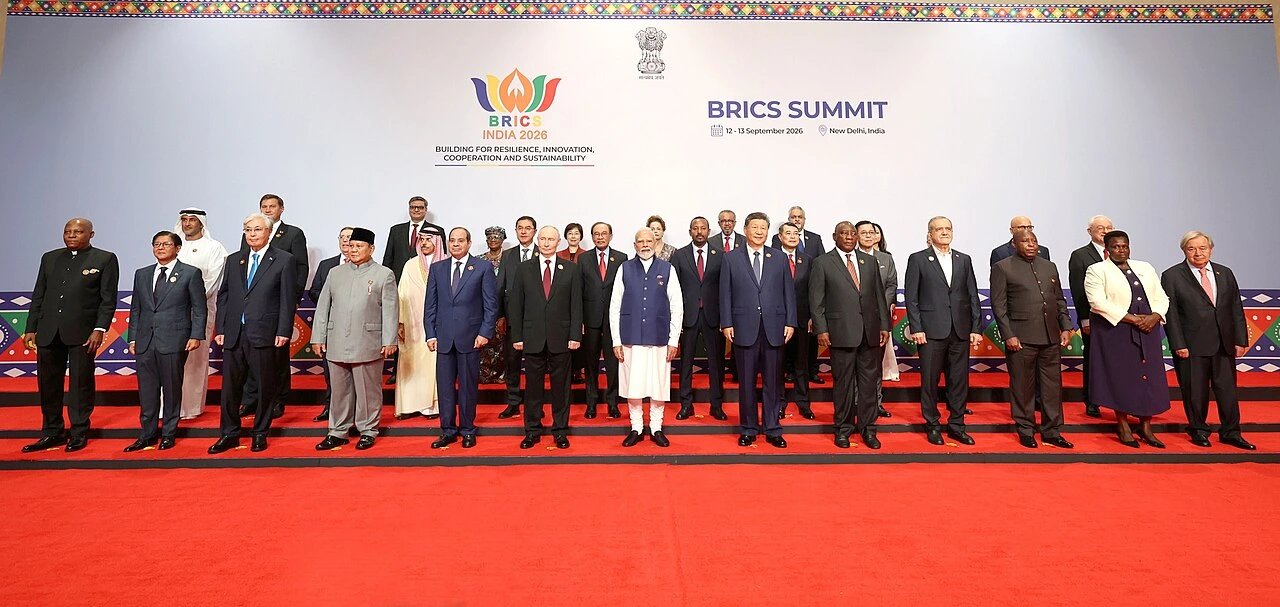
The 2026 BRICS Summit concluded in New Delhi on September 13 with an 11-member declaration of 140 points covering trade, climate, and global governance. Russian President Vladimir Putin said the G7 is being replaced by BRICS as the new engine of economic growth. Indian MP Vikramjit Singh Sahney called the summit a major diplomatic achievement for Prime Minister Narendra Modi.
Key Facts
- The BRICS New Delhi declaration contains 140 points on topics from Bretton Woods to conflict in the Middle East.
- BRICS has 11 full members: Brazil, China, Egypt, Ethiopia, India, Indonesia, Iran, Russia, Saudi Arabia, South Africa, and the United Arab Emirates.
- Russian President Vladimir Putin said the G7 is being replaced by BRICS as the new engine of economic growth.
- Indian Member of Parliament Vikramjit Singh Sahney called the summit historic and a major diplomatic achievement for India under Prime Minister Narendra Modi.
- Brazilian economist Paulo Nogueira Batista Jr. referred to India as an outlier in BRICS due to its ties with Israel and the United States.
Summit Declaration
The declaration reaffirmed the BRICS spirit of mutual respect, sovereign equality, solidarity, democracy, openness, inclusiveness, collaboration and consensus. It stressed the importance of developing nations promoting dialogue for a more just and stable international order. The document referenced the BRICS Payment Task Force and the exploration of efficient cross-border payment mechanisms. BRICS opposes carbon border adjustment mechanisms, deeming them discriminatory toward developing nations.
Environment and Human Rights
The declaration acknowledged challenges in urban development, water availability, biodiversity, desertification, deforestation and waste management. It named new initiatives including the BRICS Guidelines for Disaster Management Early Warning Data Integration and the Network of BRICS Institutions to Advance Knowledge Sharing, Research and Innovation in Sustainable Lifestyles. The document affirmed the importance of intellectual property protection and economic advancement for women.
Geopolitical Fault Lines
Brazilian economist Paulo Nogueira Batista Jr. referred to India as an outlier due to its ties with Israel and the United States. Batista said he would not go as far as others in calling India a Trojan horse in BRICS.
1 source
Time · lag behind first