
US dumped 47,800 radioactive waste containers off San Francisco between 1946 and 1970
This digest was compiled by AI from multiple sources — links to the originals are below.
Between 1946 and 1970, the United States dumped roughly 47,800 containers of radioactive waste into the Pacific Ocean west of San Francisco. The drums, mostly 55-gallon steel containers, were placed at three designated sites at depths from 90 to 1,800 meters. Many containers missed their targets and now litter about 1,400 square kilometers of seafloor inside the Greater Farallones National Marine Sanctuary.
Key Facts
- A U.S. Geological Survey open-file report puts the total at about 47,800 containers, mostly 55-gallon steel drums, alongside concrete blocks and other packaging.
- Records place them across three designated sites: roughly 150 drums at 90 metres depth, 3,600 at 900 metres, and 44,000 at a nominal 1,800 metres.
- Excluding tritium, the material carried an estimated 540 terabecquerels of thorium, uranium, transuranic elements and mixed fission products.
- Drums are thought to litter about 1,400 square kilometres of sea floor at depths from 100 metres to more than 2,000 metres, an area catalogued as the Farallon Island Radioactive Waste Dump.
- In 1994 the Navy deep submergence vehicle Sea Cliff and an unmanned Advanced Tethered Vehicle visited targets directly, finding drums intact and others disintegrated entirely.
Waste Disposal Operations
Between 1946 and 1970, the United States dumped roughly 47,800 containers of radioactive waste into the Pacific Ocean west of San Francisco. The containers were mostly 55-gallon steel drums, weighted with concrete and tipped off the stern of a ship twenty-five to sixty miles offshore. A 1981 review by the General Accounting Office stated the containers were not intended to hold anything permanently, only to carry the waste to the bottom where currents were expected to dilute it. The Navy handled most of the disposal on behalf of the Atomic Energy Commission and kept no detailed information on its Pacific dumping runs.
Dump Site Characteristics
Records place the containers across three designated sites: roughly 150 drums at 90 metres depth, 3,600 at 900 metres, and 44,000 at a nominal 1,800 metres. Navigation in the 1940s and 1950s ran on dead reckoning and optimism, and crews often missed the designated sites. Drums are thought to litter about 1,400 square kilometres of sea floor at depths from 100 metres to more than 2,000 metres, an area catalogued as the Farallon Island Radioactive Waste Dump. Much of the dump falls inside the Greater Farallones National Marine Sanctuary, designated in 1981, eleven years after the last container was tipped overboard.
Survey and Inspection Findings
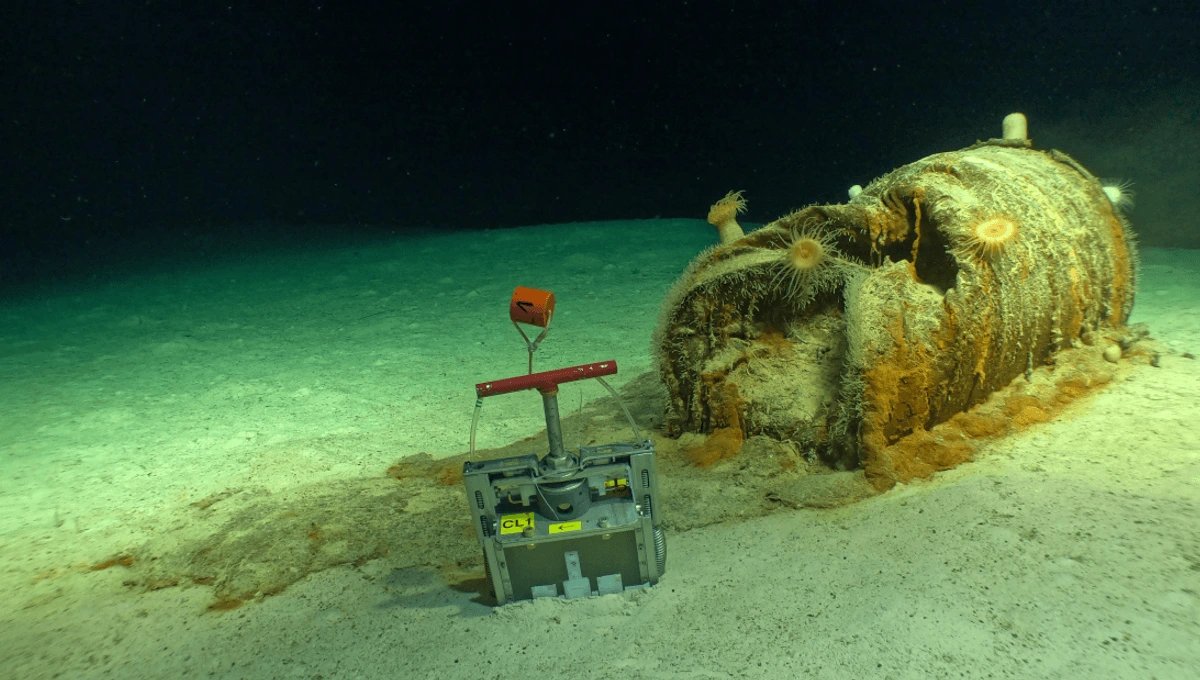
In 1990 the Geological Survey and the sanctuary ran sidescan sonar across part of the dump, and image enhancement let analysts pick out barrel-shaped targets over roughly 125 square kilometres. A camera sled made the first pass, and in 1994 the Navy deep submergence vehicle Sea Cliff and an unmanned Advanced Tethered Vehicle visited targets directly. They found a spectrum, from drums sitting perfectly intact on the sediment to others that had disintegrated entirely, leaving a smear of rust and concrete where a container used to be.
1 source
Time · lag behind first