
Researchers find new evidence of hidden chambers beyond Tutankhamun's tomb
This digest was compiled by AI from multiple sources — links to the originals are below.
Researchers report new geophysical evidence of a hidden complex of corridors and rooms beyond Tutankhamun's tomb in Egypt's Valley of the Kings. The findings, published in the Occasional Papers of the Amarna Royal Tombs Project, include the first gravitational survey of the site. Egypt's Supreme Council of Antiquities will decide whether to approve drilling to deploy miniature tractors with cameras, potentially starting in November.
Key Facts
- The study, published in the Occasional Papers of the Amarna Royal Tombs Project, combines ground-penetrating radar, gravitational surveys, and analysis of tomb structure and wall paintings.
- Lead researcher Mamdouh Eldamaty, an archaeologist at Ain Shams University and former Egyptian antiquities minister, says the data strongly suggest a hidden complex predating Tutankhamun's entombment.
- If Egypt's Supreme Council of Antiquities approves, drilling to deploy miniature tractors with cameras could start in November, according to study co-author George Ballard.
- Nicholas Reeves, an independent British Egyptologist, proposed in 2015 that the tomb may hide the resting place of Nefertiti, who many Egyptologists think briefly ruled as Pharaoh.
New Geophysical Evidence
The team conducted a range of geophysical surveys, including the first use of gravitational techniques to probe ground density around the site and ground-penetrating radar from inside the tomb. Combined with studies of the tomb structure, surrounding ground, and wall paintings, the data strongly suggest a hidden complex of corridors and rooms that predates Tutankhamun's entombment. Lead researcher Mamdouh Eldamaty, an archaeologist at Ain Shams University in Cairo and former antiquities minister, says confirmation could rank among the most transformative archaeological discoveries of the modern era. The findings are published online in the Occasional Papers of the Amarna Royal Tombs Project.
Reeves's Nefertiti Theory
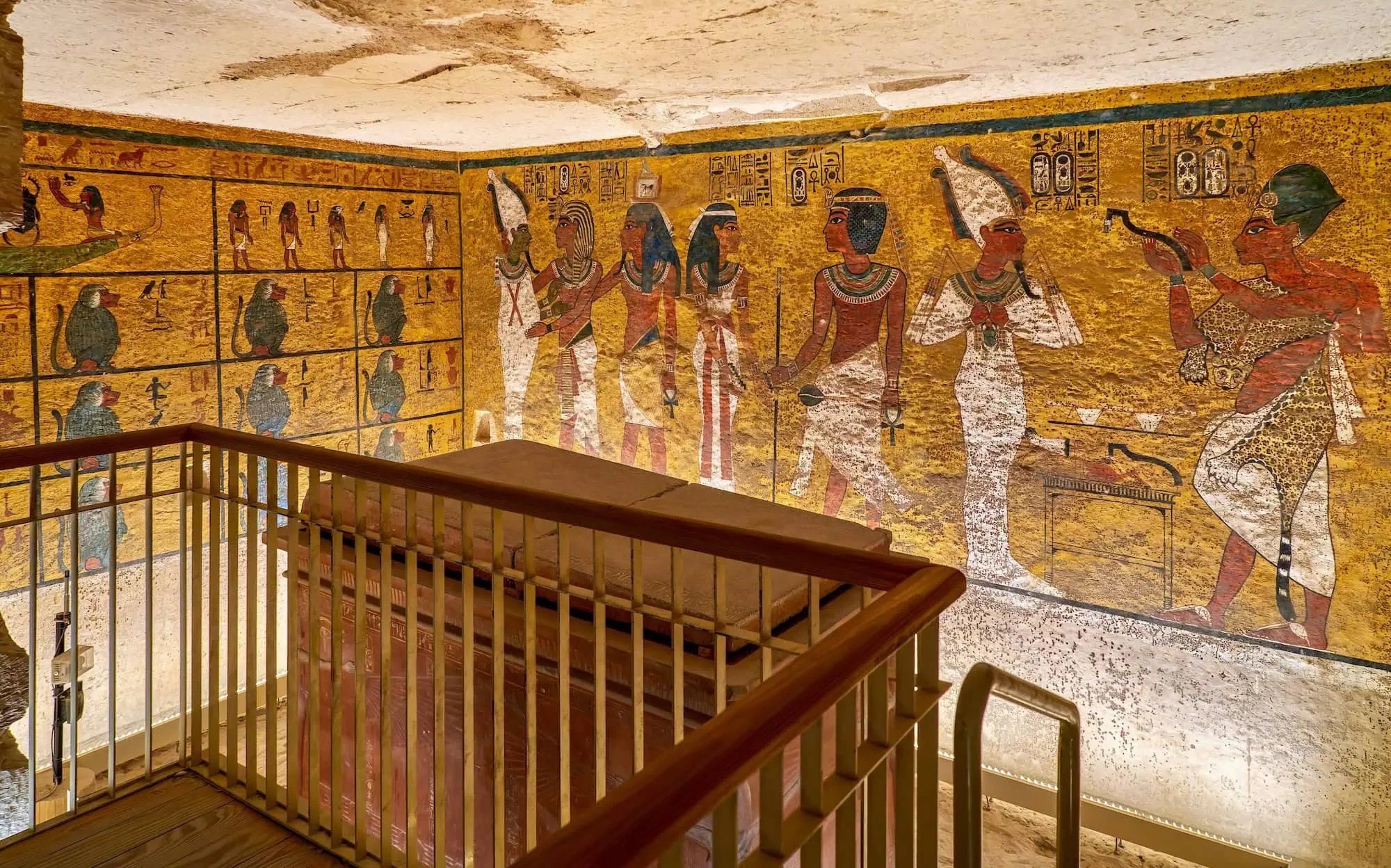
The study is the latest attempt to picture what lies behind the walls of tomb KV62 since Nicholas Reeves, an independent British Egyptologist, suggested in 2015 that it could hide the resting place of Tutankhamun's predecessor, Nefertiti. Reeves based his theory on lines and cracks in the north wall of the burial chamber and ancient alterations to the room's paintings, which he interpreted as a false wall used by ancient Egyptian tomb builders to hide further chambers. He proposed that KV62 was originally a much larger royal tomb, and that when young Tutankhamun died unexpectedly, the entranceway was enlarged and modified for his burial while deeper sections were blocked off. Previous geophysical analyses testing the theory have yielded mixed results, with some researchers concluding chambers were present and others finding nothing.
Next Steps
The decision whether to peek into the supposed chambers, a few meters from the existing tomb, rests with Egypt's Supreme Council of Antiquities. If approved, careful drilling to deploy miniature tractors equipped with cameras could start in November, according to study co-author George Ballard. Eldamaty and colleagues at Egypt's National Research Institute of Astronomy and Geophysics have once more used ground-penetrating radar to probe the interior walls of the tomb.
1 source
Time · lag behind first