
France's fish ladders ease upstream migration but raise turbine death risk
This digest was compiled by AI from multiple sources — links to the originals are below.
Fish passages built across French rivers since 1984 have improved upstream migration for migratory fish, but downstream passage through hydroelectric turbines remains deadly. Studies show juvenile Atlantic salmon mortality exceeding 50% at some facilities, with cumulative losses reaching 27% along the Loire. France is testing new protective screens and surface spillways, yet only a limited number of plants have adopted them.
Key Facts
- France has about 60,000 artificial obstacles on its rivers, including dams, weirs, locks and old mills.
- EDF Hydro operates more than 400 plants and 600 dams, with over 250 passage structures for migratory fish.
- At the Bedous-Asasp hydroelectric facility, potential mortality of juvenile salmon passing through turbines exceeded 50%.
- On the Gave d'Oloron, 93.5% of total flow is directed to turbines while only 6.5% goes to surface outlets.
- Modelling for the Loire-Bretagne basin estimated 27% of juvenile salmon die during downstream migration on the Loire, compared with about 2% in Brittany.
Downstream Migration Risks
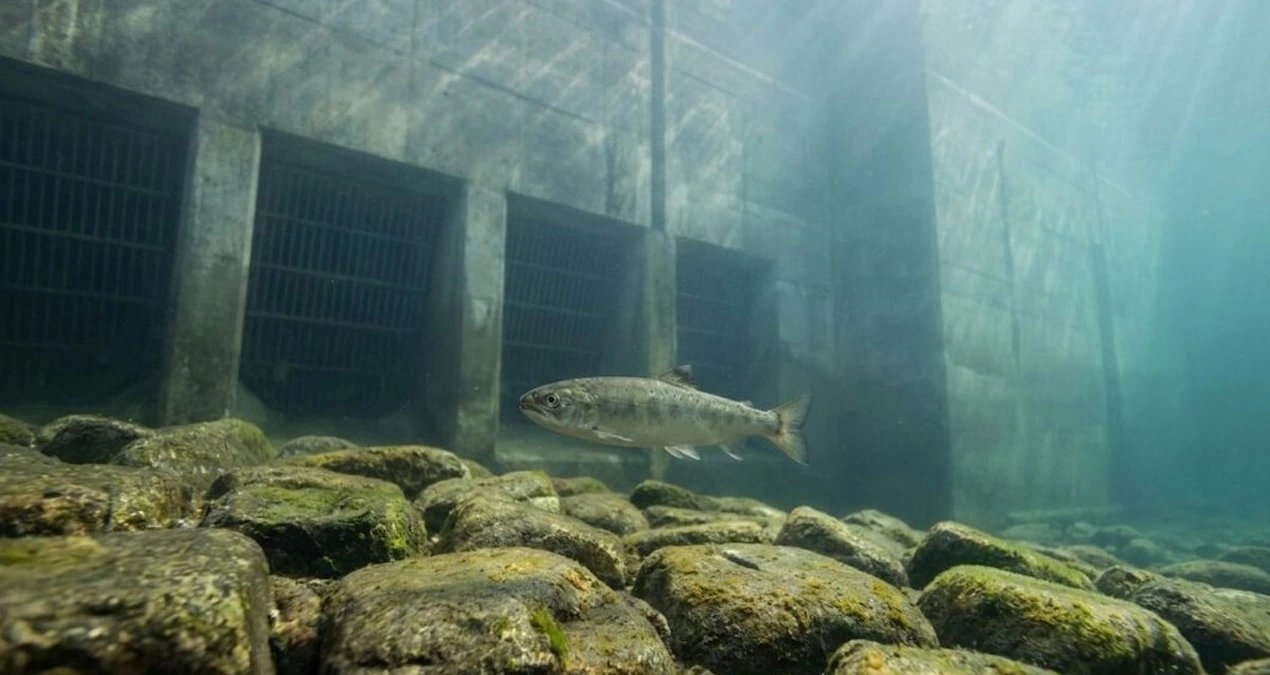
Downstream migration from spawning grounds to the sea poses serious risks at hydroelectric plant water intakes. Juvenile Atlantic salmon and silver eels can be carried by currents into turbines. At the Bedous-Asasp facility, potential mortality of juvenile salmon passing through turbines exceeded 50%. On the Gave d'Oloron, protective screens and surface spillways were tested to divert fish away from turbines. Despite these measures, 93.5% of total flow was directed to turbines while only 6.5% went to surface outlets.
Cumulative Mortality Along Rivers
The risk is not limited to a single plant; successive hydroelectric facilities on the same river increase cumulative mortality. Modelling for the Loire-Bretagne basin estimated that in Brittany, with fewer facilities, juvenile salmon mortality was about 2%. On the Loire, where many hydroelectric plants are located, 27% of juvenile salmon died during downstream migration.
New Mitigation Systems
Since 2015, France has developed new-generation water intake systems and protective screens targeting over 90% passage success during downstream migration. These systems are costly and do not directly contribute to energy production, limiting their deployment to only a small portion of facilities nationwide. Experts say protecting migratory fish requires basin-wide solutions that address both upstream and downstream passage, rather than focusing on individual dams and plants.
1 source
Time · lag behind first