
China's CETC plans to merge diverse drones into single smart swarm
This digest was compiled by AI from multiple sources — links to the originals are below.
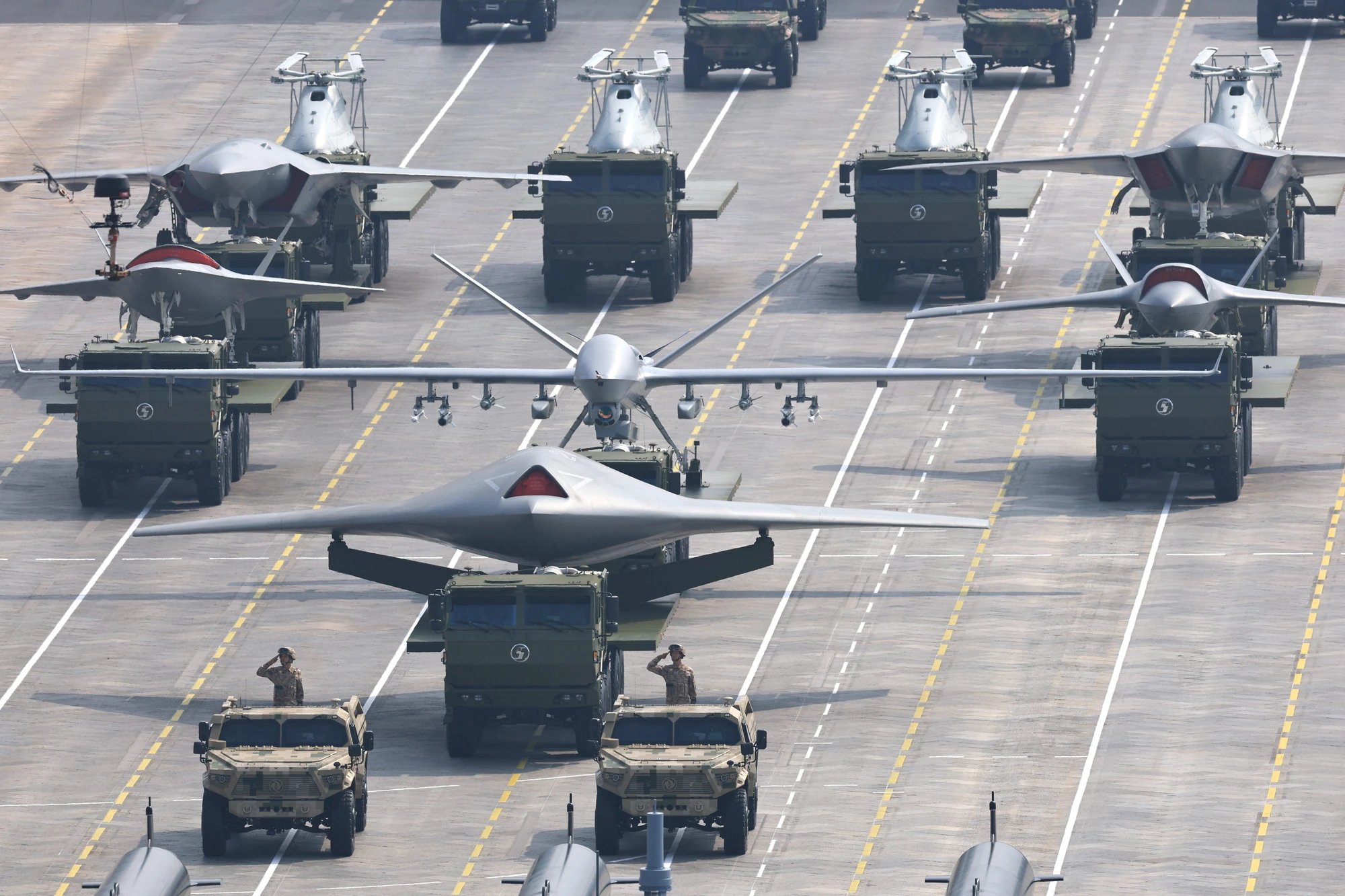
China Electronics Technology Group (CETC) outlined a roadmap to develop drone swarm technology that integrates heterogeneous unmanned systems into a single distributed network. The system would allow individual drones to share data, coordinate movements, and make autonomous decisions based on local conditions. The plan comes as China has already demonstrated significant progress in swarms of identical drones.
Key Facts
- CETC's Intelligent Technology Institute specialists view a drone swarm as a single distributed system, not merely many UAVs moving simultaneously.
- The swarm can maintain operations even if individual drones fail, communication is lost, or electronic interference occurs.
- CETC experts identified five key characteristics determining swarm combat effectiveness: survivability, situational awareness, planning and decision-making, mission execution, and autonomous learning and development.
- China has already achieved significant results in creating swarms of many identical drones, demonstrating decentralized networking, dynamic reconfiguration, and adaptive algorithms.
- Coordinating heterogeneous unmanned vehicles simultaneously across air, ground, and sea remains a considerably complex task.
Swarm Architecture
CETC's Intelligent Technology Institute specialists envision a drone swarm as a single distributed system rather than a large number of UAVs moving at the same time. In such a system, individual drones exchange information, coordinate their movements, and make independent decisions based on the local situation. The system has demonstrated the ability to build a decentralized network, reconfigure it according to the situation, and use adaptive algorithms. This allows the entire system to continue operating even if some drones fail, communication is lost, or radio-electronic interference occurs.
Combat Effectiveness Factors
CETC experts identified five key characteristics that determine the combat effectiveness of a drone swarm: survivability, situational awareness, planning and decision-making, mission execution, and the ability to learn and develop autonomously. China currently possesses sufficiently developed technologies in some of these areas. However, simultaneously operating heterogeneous unmanned vehicles in the air, on the ground, and at sea remains a considerably complex task.
Data Fusion Advantage
A key advantage of a drone swarm is its ability to combine data from many vehicles. By aggregating surveillance data from several drones, limitations in the technical capabilities of individual vehicles can be partially overcome. Such a swarm can independently search for targets, detect camouflaged objects, determine their locations, and simultaneously form a comprehensive picture of the surrounding situation. Detecting small and well-hidden objects under strong electronic interference and noise remains a difficult task.
1 source
Time · lag behind first