
CERN ALICE experiment maps gluon distribution inside atomic nuclei
This digest was compiled by AI from multiple sources — links to the originals are below.
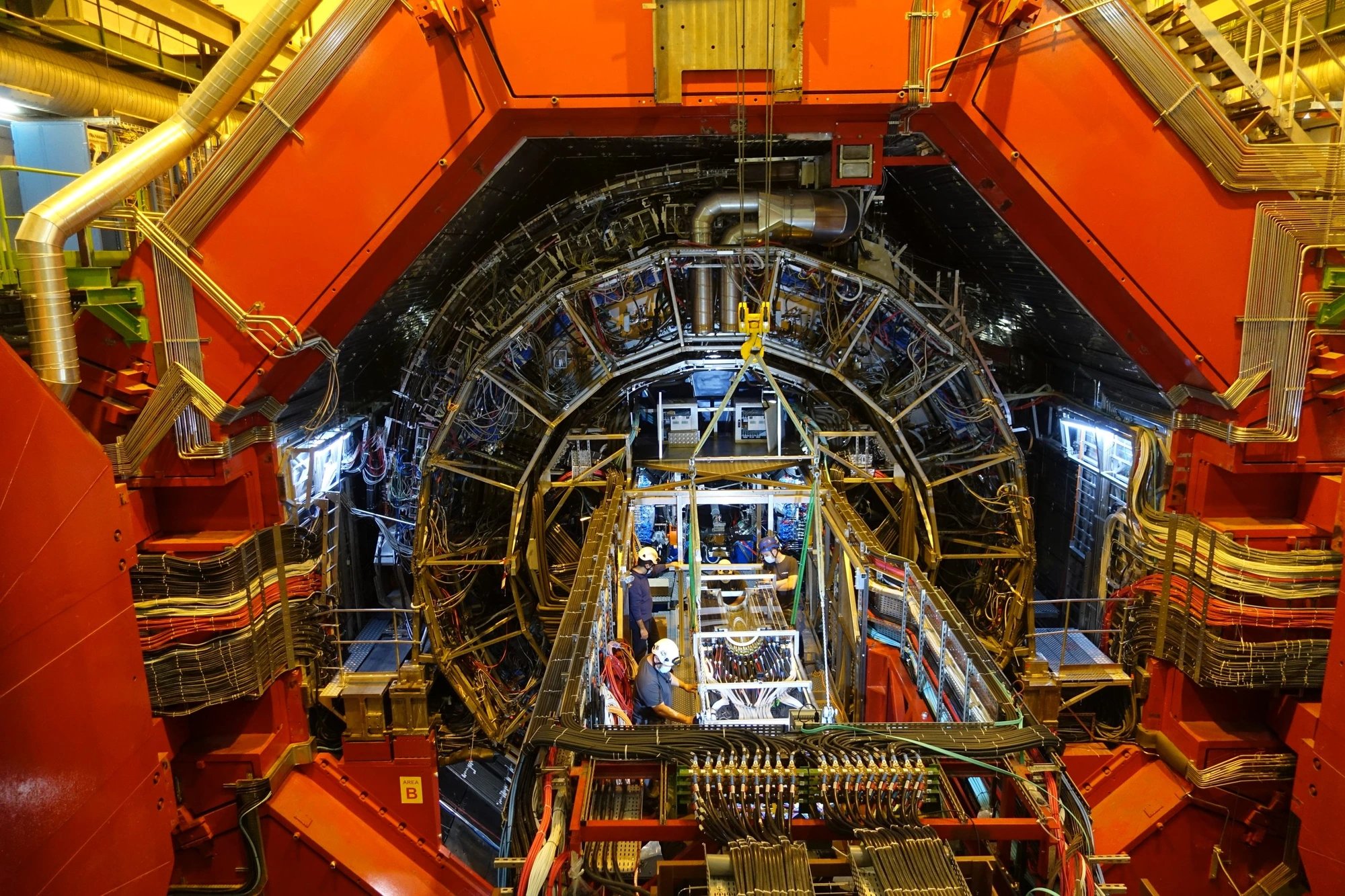
CERN's ALICE experiment has produced the first multidimensional measurement of incoherent J/ψ photonuclear production, revealing how gluons are distributed inside atomic nuclei. The measurement tracks both interaction energy and momentum transfer, offering unprecedented detail on gluon structure. University of Kansas physicist Daniel Tapia Takaki led the study, published in Physical Review Letters.
Key Facts
- The ALICE experiment at CERN's Large Hadron Collider recorded the first multidimensional measurement of incoherent J/ψ photonuclear production.
- The measurement tracks both interaction energy and momentum transfer, allowing scientists to examine gluon distribution inside nuclei with unprecedented detail.
- University of Kansas physicist Daniel Tapia Takaki played a leading role in the study, published in Physical Review Letters.
- The data were collected during Run 2 of the Large Hadron Collider, using fast-moving lead nuclei passing close to one another without directly colliding.
Gluon Structure
Gluons are particles that bind quarks together through the strong force. Nearly all the mass of the visible universe comes from the energy carried by gluons and the strong force, according to Daniel Tapia Takaki, professor of physics and astronomy at the University of Kansas. Understanding how gluons behave inside nuclei is essential to understanding how matter acquires its mass and structure.
Measurement Technique
The researchers used a technique known as incoherent J/ψ photonuclear production to examine small variations in gluon distribution. In the measurements, intense electromagnetic fields surrounding fast-moving lead nuclei behave like beams of high-energy photons. When one of these photons strikes another nucleus, it can briefly produce a particle called the J/ψ, whose production provides a sensitive probe of the underlying gluon structure. Incoherent J/ψ production can reveal local changes in gluon density, making it possible to investigate structures even smaller than a proton.
1 source
Time · lag behind first