
Monash scientists isolate Huc enzyme that turns air into electricity
This digest was compiled by AI from multiple sources — links to the originals are below.
Researchers at Monash University in Melbourne isolated an enzyme from the soil bacterium Mycobacterium smegmatis that converts atmospheric hydrogen directly into electrical current. The enzyme, named Huc, is insensitive to oxygen and can generate electricity from trace hydrogen in ambient air. The discovery was published in Nature.
Key Facts
- The enzyme Huc was isolated from Mycobacterium smegmatis, a soil bacterium related to the tuberculosis bacterium.
- Huc converts atmospheric hydrogen directly into an electrical current and is insensitive to oxygen.
- Soil microbes remove approximately 70 million tonnes of hydrogen from the atmosphere annually.
- The research was led by Rhys Grinter, Ashleigh Kropp and Chris Greening at the Monash University Biomedicine Discovery Institute.
- The findings were published in the journal Nature.
Enzyme Isolation
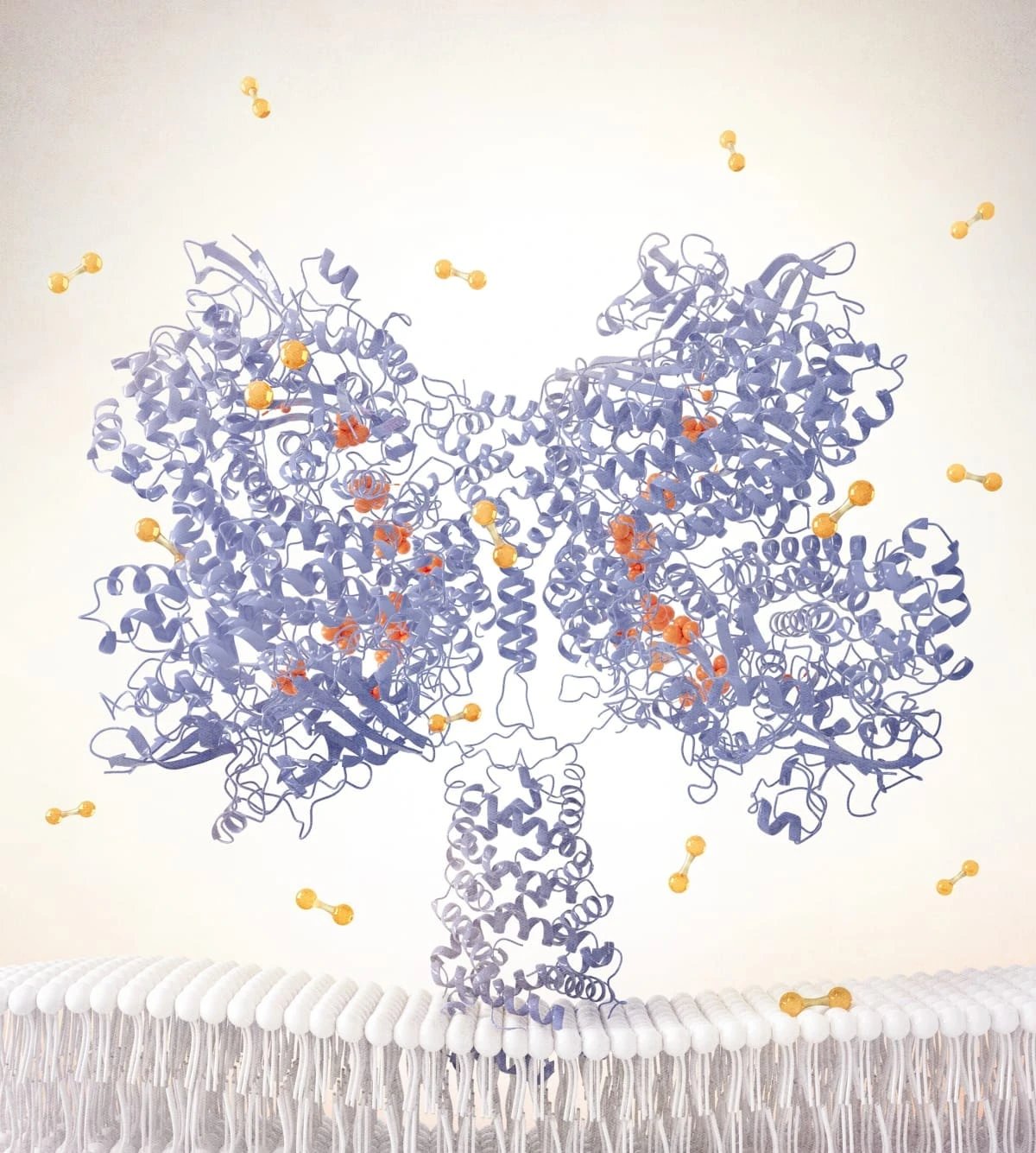
The team at Monash University Biomedicine Discovery Institute isolated the enzyme responsible for hydrogen oxidation from Mycobacterium smegmatis. The researchers named the enzyme Huc. Rhys Grinter told Cosmos that obtaining the enzyme took close to five years and many failed attempts. The structure was resolved by cryo-electron microscopy and revealed a large molecular complex mounted on a stalk.
Mechanism and Oxygen Tolerance
Huc splits hydrogen molecules into protons and electrons, sending electrons down the bacterium's respiratory chain to generate energy. Unlike most hydrogenases, Huc is not deactivated by oxygen. Computer simulations by Syma Khalid's group at Oxford showed that channels leading to the active site are wide enough for hydrogen but too narrow for oxygen. Chris Greening told Physics World that Huc's affinity for hydrogen is high enough to extract the gas directly from ambient air.
1 source
Time · lag behind first