
Kazakhstan's infrastructure delays cost years of economic and social returns
This digest was compiled by AI from multiple sources — links to the originals are below.
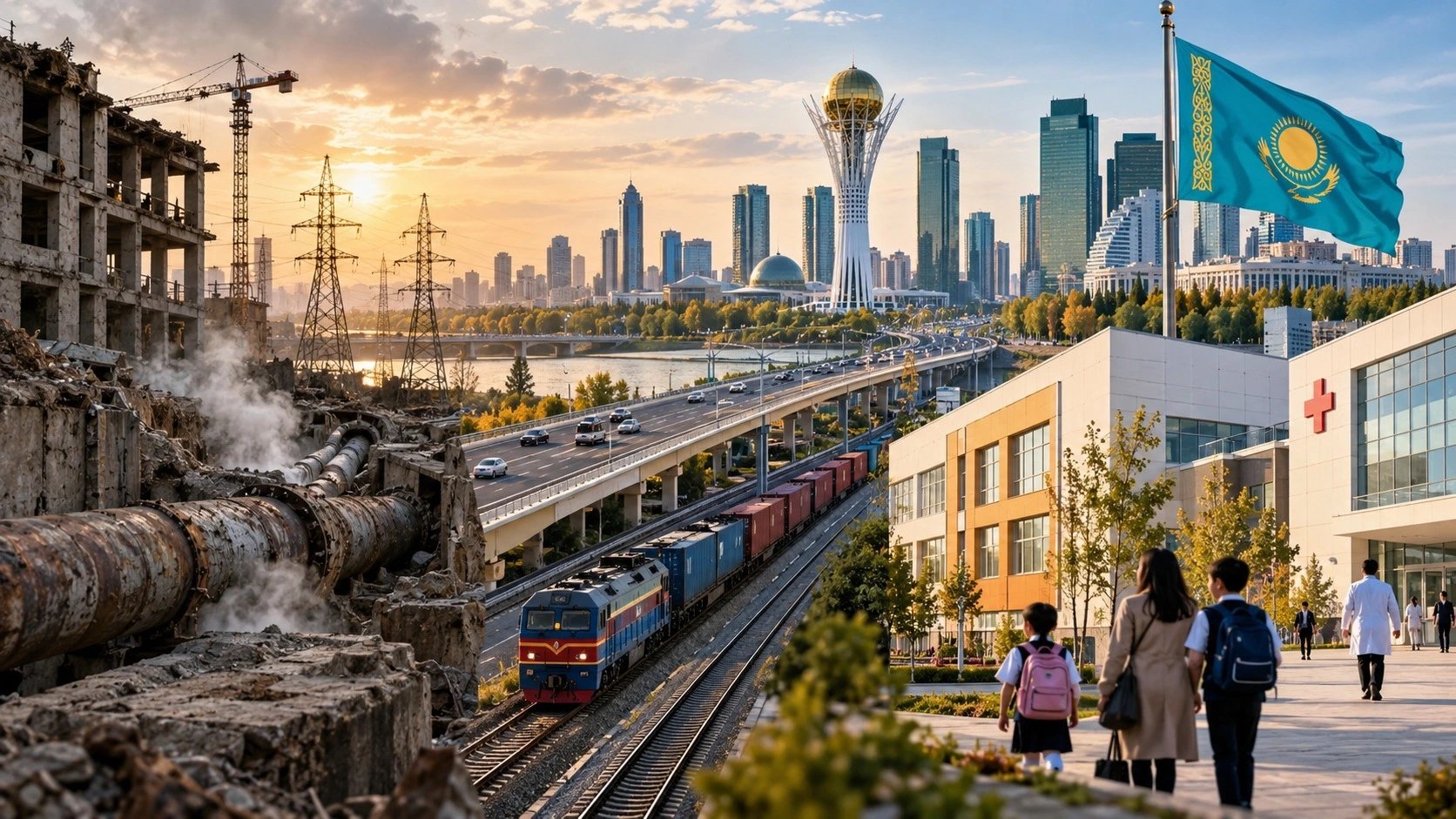
Delaying infrastructure investment costs Kazakhstan years of economic and social returns, EU Reporter writes. The publication argues that assessing National Fund spending requires weighing both the cost of drawing down savings and the ongoing costs of leaving needed facilities unbuilt. Residents face unreliable energy, limited school and healthcare access, while businesses struggle to transport goods and expand.
Key Facts
- Kazakhstan drew $10 billion from the National Fund for a stabilization plan during the global financial crisis, according to EU Reporter.
- Of that $10 billion, $4 billion was allocated to financial sector stabilization and $3 billion to the housing sector, per the National Bank's economic review.
- An additional $9 billion was used in 2015–2017, with further transfers during the 2020–2021 pandemic, EU Reporter reports.
- EU Reporter argues that the key question is not how much was withdrawn from the National Fund, but what long-term assets were created in return.
Cost of Delay
EU Reporter frames the trade-off as one of timing: if a needed facility opens now rather than in ten years, the country gains additional years of its operation. The publication stresses that the need for roads, energy capacity, and utility systems does not disappear when construction is postponed. Worn-out networks and capacity shortages continue to constrain residents and businesses, making the timing of investment a critical factor.
National Fund Drawdowns
In response to the global financial crisis, Kazakhstan adopted a stabilization plan funded with $10 billion from the National Fund. According to the National Bank's economic review, $4 billion of that amount went to financial sector stabilization and $3 billion to the housing sector. One billion dollars each were directed to small and medium business support, the agro-industrial complex, and innovative, industrial, and infrastructure projects. EU Reporter also cites the use of another $9 billion in 2015–2017 and transfers during the 2020–2021 pandemic.
Long-Term Returns
EU Reporter argues that the main conclusion is not how much money Kazakhstan withdrew from the National Fund, but what assets the country received in return and what long-term economic returns they will generate. The publication contends that the inheritance of future generations is not only a figure in the National Fund account, but also the economy, infrastructure, and human capital they will receive. Infrastructure projects deliver results only after commissioning: a road begins serving traffic, an energy facility supplies consumers, and a school admits students.
3 sources
Time · lag behind first