
HZB researchers simulate fractons in realistic quantum spin liquid model
This digest was compiled by AI from multiple sources — links to the originals are below.
Researchers at Helmholtz-Zentrum Berlin have shown that fractons, exotic quasiparticles with severely restricted mobility, can emerge in a realistic quantum solid-state model. The simulations overcome earlier difficulties where fractons vanished under strong quantum effects. The work brings experimental detection of fractons in quantum spin liquids closer.
Key Facts
- Fractons are quasiparticles that appear at corners of magnetic domain walls and are essentially immobile individually.
- The study was led by Professor Johannes Reuther and Dr. Nils Niggemann at Helmholtz-Zentrum Berlin.
- Earlier simulations failed because fractons disappeared under strong quantum effects or survived only as classical particles under weak quantum effects.
- The improved model accounts for quantum effects and provides evidence that the fracton phase can exist under realistic quantum conditions.
Fracton Properties
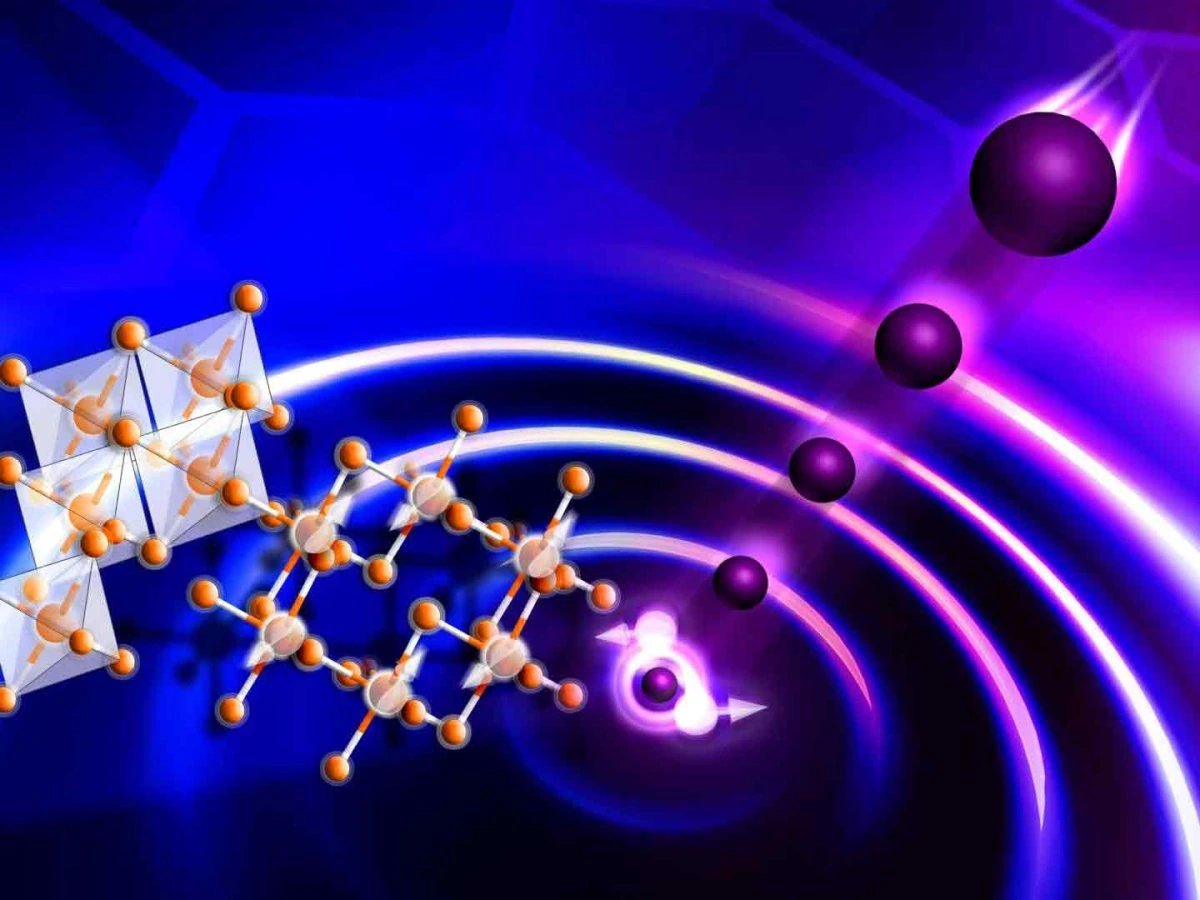
Fractons are quasiparticles that emerge from collective behavior of many interacting particles in a solid. They appear at the corners of magnetic domain walls separating different spin arrangements. A single fracton is essentially unable to move by itself and can only be shifted through interactions with other fractons. This restricted mobility has led researchers to propose fractons as a way to store quantum information more robustly.
Simulation Breakthrough
Previous theoretical predictions of fractons in quantum spin liquids relied on highly generalized rank-2 U(1) gauge theories. The new study by Reuther and Niggemann shows that fractons can emerge in a more realistic model of a quantum solid. Earlier work by the group ran into a major problem: when quantum effects were too strong, fractons disappeared; when too weak, they survived only as classical particles. By improving the way the model represents interactions between spins, the researchers overcame this difficulty. The new numerical simulations provide evidence that the sought-after phase of matter can exist under more realistic quantum conditions.
Path to Experiment
Johannes Reuther noted that modeling the complex spin interaction benefits from personal exchanges with HZB colleagues in experimental solid-state physics. The next challenge is to identify or create real physical systems that reproduce the conditions assumed in the theoretical model. Doing so could allow researchers to test experimentally whether the predicted fractons actually appear.
1 source
Time · lag behind first