
Dark energy and dark matter may be entangled in a hidden dimension
This digest was compiled by AI from multiple sources — links to the originals are below.
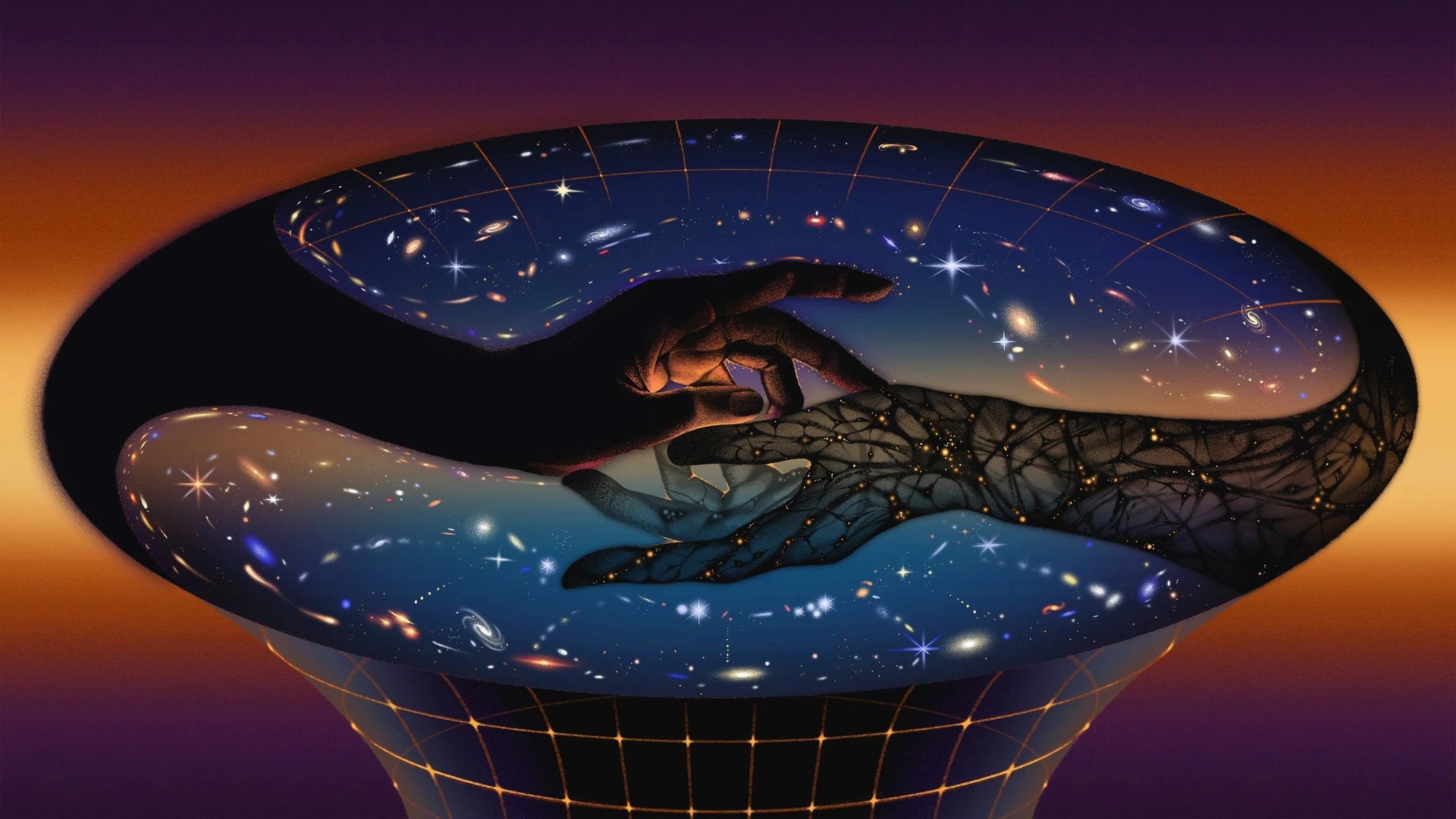
Recent astronomical observations suggest dark energy may be weakening over time, challenging its presumed constancy. A growing number of theorists are exploring whether dark energy and dark matter are physically intertwined. The idea, though not new, is gaining traction as data from the Dark Energy Spectroscopic Instrument indicates dark energy's strength has changed.
Key Facts
- Dark energy constitutes approximately 70 percent of the cosmos, and dark matter about 25 percent.
- In 2024, the Dark Energy Spectroscopic Instrument (DESI) team found evidence that dark energy's strength had changed over time.
- A 2025 study based on more than twice as much data concluded that dark energy was changing over time.
- Dark energy may have reached a maximum value about 2 billion years ago and then begun to weaken.
- Justin Khoury, a physicist at the University of Pennsylvania, investigated the idea of dark energy and dark matter interactions in 2005.
Observational Evidence
The Dark Energy Spectroscopic Instrument (DESI) team found evidence in 2024 that dark energy's strength had lost its presumed constancy. A 2025 study using more than twice as much data also concluded that dark energy was changing over time. These results indicate that after attaining a maximum value about 2 billion years ago, dark energy may have begun to weaken. The results also suggested that in an earlier era, dark energy could have grown stronger, seemingly defying the law of energy conservation.
Theoretical Implications
Researchers describe dark energy entering the 'phantom regime,' likening the situation to a ball rolling uphill under the influence of something other than gravity. A growing number of theorists are exploring whether dark energy's ties to dark matter could be the influencing factor. Tim Tait, a particle physicist at the University of California, Irvine, said it would not be surprising if dark energy and dark matter were manifestations of a unified theory of the dark universe. The idea that dark energy and dark matter interact is not new; Justin Khoury, a physicist at the University of Pennsylvania, investigated the prospect in 2005.
1 source
Time · lag behind first