
Thousands attend Belgrade funeral for convicted war criminal Ratko Mladić
This digest was compiled by AI from multiple sources — links to the originals are below.
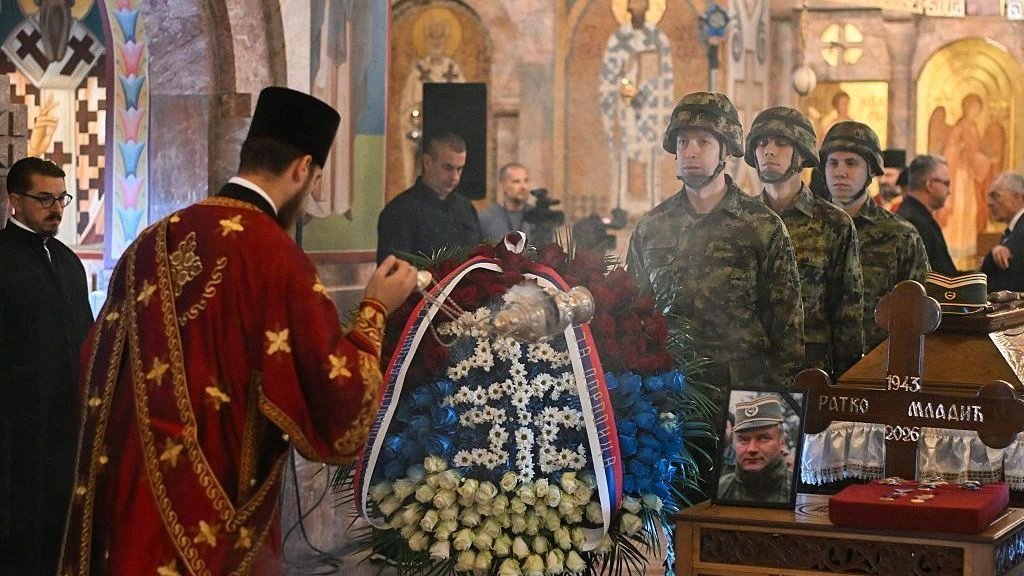
Thousands gathered in Belgrade on Monday for the funeral of Ratko Mladić, the Bosnian Serb commander convicted of genocide and sentenced to life in prison. The ceremony, held with military honours, drew condemnation from the EU and US over the glorification of a war criminal. Mladić died on August 27 at age 84 while serving his sentence in The Hague.
Key Facts
- Ratko Mladić died on August 27 at age 84 while serving a life sentence in the UN prison in The Hague.
- Mladić was convicted of genocide for the 1995 Srebrenica massacre, in which around 8,000 Bosniak Muslim men and boys were killed.
- The funeral was held with full military honours and attended by Serbian government ministers, including Defence Minister Bratislav Gašić and Justice Minister Nenad Vujić.
- The EU issued a statement saying any glorification of war criminals contradicts fundamental European values and has no place in the EU or candidate countries.
- Serbian President Aleksandar Vučić did not attend the funeral, but his son Danilo was present.
Funeral Ceremony
Thousands of people lined the streets of Belgrade and queued outside St. Luka church to pay respects to Mladić's coffin. The service was led by Patriarch Porfirije, head of the Serbian Orthodox Church, who said Mladić's name would remain 'deeply etched in the memory and prayers of the majority of our Serbian Orthodox people'. Mladić was buried in a coffin wrapped in the Serbian flag with full military honours. Among attendees were Serbian opposition figures, officials from Republika Srpska, pro-Serbian politicians from Montenegro, and Russia's Ambassador to Serbia Alexandar Botsan-Kharchenko.
International Condemnation
The European Union denounced the glorification of Mladić, stating that 'any glorification of war criminals, genocide denial and revisionism contradict the most fundamental European values'. US officials also condemned the funeral, according to RFE/RL. Survivors and relatives of victims of the Srebrenica massacre said the continued glorification of Mladić is deeply painful and dangerous. Serbia has been a candidate to join the EU since 2012, though membership talks have recently stalled.
Mladić's Legacy
Mladić commanded Bosnian Serb forces during the 1992–1995 Bosnian war, during which his troops carried out ethnic cleansing and besieged Sarajevo, killing more than 10,000 people. He was arrested in 2011, 16 years after his first indictment, and sentenced to life in prison in 2021 after a nine-year trial. Despite his conviction, many Serb nationalists view Mladić as a hero and protector, particularly in Republika Srpska, where his death sparked vigils.
3 sources
Time · lag behind first