
EPA ties fuel economy to CO2 emissions via carbon balance method
This digest was compiled by AI from multiple sources — links to the originals are below.
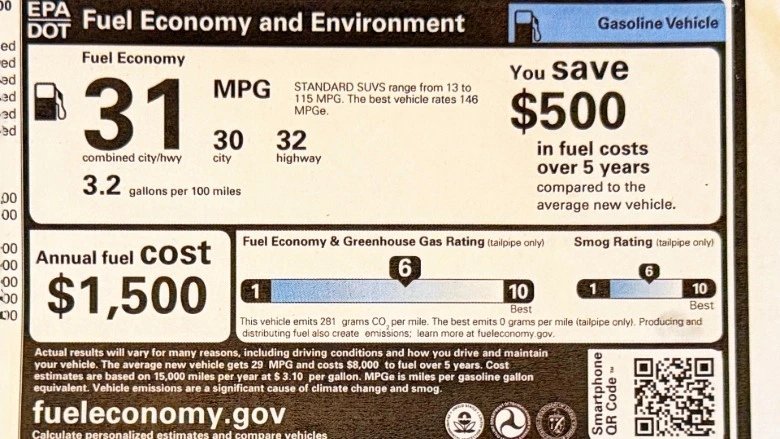
The EPA rates vehicle greenhouse gas emissions in grams of CO2 per mile, directly linked to fuel consumption through the carbon balance method. The agency tests only 10-15% of models, with automakers self-certifying using EPA methodology. The rating scale ranges from 1 (at least 659 g/mi) to 10 (0-74 g/mi).
Key Facts
- The EPA's greenhouse gas rating measures CO2 grams per mile, with a score of 6 corresponding to 266-323 grams per mile for 2025 and newer models.
- The lowest rating of 1 means at least 659 grams of CO2 per mile, while the best rating of 10 is 0-74 grams per mile.
- The EPA tests only 10-15% of vehicle models each year, and carmakers self-certify the rest using EPA methodology.
- The EPA's testing procedure includes five cycles, three of which were added in the 2008 model year to address complaints about overly generous estimates.
- The carbon balance method was proven by evaluating a 1976 Mercury Montego.
Carbon Balance Method
The EPA developed its rating system in the 1970s using the carbon balance method, which links carbon burned to fuel consumed. By capturing emissions, the agency can calculate the exact volume of fuel burned and the amount of carbon produced, deriving both fuel economy and CO2 emissions. This method is cheaper than separate testing and can be performed on an automotive treadmill simulating wind and road friction. The EPA validated the approach by evaluating a 1976 Mercury Montego.
Lab Testing Protocol
The EPA does not test every car each model year; it tests only 10-15% of models, with carmakers certifying their own vehicles using the same methodology. The testing procedure consists of five parts, three of which were added in the 2008 model year after complaints that EPA estimates were overly generous. The cycles include a city cycle at 21.2 mph, a highway cycle at 48.3 mph, a higher-speed test simulating acceleration up to 80 mph, an air-conditioning test at 95 degrees, and a cold-weather city cycle at 20 degrees. The EPA uses specially formulated fuel to ensure every car burns nearly identical fuel, controlling for fuel purity. Lab testing is preferred over road testing because it provides controllable and repeatable measurements, avoiding wind and temperature variables.
1 source
Time · lag behind first