
Miners in Mexico's Naica mine broke into a cave of giant crystals in 2000
This digest was compiled by AI from multiple sources — links to the originals are below.
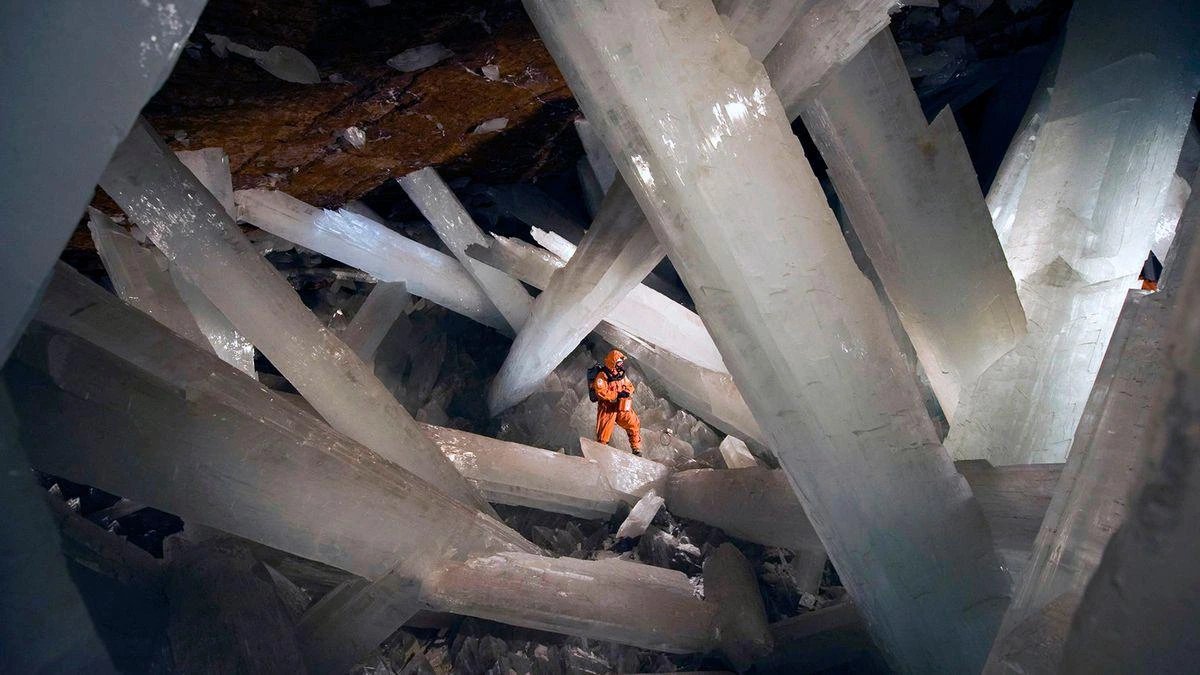
In April 2000, miners tunnelling 300 metres beneath Mexico's Chihuahuan Desert broke into a chamber filled with giant selenite crystals. The largest crystal measured 11.4 metres long and about a metre thick. The crystals grew over hundreds of thousands of years in mineral-rich water at around 54 degrees Celsius.
Key Facts
- The largest documented crystal in the Naica mine chamber measured 11.4 metres long and about a metre thick.
- The chamber is a horseshoe-shaped cavity about 109 metres from end to end.
- The crystals grew from low-salinity water at roughly 54 degrees Celsius, just below the temperature where anhydrite becomes stable.
- A crystal thickens by about the width of a human hair every hundred years, meaning a metre-thick crystal took close to a million years to form.
- Mining company Peñoles pumped groundwater out of the mountain at a rate equivalent to filling an Olympic swimming pool every 40 minutes, draining the chamber in 1975.
Discovery in the Naica Mine
In April 2000, miners cutting a new tunnel in search of fresh ore deposits broke through into a void roughly 300 metres down in the Naica lead, zinc and silver mine. The void was filled floor to ceiling with translucent beams of crystal the size of tree trunks, jutting out at every angle. The longest of the crystals stretched further than a city bus, as National Geographic reported. The chamber held some of the largest natural crystals ever found.
Crystal Growth Mechanism
Gypsum has a drier twin called anhydrite, the same compound without the water. Above about 58 degrees Celsius, anhydrite is the stable form; below that line, gypsum takes over. Juan Manuel García-Ruiz of the University of Granada and his co-authors analysed fluid trapped inside the crystals and documented growth from low-salinity water at roughly 54 degrees, just under the switchover point. Parked a few degrees below the line, anhydrite dissolves at a crawl and reprecipitates as gypsum, quietly feeding beams that already exist instead of seeding new ones. García-Ruiz called the process self-feeding, and hundreds of thousands of years of it produced the beams.
Draining the Chamber
Mining is the sole reason anyone ever laid eyes on the place. While the mine ran, Peñoles pumped groundwater out of the mountain at a rate Van Driessche compared to filling an Olympic swimming pool every 40 minutes. That dropped the water table and drained the chamber in 1975. Nobody got inside until the new tunnel broke through 25 years later.
1 source
Time · lag behind first