
Astronomers confirm helium atmosphere on habitable-zone rocky planet LHS 1140 b
This digest was compiled by AI from multiple sources — links to the originals are below.
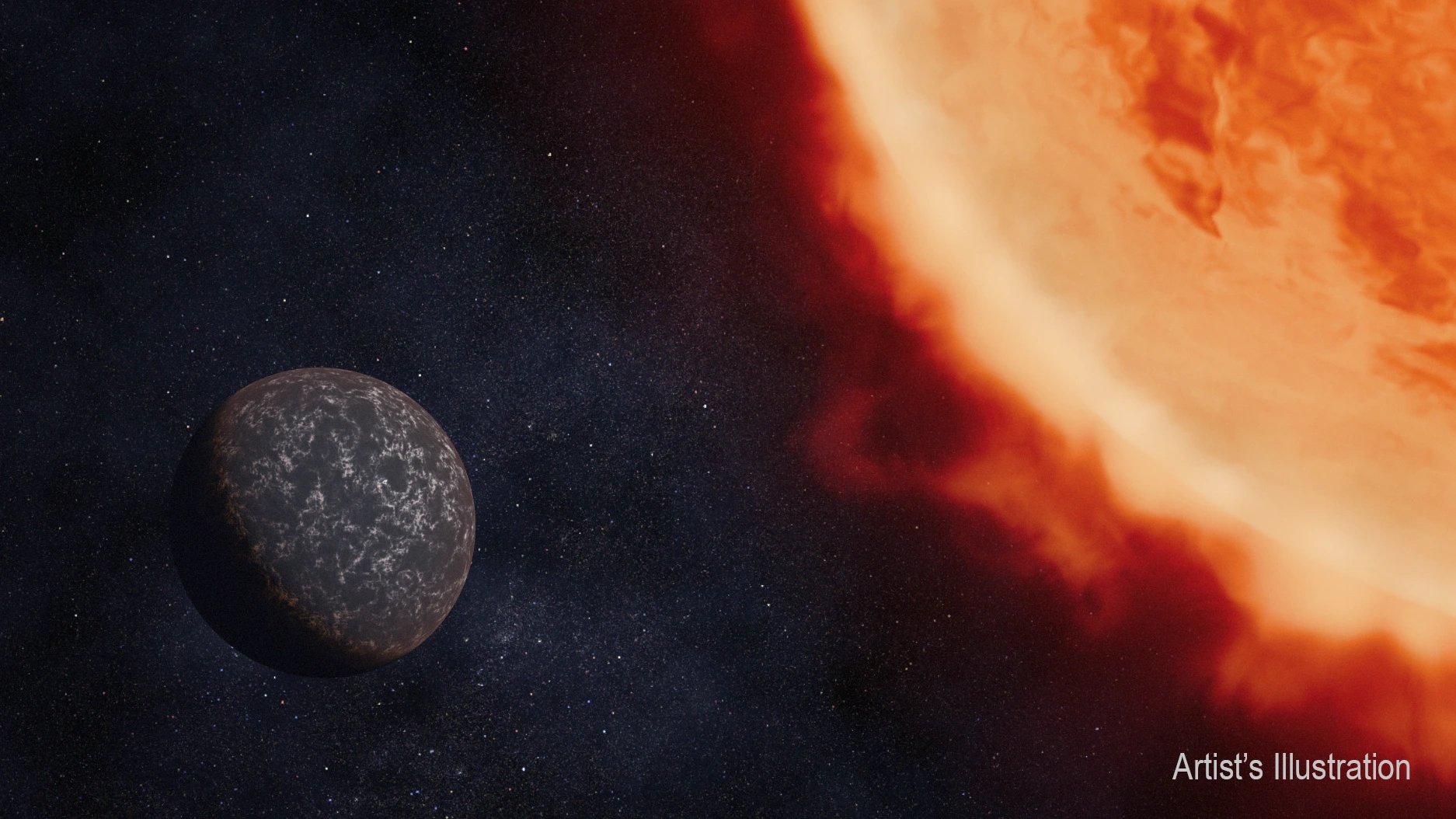
Astronomers have detected a helium atmosphere around the rocky exoplanet LHS 1140 b, 48 light-years away in the constellation Cetus, marking the first confirmed atmosphere on a habitable-zone rocky world. The detection, made with the Magellan Clay Telescope in Chile in 2024, relied on observing escaping helium gas that absorbed starlight during a transit. The finding advances the search for potentially habitable planets even as the planet’s surface conditions remain unknown.
The Planet LHS 1140 b
LHS 1140 b is a super-Earth about 1.7 times Earth’s radius and 5.6 times its mass, orbiting a cool red dwarf in the constellation Cetus. The planet completes one orbit every 24.7 days, receiving stellar energy that places it within the star’s habitable zone, where liquid water could exist under the right conditions. Despite its promising location, a habitable-zone orbit alone does not guarantee a temperate surface or the presence of water. Red-dwarf systems like this one are valuable for observations because their relatively small stars create deeper, more measurable transits when planets pass in front of them.
Helium Detection Method
In 2024, researchers used the WINERED infrared spectrograph on the Magellan Clay Telescope to observe LHS 1140 b during a transit. At wavelengths near 1,083.3 nanometres, where excited helium absorbs light, the star appeared about 1.24 percent dimmer than expected. Absorption was also detected before the planet began crossing the star, interpreted as a leading stream of escaping gas, with tentative evidence of material trailing behind. High-altitude helium atoms, heated by the star’s ultraviolet and X-ray radiation, flow outward and are detectable by ground-based instruments. This spectroscopic detection provides direct evidence of atmospheric material associated with the planet, though composition, pressure, and surface temperature remain undetermined.
1 source
Time · lag behind first