
Great power rivalry fractures Pacific Islands Forum as China missile test divides members
This digest was compiled by AI from multiple sources — links to the originals are below.
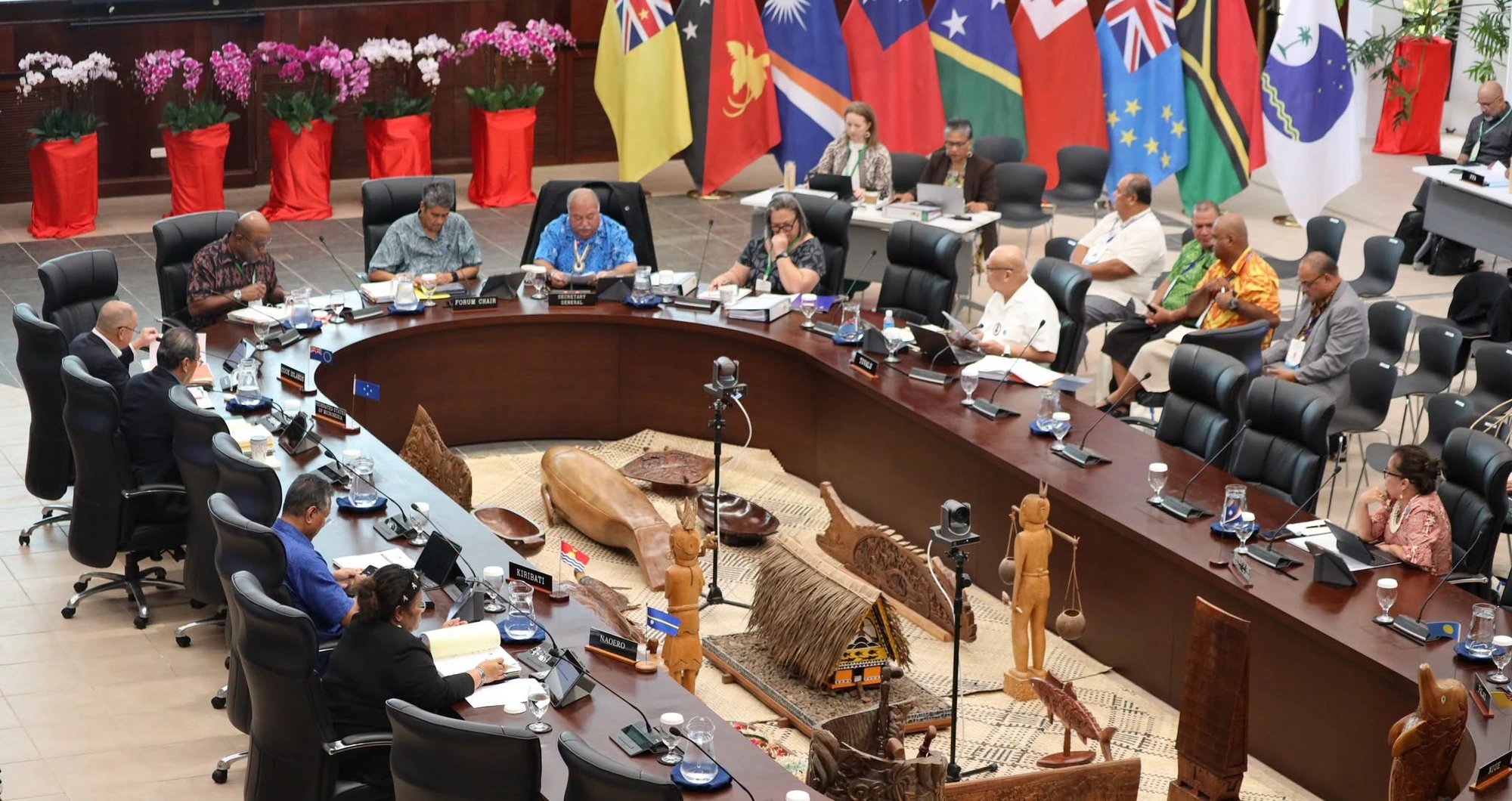
The 55th Pacific Islands Forum Leaders' Meeting opened in Palau on August 31 under the theme B.E.L.A.U., but at least five leaders were absent. China's July 6 submarine-launched ballistic missile test, which transited the exclusive economic zones of three Pacific nations, has deepened divisions. The forum's consensus model is now seen as a mechanism through which outside powers reshape regional outcomes.
Key Facts
- At least five Pacific leaders did not attend the 55th PIF Leaders' Meeting in Palau, including the prime ministers of Fiji, Solomon Islands, Kiribati, Samoa, and Vanuatu.
- China conducted a submarine-launched ballistic missile test on July 6 that transited the exclusive economic zones of the Federated States of Micronesia, Naoero, and Kiribati before landing near Tuvalu's maritime boundary.
- Solomon Islands' Prime Minister Matthew Wale left the summit hours after arriving due to a no-confidence motion filed against him in Honiara.
- Kiribati sent David Teaabo, director of foreign service and former ambassador to China, instead of a cabinet minister to the summit.
- Papua New Guinea's Prime Minister James Marape said Pacific nations 'do not want history repeated' in response to the missile test.
Absences and Delegation Levels
The leaders of Kiribati, Samoa, and Vanuatu dispatched deputies, while Fiji's Prime Minister Sitiveni Rabuka stayed home to manage domestic affairs. Solomon Islands' Prime Minister Matthew Wale landed in Palau but left hours later after a no-confidence motion was filed against him in Honiara. Wale had served as prime minister for barely three months and was meant to hand the PIF chairmanship to Palau's President Surangel Whipps Jr. Kiribati's President Taneti Maamau sent David Teaabo, his director of foreign service and a former ambassador to China, rather than a cabinet minister. In an organization requiring consensus at the level of heads of state, sending a lower-ranking delegate who cannot commit to communique language with full authority is itself a political statement.
Missile Test and Regional Reaction
On July 6, China conducted a submarine-launched ballistic missile test in the Pacific, firing what Taiwan identified as a JL-2 from the South China Sea. The missile, carrying a dummy warhead, transited the exclusive economic zones of the Federated States of Micronesia, Naoero, and Kiribati before landing near Tuvalu's maritime boundary. Beijing provided only a few hours' notice to the affected Pacific Island nations. Papua New Guinea's Prime Minister James Marape invoked the region's traumatic history of nuclear testing, insisting that Pacific nations 'do not want history repeated.' Australia's Prime Minister Anthony Albanese called the test 'provocative' and 'destabilizing.'
1 source
Time · lag behind first