
Magnetar observations may reveal first evidence of vacuum birefringence
This digest was compiled by AI from multiple sources — links to the originals are below.
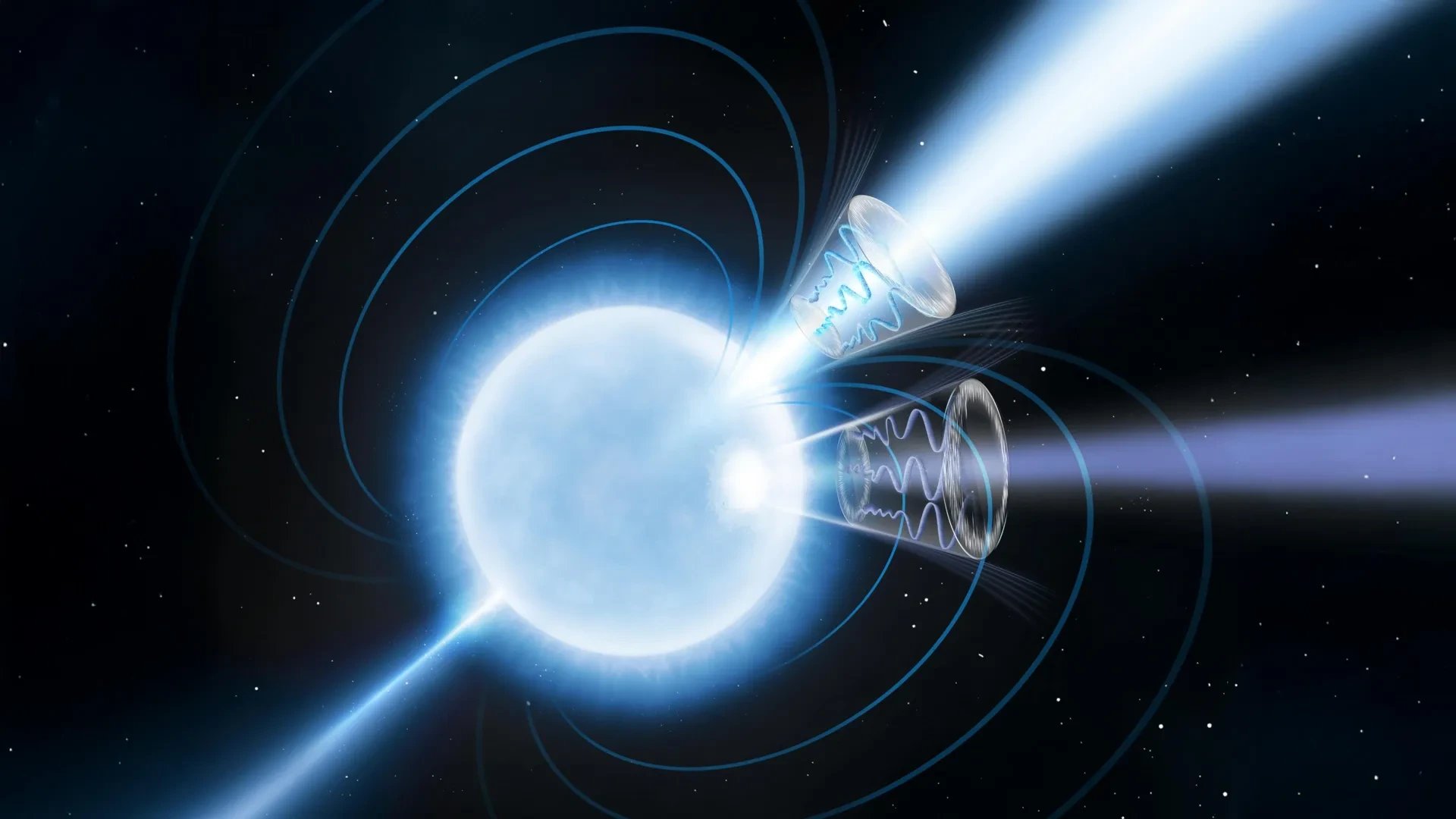
Scientists studying magnetar 1E 1547.0-5408 have detected polarization changes in its radio emissions that may be the first evidence of vacuum birefringence, a quantum effect predicted by Werner Heisenberg in 1936. The team combined data from CSIRO's Murriyang telescope, NASA's IXPE and NICER instruments, and analyzed them with Swinburne University's Ngarrgu Tindebeek supercomputer. The findings, published in Nature, could open new ways to test quantum physics under extreme magnetic fields.
Key Facts
- Werner Heisenberg predicted vacuum birefringence in 1936, describing how virtual particles in a vacuum can alter light's polarization under extreme magnetic fields.
- The study focused on magnetar 1E 1547.0-5408, a neutron star with magnetic fields over 100 million times stronger than any created on Earth.
- Researchers combined radio observations from CSIRO's Murriyang telescope with X-ray data from NASA's IXPE and NICER instruments aboard the International Space Station.
- The findings were published in Nature, with Rachael E. Stewart of George Washington University as lead author.
Quantum Prediction
Werner Heisenberg proposed in 1936 that a vacuum is not truly empty but contains virtual particles that briefly appear and disappear. According to quantum electrodynamics, these virtual particles can affect light passing through a vacuum when exposed to an extraordinarily strong magnetic field, an effect called vacuum birefringence. Detecting the effect requires magnetic fields far beyond what laboratories can generate, so researchers turned to magnetars—neutron stars with the strongest known magnetic fields in the universe.
Magnetar Observations
The team monitored magnetar 1E 1547.0-5408 using CSIRO's Murriyang radio telescope, tracking the polarization state of its radio emissions as the star rotated. These radio observations were combined with measurements from NASA's Imaging X-ray Polarimetry Explorer (IXPE) and the NICER X-ray telescope on the International Space Station. Data analysis was performed on Swinburne University's Ngarrgu Tindebeek supercomputer, led by Dr. Marcus Lower of the Centre for Astrophysics and Supercomputing. The observed polarization changes are consistent with vacuum birefringence, though the team describes the results as potential first evidence rather than conclusive proof.
1 source
Time · lag behind first